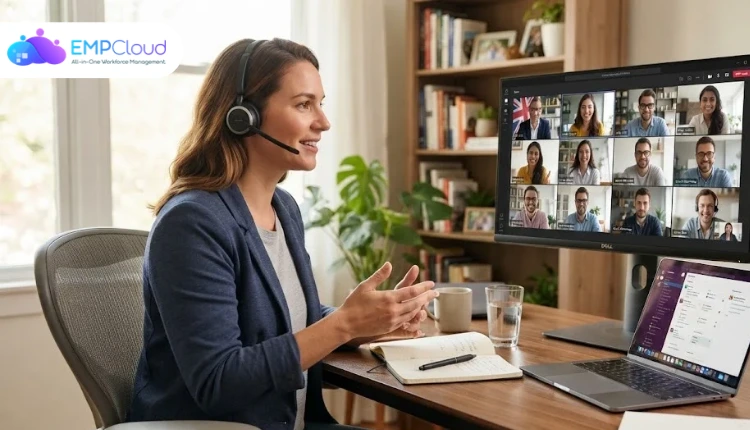
Remote work is slowly becoming a permanent part of how organizations operate.
Yet distance introduces real challenges: reduced visibility, communication gaps, inconsistent processes, and difficulty sustaining accountability.
Leaders who manage a remote workforce deliberately, rather than by improvisation, gain a measurable competitive advantage and drive results. This guide outlines the practices that consistently raise productivity across distributed teams.
Why Remote Workforce Management Demands a Different Approach

Traditional supervision relies on physical presence. Managers observe activity, and productivity is often measured by hours spent at a desk.
With a distributed workforce, this model fails. Due to the physical absence of the employee, managers cannot actually perceive things getting done.
Thus, effective remote workforce management shifts the emphasis from monitoring presence to measuring outcomes and from supervising activity to actually enabling performance.
Organizations that make this transition typically see higher engagement, lower attrition, and a stronger delivery of the business goals. Those that do not often struggle with missed deadlines, duplicated effort, and disengaged employees who feel invisible and undervalued.
1. Define Clear Expectations and Measurable Goals
Ambiguity is the greatest enemy of remote productivity. Every member of your remote workforce should understand:
- Their core responsibilities and deliverables
- The key performance indicators (KPIs) used to evaluate their work
- Deadlines, priorities, and decision-making authority
- How their individual contribution supports team and company objectives
Frameworks such as OKRs (Objectives and Key Results) help align individual contributions with company strategy. When employees know precisely what success looks like, they can work autonomously without constant direction. Review these goals regularly so that they remain relevant as business priorities evolve.
2. Establish Structured Communication Rhythms
Distributed teams cannot rely on informal hallway conversations. Communication must be intentional and predictable. Consider adopting:
- Daily or weekly check-ins to review priorities and remove blockers
- One-on-one meetings for coaching, feedback, and career discussion
- Documented communication guidelines that specify which channels to use for urgent, routine, and collaborative matters
- Shared documentation so that knowledge is accessible to everyone, regardless of location or time zone
Prefer asynchronous communication wherever possible. It respects time zones, reduces unnecessary meetings, and gives employees the uninterrupted time needed for deep, focused work. Reserve live meetings for discussions that genuinely require real-time collaboration.
3. Invest in the Right Technology
Technology is the backbone of any successful distributed operation. Collaboration tools, such as separate applications for attendance, payroll, leave, and performance, create inefficiency and data silos. Reliable remote workforce solutions bring these functions together, giving managers and employees a single source of truth.
At a minimum, your technology stack should support:
- Leave and shift management
- Performance reviews and reporting
- Secure document handling and payroll integration
- Role-based access and data security
- Attendance and time tracking
When evaluating tools, prioritize ease of adoption. Even the most powerful platform delivers little value if employees find it difficult to use.
4. Leverage Remote Workforce Management Software
As teams scale across cities and countries, manual processes quickly become unsustainable. Spreadsheets and email chains cannot provide the real-time insight that modern leaders require. Dedicated workforce management software automates administrative work and provides a clear view of how work is progressing.
This is where EmpCloud offers significant value. EmpCloud is a cloud-based platform designed to simplify how organizations manage their people, whether they work from home, from the office, or in a hybrid arrangement. Its capabilities help businesses:
- Track attendance and working hours accurately across locations
- Monitor productivity through transparent, data-driven reporting
- Streamline HR operations such as leave, shifts, and employee records
- Gain actionable insights that support better workforce planning and informed decision-making
- Reduce administrative workload so that HR teams and managers can focus on strategic priorities
By centralizing these functions, EmpCloud removes the guesswork from managing an online workforce. Managers gain the visibility they need to lead confidently, while employees benefit from transparent processes and fair, data-backed evaluation, all without resorting to micromanagement.
5. Build Trust and Accountability
Productivity thrives in an environment of trust. Managers should resist the urge to over-monitor and instead focus on results. Share goals openly, recognize accomplishments publicly, and address performance concerns early and constructively.
Accountability does not require surveillance. When expectations are clear, and progress is visible through shared dashboards and reports, employees naturally take ownership of their work. Transparency in both directions, with managers sharing context and employees sharing progress, builds the confidence on which high-performing remote teams depend.
6. Prioritize Employee Well-Being
A productive distributed workforce is a healthy one. Isolation, burnout, and blurred boundaries between work and home can erode performance over time. Leaders can counter this by:
- Encouraging defined working hours and respecting off-hours
- Promoting regular breaks and the use of paid leave
- Offering access to wellness resources and mental health support
- Creating opportunities for virtual team engagement and recognition
Employees who feel valued and supported consistently deliver stronger results. They are also far more likely to stay with the organization, reducing recruitment costs and preserving institutional knowledge.
7. Provide Continuous Learning and Feedback
Remote employees can feel disconnected from growth opportunities. Counter this by offering access to online training, mentorship programs, and clear career pathways. Frequent, specific feedback, rather than reliance on annual reviews, keeps performance aligned and employees motivated.
Equally important is creating channels for upward feedback. Employees who are invited to share their experience of remote work often identify practical improvements that managers would otherwise overlook.
8. Strengthen Security and Compliance
A distributed environment expands the surface area for data risk. Establish clear policies covering device usage, data access, password management, and the handling of confidential information. Provide regular training so that every member of the workforce understands their responsibilities. Choosing platforms with strong access controls and reliable data protection further reduces exposure and supports regulatory compliance.
9. Review and Refine Continuously
No remote management framework is final. Use performance data, employee feedback, and engagement surveys to evaluate what is working and what is not. Regularly refining your processes ensures that your approach to workforce management evolves alongside your organization and its people.
Conclusion
Maximizing the productivity of a remote workforce depends on clarity, communication, trust, and the right technology. Organizations that set measurable goals, maintain structured communication, protect employee well-being, and adopt dependable distributed workforce solutions will be well positioned to thrive in a distributed environment.
Platforms like EmpCloud make this transition simpler by uniting attendance, productivity tracking, and HR management in a single system. For businesses ready to elevate how they manage an online workforce, adopting the right software is a decisive first step.
Quick Search Our Blogs
Type in keywords and get instant access to related blog posts.