
For any growing business, workforce productivity is not a metric to track occasionally; it’s the engine that drives everything else. When teams are productive, operations run smoothly, customer satisfaction improves, and revenue growth follows naturally. But as businesses scale, managing people, processes, and performance becomes increasingly complex. Gaps in communication, inefficient tools, and poor visibility over daily work can quietly erode output at every level.
That’s why investing in the right workforce productivity strategy backed by the right technology isn’t optional anymore. It’s foundational. This guide walks you through the most practical and proven solutions to help growing businesses build a more efficient, engaged, and high-performing workforce.
Listen to the podcast!
Why Workforce Productivity Matters More As You Scale
Small teams can operate on instinct. Everyone knows their role, communication is direct, and accountability is easy to maintain. But the moment a business begins to scale, adding departments, remote employees, or field teams, the informal systems start to break down.
Workforce productivity at scale requires structure. Without clearly defined processes, measurable goals, and reliable data, even talented teams begin underperforming. Projects stall. Deadlines slip. Managers lose visibility. And the cost of these inefficiencies compounds quickly.
Growing businesses that prioritise workforce productivity early build the systems that allow them to scale without chaos, creating a competitive advantage that’s hard to replicate.
How to Measure Workforce Productivity Accurately

Before you can improve anything, you need to measure it honestly. Knowing how to measure workforce productivity begins with identifying the right metrics for your specific business model.
Key metrics to track include:
- Output per employee: total work completed relative to hours worked
- Task completion rates: percentage of assigned work finished on time
- Attendance and time utilization: how effectively working hours are being used
- Project milestone adherence: whether teams are hitting deadlines consistently
- Error and revision rates affect the quality of output, not just volume
Combining quantitative data with qualitative feedback from managers and employees gives the most complete picture. Modern workforce productivity platforms make this data collection automatic and continuous, replacing guesswork with real-time insight.
Common Barriers That Hurt Workforce Productivity
Understanding what’s blocking workforce productivity is just as important as knowing what drives it. Most growing businesses struggle with one or more of the following:
Lack of visibility is perhaps the biggest barrier. When managers can’t see what their teams are working on in real time, especially with remote or field-based workers, accountability erodes and output dips.
Manual and disconnected processes slow everything down. When HR, payroll, attendance, and project management all run on separate systems, data falls through the cracks, and employees waste time on administrative friction.
Poor onboarding creates long-term drag. Employees who aren’t set up for success from day one take longer to reach full productivity and are more likely to disengage early.
No recognition system leads to quiet disengagement. Employees who feel unseen do the minimum. Those who feel valued consistently go beyond it.
Proven Strategies to Improve Workforce Productivity
Once barriers are identified, businesses can implement targeted strategies to improve workforce productivity across every level of the organisation.
1. Automate Repetitive Administrative Work
Every hour an HR team spends manually processing attendance records or chasing payroll data is an hour not spent on strategic work. Automating these processes through dedicated workforce productivity software frees up significant time and reduces costly human error.
2. Set Clear, Measurable Goals
Vague expectations produce vague results. Equip managers and employees with specific, time-bound objectives and the tools to track progress against them. OKRs and performance review cycles help align individual effort with business priorities.
3. Invest in Real-Time Monitoring
Real-time productivity tracking allows managers to identify and address performance issues before they become systemic. For remote and field teams, especially, visibility tools transform management from reactive to proactive.
4. Streamline Onboarding and Training
A structured onboarding process shortens the time it takes for new hires to become productive contributors. Integrating learning management tools ensures employees continuously develop skills aligned with their role.
5. Build a Culture of Recognition
Recognising high performers consistently and transparently drives motivation across the entire team. When employees see that effort is rewarded, workforce productivity improves naturally.
How Workforce Productivity Solutions Transform Operations
The right workforce productivity solutions don’t just digitise existing processes; they fundamentally improve how work gets done. Businesses that implement integrated platforms report faster decision-making, better compliance, reduced absenteeism, and stronger employee retention.
Workforce productivity solutions consolidate data from across the business, attendance, performance, projects, payroll, and communication into a single source of truth. Managers spend less time gathering information and more time acting on it. Employees spend less time navigating disconnected systems and more time on meaningful work.
The shift from fragmented tools to unified workforce productivity solutions is one of the highest-leverage investments a growing business can make.
Read More:
Best Task Tracking Methods to Boost Productivity in 2026
How to Choose the Right Productivity Tools for Teams
Boost Workforce Productivity with EmpCloud
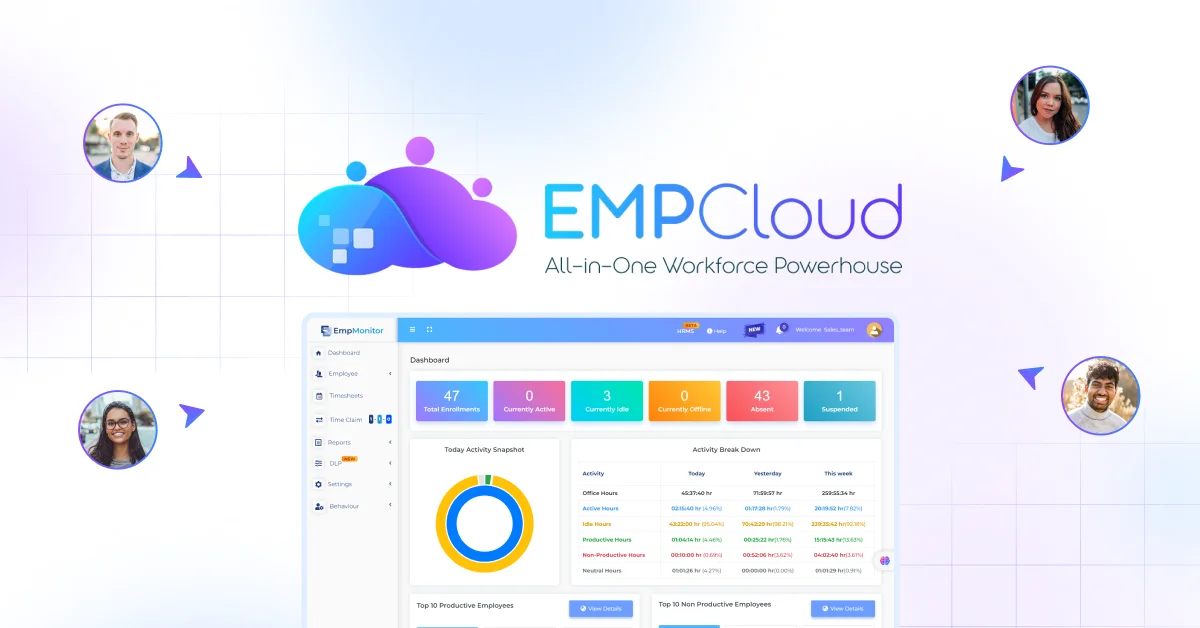
If you’re serious about improving workforce productivity, you need a platform built to handle the full complexity of managing a modern workforce, and that’s exactly what EmpCloud delivers.
EmpCloud is a complete workforce management suite that acts as the central control tower for your entire HR ecosystem, from recruitment and onboarding all the way through exit formalities. Trusted by businesses like Wipro, Cognisant, Airtel, Tata Projects, and ICICI, it’s designed to help growing organisations operate with the efficiency of an enterprise.
Here’s what EmpCloud brings to your workforce:
- EmpMonitor: Real-time productivity and internet activity tracking to maximize employee performance and enable proactive management
- Time & Attendance Tracking: Precise monitoring of work hours, leave, and attendance with automated records and biometric verification
- Geo-Location & Field Force Management: Live tracking and activity monitoring for mobile and field teams to enhance operational efficiency
- 41 AI Tools Across 7 Providers: AI-powered insights that query any module, run reports, and answer HR questions through natural language
- Performance & Career Management: Skill enhancement, certifications, and performance-based appraisals to drive employee growth
- Rewards & Recognition: an AI-powered system that automatically identifies high performers for incentives and recognition
- Payroll Management: Fully automated payroll processing with tax management and compliance built in
- Project Management: Gantt charts and Kanban boards to track tasks, manage deadlines, and optimize team delivery
- Data Loss Prevention & Compliance: SOC 2-compliant security with robust access control and audit logging
Choosing the Right Workforce Productivity Software
Not all platforms are built equally. When evaluating workforce productivity software, growing businesses should look for these non-negotiables:
- Ease of deployment: A platform that requires months of setup is a liability, not an asset. Look for solutions with minimal downtime and quick configuration.
- Integration capability: Your productivity software should connect seamlessly with the tools you already use, not force you to abandon them.
- Scalability: The platform needs to grow with you. Seat-based licensing, multi-tenant architecture, and customisable roles ensure it fits your needs today and tomorrow.
- Data security: As your workforce grows, so does your data footprint. Robust security protocols and compliance standards are non-negotiable.
- Actionable reporting: Raw data without interpretation is noise. Choose software that translates workforce data into clear, actionable insights for managers and leadership.
Conclusion
Workforce productivity isn’t something that happens on its own; it’s built through intentional strategy, the right tools, and a culture that values both performance and people. Growing businesses that invest in unified workforce productivity solutions gain the visibility, efficiency, and data-driven insight they need to scale with confidence. Whether you’re a startup building your first HR process or a mid-sized business managing distributed teams, the path forward starts with knowing your metrics, removing friction, and choosing a platform that grows with you.
FAQ
Q: What are workforce productivity solutions?
A: They are integrated software platforms that help businesses manage, monitor, and improve how employees work, covering attendance, performance, projects, payroll, and more in one system.
Q: How do I measure workforce productivity?
A: Track output per employee, task completion rates, time utilisation, and project adherence ideally through a centralised platform that surfaces this data automatically.
Q: How does workforce productivity software help growing businesses?
A: It replaces manual, disconnected processes with automated, data-driven workflows, reducing administrative overhead and giving managers real-time visibility into team performance.
Q: Is EmpCloud suitable for small and growing businesses?
A: Yes. EmpCloud is designed for startups, SMBs, and enterprise organisations alike, with flexible pricing and scalable modules that grow alongside your business.
Quick Search Our Blogs
Type in keywords and get instant access to related blog posts.