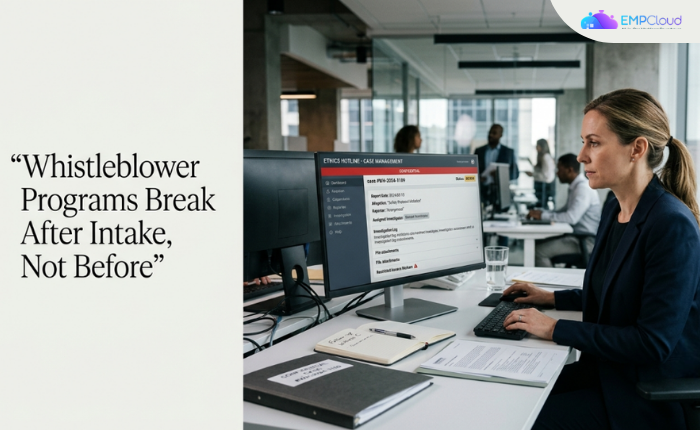
The secure hotline is not your compliance problem. It never was.
NAVEX’s 2025 Whistleblowing & Incident Management Benchmark Report tracked 2.15 million reports across 4,077 organizations covering 69 million employees — volume at record levels for the second consecutive year. The SEC pulled in approximately 27,000 whistleblower tips in FY 2025 alone. Numbers like those suggest employees are willing to report. What they are not willing to do is report into a system they don’t trust to stay confidential after it receives their complaint.
And that trust breaks — not at the intake screen, but the moment an HR manager emails the case notes to a shared inbox.
In a hurry? Listen to the blog instead!
The Intake Illusion
Spend ten minutes in any compliance forum and you’ll see the same question: “Which hotline vendor should we use?” Reasonable question. Wrong question.
A phone line or a web form captures the report. What it cannot do is guarantee chain of custody, restrict who opens the file at 11 p.m. on a Wednesday, or produce a timestamped audit trail when a regulator asks who knew what, and when. That audit trail is exactly what the DOJ’s Evaluation of Corporate Compliance Programs requires — a whistleblower system that is genuinely operational, demonstrably confidential, and traceable through to resolution. A hotline that routes into an unmanaged inbox satisfies zero of those requirements. Miss that bar and the compliance program disappears from the DOJ’s leniency calculus entirely.
Yet most compliance teams still handle case notes in shared drives or email threads. Untracked data. Compounding liability before a single violation is confirmed.
Three Places Anonymity Actually Collapses
1. The Investigation Stage

This is the one nobody talks about. Anonymity does not collapse at intake — it collapses when someone screenshots a report to paste into a Slack thread, or when the VP of HR forwards it to a department head “just for context.” The reporter’s identity can often be reverse-engineered from the detail in the allegation combined with who had access to that situation. Once that email exists, so does the exposure.
Role-restricted, logged access from first receipt to final disposition is not a nice-to-have. SOC 2 and ISO 27001 both require access logs as proof of data protection; in whistleblower contexts, that requirement extends to timestamped, role-restricted logs throughout the case lifecycle. Most organizations have no such logs.
2. Cross-Module Data That Lives in Silos
A credible investigation rarely stays inside one dataset. You need attendance records to check whether someone was on-site when alleged misconduct occurred. You need payroll data to trace whether a financial irregularity matches compensation timing. You need project history to understand who had access to what, when.
When those datasets live in disconnected systems, investigators cross-reference them manually. They pull exports, stitch spreadsheets, annotate PDFs. Every one of those handoffs is a gap in the chain of custody — a gap regulators can pull apart. The FCA’s Q4 2025 whistleblowing data found that 281 reports contained 788 separate allegations, nearly three per report. Multi-allegation cases require multi-source evidence. Manual cross-referencing is not a process; it is a liability.
3. No Chain of Custody on the Report Itself
Simple question: if a regulator called you today and asked who saw a specific report, when, and what action was taken — could you answer it? In under five minutes? Most HR teams I’ve worked with cannot. They could reconstruct something, probably, given a few days and access to inboxes they’re hoping no one subpoenas.
That inability to answer the chain-of-custody question is itself the compliance failure. It does not matter whether the underlying allegation was substantiated or not.
What Integrated HR Data Changes

Here is an argument compliance vendors won’t love. The most dangerous gap in most whistleblower programs is not the reporting channel — it is the separation between the report and the rest of the HR data stack.
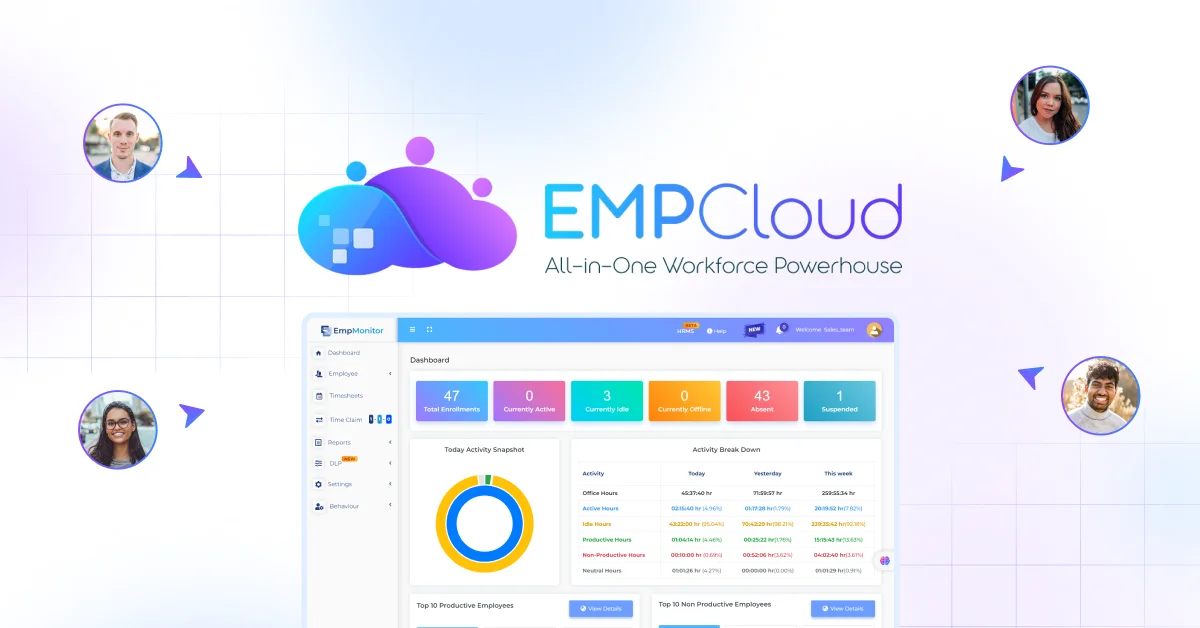
EMPCloud, the AI-powered HRMS, addresses this through its AI agent’s Feedback Stream tool, which routes whistleblower reports confidentially while keeping the case inside the same platform that holds attendance records, payroll data, performance history, and project assignments. That matters because an investigator no longer needs to manually pull exports across systems. The cross-module data — biometric attendance, geo-location records for field workers, leave patterns, performance metrics — is available within the same environment, under the same role-based access controls.
For sectors where this is acutely relevant, the stakes are higher still. Telecom and NBFC workforces frequently involve field staff whose geo-location and activity data become compliance-relevant evidence in fraud or misconduct investigations. When that data lives outside the case management environment, you create exactly the kind of paper trail regulators are trained to pick apart.
EMPCloud’s RBAC and multi-tenant isolation — part of the platform’s OAuth2/OIDC authorization architecture — mean access to a case can be scoped precisely: who can read it, who can annotate it, who can close it. The access log exists by design, not by heroic effort at audit time.
The platform also supports natural-language queries across modules through its Smart SQL analytics tool. An investigator can pull correlated data — attendance anomalies against payroll timing, say — without writing SQL or submitting a ticket to the data team. Speed matters in investigations. Delay creates secondary risk.
An Actionable Audit for Your Current Setup
Before your next compliance review, run through these four questions honestly:
- Who has read access to your open whistleblower cases right now? If the answer is “whoever is on the shared drive” or “I’d have to check,” that is the problem.
- Can you produce a timestamped log of every action taken on a case from intake to close? Not a narrative summary — an actual log.
- How many manual handoffs happen between receiving a report and pulling supporting HR data? Each one is a custody gap.
- What happens to case notes when the lead investigator leaves the company? If the answer involves email archive searches, the answer is wrong.
If two or more of those answers are uncomfortable, the intake channel is the least of your problems. See also the most common whistleblower reporting mistakes HR teams make — several of the errors there feed directly into the custody and access failures described above.
The Case for Treating This as an HR Problem, Not Just a Legal One
Compliance teams tend to own whistleblower programs. That makes sense legally. But the operational execution — the access controls, the data integration, the audit trails — is an HR infrastructure problem. It requires the same rigor you would apply to payroll processing or biometric attendance: system design, not just policy.
The IRS’s own admission that its award processes average over ten years — often after reporters have already lost their jobs — tells you what employees understand about the systemic risk of coming forward. If your internal program cannot demonstrate, concretely, that a report stays confidential through investigation and resolution, you are not running a whistleblower program. You are running a document-collection exercise that happens to accept complaints.
Record report volumes are a signal that employees are willing to use a system they trust. The gap between “willing to report” and “confident the system is safe” is where organizations get hurt — and where a properly integrated HRMS can close the distance.
There is another dimension worth considering: what happens when a reporter or subject leaves mid-investigation. This guide on employee offboarding software covers how HR platforms should handle sensitive records on exit — so custody doesn’t break when a name disappears from the org chart.
Bottom Line
Fix the intake channel if it is broken. But if your investigation workflow runs through uncontrolled email threads and manual data pulls across disconnected systems, the intake channel is not your risk. The process after the report lands is.
Confidentiality is only as strong as the weakest access control in the chain. Right now, for most organizations, that weak link is not the hotline — it is everything that comes after it.
Start your free EMPCloud trial and see how integrated, role-restricted case management works across payroll, attendance, and performance data — without stitching spreadsheets together when it matters most.
FAQs: –
- What happens after a whistleblower report is submitted?
After intake, the report enters the investigation stage, where access controls, case notes, evidence handling, and audit trails determine whether confidentiality is actually maintained. - How can HR protect whistleblower confidentiality during an investigation?
HR should use role-based access, maintain a timestamped record of every case action, and avoid uncontrolled email threads or shared drives for sensitive case information. - What is a whistleblower chain of custody?
A whistleblower chain of custody records who accessed a report, when they accessed it, what actions they took, and how the case moved from intake through resolution. - Why do whistleblower investigations need integrated HR data?
Investigations may require attendance, payroll, performance, leave, project, or location data. Keeping these records within a controlled HR environment reduces manual exports and data handoffs. - How does EMPCloud help manage whistleblower investigations?
EMPCloud keeps whistleblower cases within its HRMS environment, with role-based access controls and access to connected HR data such as attendance, payroll, performance, and project records.
Quick Search Our Blogs
Type in keywords and get instant access to related blog posts.