
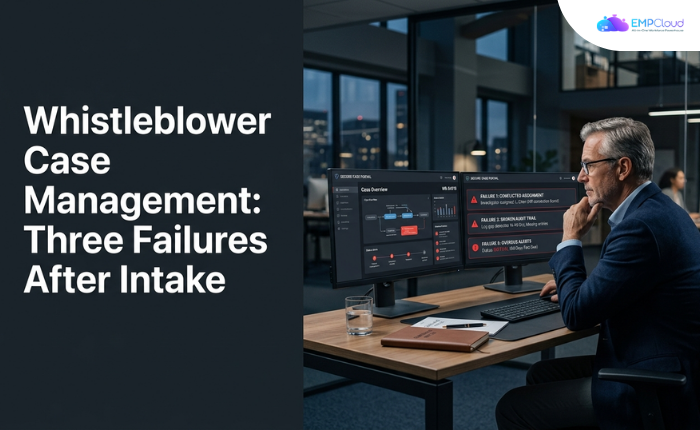
Getting an employee to file a report is the easy part. What kills a whistleblower program is everything that happens in the 72 hours after the report lands.
Compliance teams obsess over intake channels — hotlines, web forms, AI chat — while treating case management as an afterthought. That’s backwards. According to the NAVEX 2025 benchmark, which tracked 4,077 organizations, 2.15 million reports, and 69 million employees, phone hotlines and similar traditional channels account for only 29.5% of incoming reports by intake method. Reporting behavior has already diversified. The bottleneck is downstream.
Here’s the uncomfortable truth: the moment a case is mishandled, you haven’t just fumbled one complaint. You’ve signaled to every other employee who was watching — and employees are always watching — that speaking up carries risk and delivers nothing. That perception compounds silently until the next serious violation goes unreported, or worse, surfaces through a regulator.
The Retaliation Problem Is Larger Than You Think
The Ethics and Compliance Initiative’s 2023 survey found that nearly 50% of employees who reported misconduct experienced some form of retaliation. Half. That figure doesn’t mean half of all companies are run by bad actors. It means that even well-intentioned organizations are allowing structural failures in their case-handling process to create conditions where retaliation — intentional or inadvertent — becomes almost inevitable.
Separately, 23% of employees cite fear of not being taken seriously as the primary reason they don’t file at all. Both problems share the same root: case management that isn’t built to protect the reporter throughout the investigation, not just at the moment of intake.
The regulatory stakes have risen accordingly. The SEC awarded more than $60 million to 48 individual whistleblowers in fiscal year 2025. In the U.S., SOX Section 806 protects whistleblowers at publicly traded companies. The EU Whistleblower Protection Directive (2019/1937) mandates formal internal reporting channels for organizations with 50 or more employees. In India, SEBI and RBI guidelines place formal reporting obligations on listed entities and NBFCs. These aren’t soft expectations. They carry audit trails, enforcement mechanisms, and, increasingly, individual liability.
Three Post-Receipt Failures That Break Programs
Most compliance frameworks dedicate the bulk of their guidance to channel design — which intake types to offer, how to promote them — while what happens after submission gets thin treatment. You should reverse that ratio. Based on documented patterns in how organizations handle reports after intake, three failure modes recur with damaging consistency.
1. Assigning Cases to the Wrong Manager

A report comes in about a team lead’s behavior. HR routes it to that team lead’s department head — someone who has lunch with the subject every Thursday. No formal conflict of interest. No obvious problem on paper. But the reporter knows the connection, and so does everyone else in the department.
This isn’t a hypothetical. It is one of three named post-receipt failure modes that compliance professionals identify repeatedly: assigning the case to a manager tangentially connected to the subject. The fix isn’t complicated in theory — route cases away from anyone in the subject’s chain of influence — but it requires a system that enforces that routing without depending on HR’s memory of who knows whom.
EMPCloud‘s AI agent includes a Feedback Stream tool specifically designed to route reports without exposing the source’s identity to case managers who might know them personally. The goal isn’t anonymity for its own sake. It’s structural separation between the reporter’s identity and the people handling the case — enforced automatically, not by asking a busy HR generalist to recall every relationship in a 200-person org.
2. No Auditable Investigation Trail
The second failure mode is subtler and more legally dangerous: failing to document investigation steps in an auditable trail. When a regulator or plaintiff attorney asks “what did you do after receiving this report, and when did you do it?” — the answer “we looked into it” is not an answer.
Every step — who reviewed the report, what evidence they gathered, who they interviewed, what decision they reached, and when — needs a timestamped record. Not because you expect a lawsuit, but because missing records can make your organization look either incompetent or deliberately evasive when regulators or attorneys ask questions. Courts and regulators make little distinction between the two.
This is where HR platforms built for compliance workflows earn their cost. The alternative — documenting in email threads and shared drives — creates gaps that are genuinely difficult to reconstruct under pressure.

3. Letting Cases Go Cold
The third failure is the most common: cases going stale for weeks with no status update to the reporter. The reporter files a complaint, receives no update, assumes the team ignored or suppressed the report, and either discusses it with colleagues or decides not to report again. Or both.
Neither outcome is acceptable. When employees discuss unresolved complaints among colleagues before any investigation is concluded, they expose themselves to retaliation and contaminate the investigation by alerting the subject. The recommended practice — “report-first, discuss-never” guidance built into onboarding, manager training, and speak-up communications — only holds if the reporter trusts the system enough to wait for it to work.
That trust is built by consistent status communication, even when the only update is “we’re still reviewing.” Silence reads as inaction.
The Benchmark You Should Actually Be Tracking
Across the 4,077 organizations in the NAVEX 2025 dataset, 2.15 million reports filed by 69 million employees works out to roughly one report per 32 employees annually. That’s not a threshold you have to hit — it’s a calibration signal. An organization running significantly below that ratio isn’t necessarily cleaner. It may just have a speak-up culture that hasn’t been earned.
If your report volume is low, the first question isn’t “do we have a reporting problem?” It’s “do employees believe anything will happen if they file?” Case management quality answers that question before employees ever decide to submit.
What Good Case Management Actually Requires
No checklist replaces judgment, but the structural requirements are clear:
- Conflict-aware routing. The case handler must be organizationally separated from the subject. The system should enforce this, not assume it.
- Timestamped documentation at every decision point. If you can’t reconstruct the investigation in sequence, you can’t defend it.
- Defined SLAs for status updates. Not resolution — updates. The reporter should receive a communication within a defined window even when the investigation is ongoing.
- Intake channel diversity. Phone hotlines, text, web form, and AI chat each serve different reporter comfort levels. A program offering only one channel cuts off reporters before they start.
- Pre-filing guidance embedded in onboarding. Employees should understand the “report-first, discuss-never” principle before they ever need it.
These aren’t sophisticated interventions. They’re process disciplines. But they require a platform that enforces them consistently — not a policy document that assumes everyone will remember to follow it under pressure.
For HR and compliance teams managing this at scale, the overhead of manual case management compounds fast. EMPCloud operates across 15+ countries, managing 50K+ employees across 200+ companies — including NBFCs and telecom organizations where regulatory exposure on reporting failures runs high. The Feedback Stream tool inside EMPCloud’s AI agent exists precisely because confidential routing and case integrity aren’t things you want to depend on individual human memory.
If you’re reviewing your overall compliance posture, our piece on compliance monitoring as a shield for enterprise security is worth reading alongside this one. And if you’re dealing with the downstream people-ops effects of poor feedback culture, these seven employee communication mistakes cover where managers most often break trust before a formal report is ever filed.
Your intake channel is table stakes. What employees remember — and what regulators examine — is what you did next.
Start your free 15-day EMPCloud trial and see how the Feedback Stream tool handles confidential report routing, case documentation, and investigator assignment without putting case integrity at risk.
FAQs: –
1. What is whistleblower case management?
Whistleblower case management is the process of securely receiving, assigning, investigating, documenting, and resolving whistleblower reports. It helps organizations protect reporters, prevent conflicts of interest, maintain an audit trail, and handle cases consistently.
2. How should a company manage a whistleblower complaint?
A company should route the complaint to an impartial investigator, protect the reporter’s identity, document every investigation step, track deadlines, and provide appropriate status updates. A structured whistleblower case management process helps ensure teams address every complaint properly and on time.
3. What are the most common whistleblower case management mistakes?
The most common mistakes include assigning cases to someone connected to the subject, failing to maintain an auditable investigation trail, and allowing cases to go cold without status updates. These failures can increase retaliation, compliance, and reputational risks.
4. How does whistleblower case management prevent retaliation?
A strong case management process limits unnecessary access to the reporter’s identity, separates investigators from conflicts of interest, and documents how the team handles each complaint. These controls can reduce retaliation risks and improve accountability.
5. Why is an audit trail important in whistleblower cases?
An audit trail shows who handled a case, what actions they took, when they made decisions, and how the investigation progressed. This documentation helps organizations demonstrate that their teams handled whistleblower complaints fairly, consistently, and according to established procedures.
Quick Search Our Blogs
Type in keywords and get instant access to related blog posts.