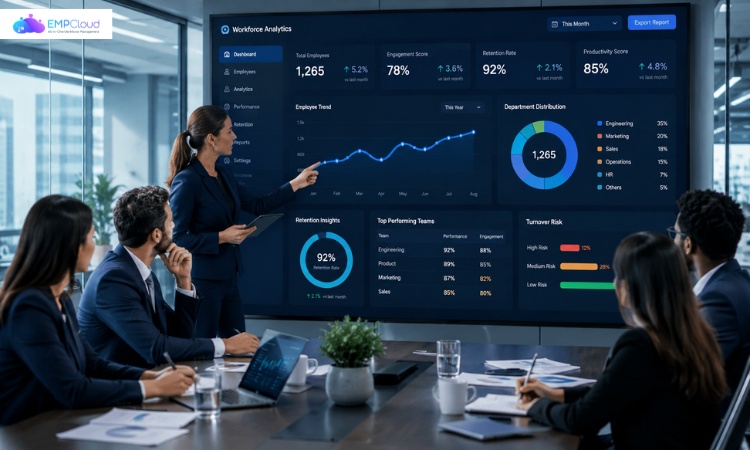
A mid-sized company spends months recruiting a senior manager. The interviews go well. The references check out. Everyone believes they have found the right person.
Ten months later, that employee resigns.
The reason isn’t compensation or company culture. It is a workload imbalance, something nobody tracked until it became a problem. The company loses productivity, spends money replacing the role, and disrupts an entire team.
This happens more often than most leaders realize.
Organizations make hiring, retention, and performance decisions every day. Yet many of those decisions still rely heavily on assumptions, limited visibility, or gut instinct. When people’s decisions are disconnected from data, costly mistakes become difficult to avoid.
That’s where workforce analytics creates a competitive advantage.
Instead of guessing what employees need or why workforce challenges occur, businesses can identify patterns, predict outcomes, and make informed decisions that support growth. The result is better hiring, stronger retention, higher productivity, and a healthier workforce overall.
By the end of this article, you’ll have a practical framework for using workforce to improve business performance and reduce avoidable people-related costs.
Read Aloud!
What Is Workforce Analytics? (And Why the Textbook Definition Misses the Point)
Many professionals search for what is workforce analytics? because they want more than a technical definition. They want to understand why it matters.
It is the use of data, statistical methods, and predictive tools to understand, optimize, and forecast how employees impact business outcomes.
The definition is simple. The value comes from how organizations use it.
Traditional HR reports typically show what happened in the past. Workforce analytics goes further by uncovering why something happened and what is likely to happen next.
Think about employee turnover.
A report may show that turnover increased by 15% during the last quarter. Useful information, but it only describes the outcome. Analytics helps identify the departments affected, the underlying causes, and the employees most likely to leave in the future.
Most organizations progress through four stages:
- Descriptive Analytics: What happened?
- Diagnostic Analytics: Why did it happen?
- Predictive Analytics: What is likely to happen next?
- Prescriptive Analytics: What should we do about it?
A company tracking resignations is operating at the first level. A company forecasting future turnover and recommending retention actions is using advanced workforce analytics.
The difference is significant because growth depends on future decisions, not past observations.
The Real Cost of Running Your Workforce on Gut Instinct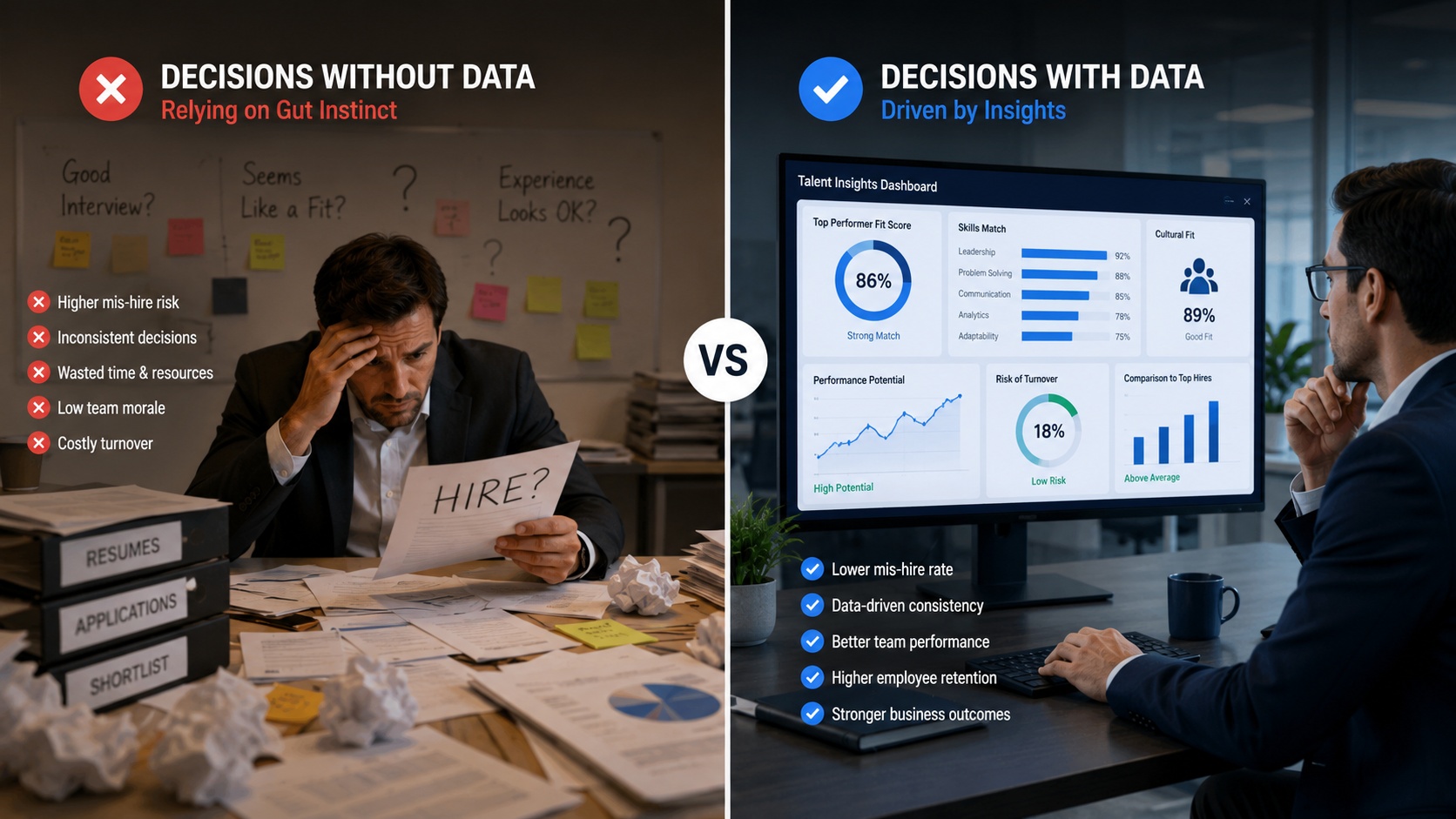
People-related mistakes are expensive.
A poor hiring decision can cost anywhere from 30% to 200% of an employee’s annual salary, depending on the role and business impact. Yet direct costs tell only part of the story.
Hidden costs often include:
- Reduced team morale
- Lower productivity
- Delayed projects
- Increased manager workload
- Customer experience issues
Turnover creates another challenge.
Many organizations investigate employee departures only after retention becomes a visible problem. By that point, valuable employees may already be planning their exit.
Employee engagement creates similar blind spots. Annual surveys provide useful feedback, but workplace sentiment changes faster than yearly reporting cycles.
Without a workforce analysis, leaders often react after damage has already occurred.
This is why data-driven workforce management is no longer optional for growing organizations. It has become a practical tool for reducing risk and improving decision quality.
Where Workforce Analytics Actually Drives Business Growth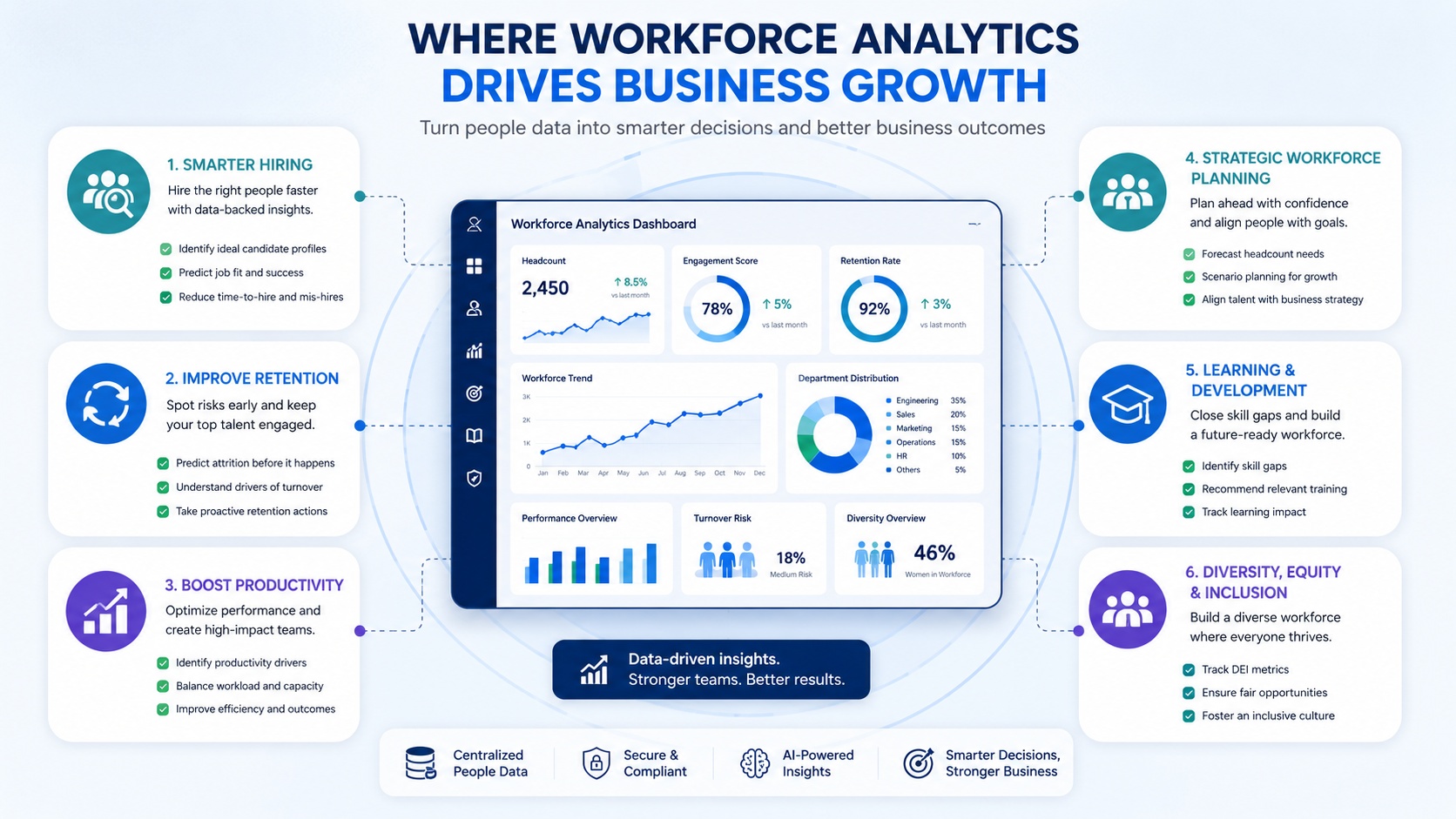
The strongest business case for the workforce comes from real-world applications. Organizations see results when data directly influences decisions.
1. Smarter Hiring That Reduces Mis-Hire Rate
Successful employees often share patterns.
They may possess similar skills, experiences, certifications, or behavioral traits. Analytics helps organizations identify those characteristics and use them to improve recruiting strategies.
Instead of relying solely on interviews, hiring teams can use evidence to define ideal candidate profiles.
The result is faster onboarding, stronger performance, and fewer costly hiring mistakes.
2. Predicting and Preventing Attrition Before It Hurts
Employee departures rarely happen without warning signs.
Changes in engagement scores, attendance patterns, workload levels, and manager interactions often reveal growing dissatisfaction.
Workforce analytics helps organizations identify those signals early.
When leaders know who may be at risk of leaving, they can intervene before retention issues become expensive problems.
3. Optimizing Workforce Productivity Without Burning People Out
More hours do not automatically create better outcomes.
Some teams struggle because workloads are unevenly distributed. Others face process inefficiencies that limit performance.
Analytics helps uncover these patterns.
Leaders gain visibility into resource allocation, project demands, and productivity trends. That allows organizations to improve output while protecting employee well-being.
4. Strategic Workforce Planning and Headcount Decisions
Growth requires accurate forecasting.
Businesses need to understand how hiring decisions affect future performance. This is where workforce planning and analytics become closely connected.
Consider a company preparing for rapid expansion.
What happens if a critical position remains unfilled for sixty days? How will that affect revenue targets or customer delivery timelines?
Data-driven workforce planning provides answers before problems emerge.
5. Learning and Development ROI
Training budgets are often substantial.
Yet many organizations struggle to determine whether learning initiatives produce meaningful results.
Workforce analytics connects training investments to measurable outcomes such as productivity, promotion rates, performance improvements, and skill development.
Instead of tracking completion rates alone, leaders can evaluate actual business impact.
6. Diversity, Equity, and Inclusion Measurement
Creating an inclusive workplace requires more than good intentions.
Organizations need visibility into hiring practices, promotion outcomes, compensation fairness, and representation trends.
Analytics transforms DEI from a discussion into a measurable business initiative.
Leaders gain objective insights that support accountability and continuous improvement.
How to Build a Workforce Analytics Strategy
Many organizations delay implementation because they believe they need perfect data.
They don’t.
The most successful workforce analytics initiatives begin with a clear business objective.
Step 1: Define the Business Question First
Start with a decision you need to make.
For example, a company may want to reduce first-year employee attrition by 20%. Once the objective is defined, identifying relevant metrics becomes much easier.
Data should support a question, not drive one.
Step 2: Audit Existing Data Sources
Most organizations already possess valuable workforce information.
Common sources include:
- HRIS platforms
- Payroll systems
- Performance reviews
- Employee surveys
- Recruitment platforms
- Exit interviews
The challenge is usually fragmentation rather than data availability.
Step 3: Choose the Right Technology
Different businesses require different levels of sophistication.
Startups often need simple reporting capabilities. Mid-sized companies may require predictive insights. Large enterprises frequently need advanced modeling and integration support.
When evaluating workforce analytics solutions, consider ease of use, scalability, predictive capabilities, and integration options.
Many organizations begin this process by evaluating workforce analytics software that centralizes workforce data across multiple systems.
Step 4: Build Dashboards That Drive Decisions
A dashboard should support action.
Tracking dozens of metrics sounds impressive, but decision-makers often benefit from a focused set of indicators.
Useful metrics commonly include:
- Employee turnover rate
- Time-to-fill positions
- Employee engagement score
- Internal mobility rate
- Absenteeism rate
The goal is not visibility alone. The goal is better decisions.
Step 5: Create Feedback Loops
Analytics should become part of ongoing business operations.
Review workforce metrics regularly. Share insights with managers. Connect discussions to strategic planning and operational reviews.
Organizations that treat analytics as a continuous process generate more value than those that view it as a one-time initiative.
Why EmpCloud Belongs in Your Workforce Analytics Stack
Understanding workforce trends is important. Acting on those insights is what creates results.
EmpCloud is designed to help organizations move from disconnected data to informed decision-making.
Key capabilities include:
- Real-time people data across hiring, engagement, productivity, and performance
- Built-in workforce planning and analytics tools connected to business goals
- Skills and learning analytics are tied directly to performance outcomes
- No-code dashboards for faster insight sharing
- Integration support across payroll and recruitment platforms
The platform doesn’t replace experience or leadership judgment.
Instead, it strengthens decision-making by providing timely and actionable workforce intelligence.
Mistakes That Make Workforce Analytics Backfire (And How to Avoid Them)
Analytics projects fail for predictable reasons.
Understanding those mistakes can save significant time and resources.
One common problem is tracking vanity metrics.
Organizations sometimes collect large volumes of information without connecting metrics to actual business decisions. More data does not automatically create better outcomes.
Another issue is failing to act on insights.
A dashboard that nobody uses delivers no value. Every metric should connect to a process, decision, or intervention.
Manager involvement also matters.
Analytics initiatives often remain confined to HR teams. Yet frontline managers influence engagement, productivity, and retention more than anyone else. Without their participation, the impact remains limited.
Data quality presents another challenge.
Incomplete records, inconsistent reporting, and outdated employee information can undermine even the most advanced workforce analytics programs.
Some companies also make the mistake of treating implementation as a technology project.
Technology matters, but success depends on people, processes, communication, and organizational alignment.
Privacy deserves equal attention.
Employees need transparency regarding how data is collected, analyzed, and used. Trust remains essential for sustainable analytics programs.
Read More!
Silent Quitting Is Rising in 2026: How to Spot It and Stop It
Master Your Timeline with a Project Schedule Example (Step-by-Step + Real Templates)
The Next Frontier: Where Workforce Analytics Is Heading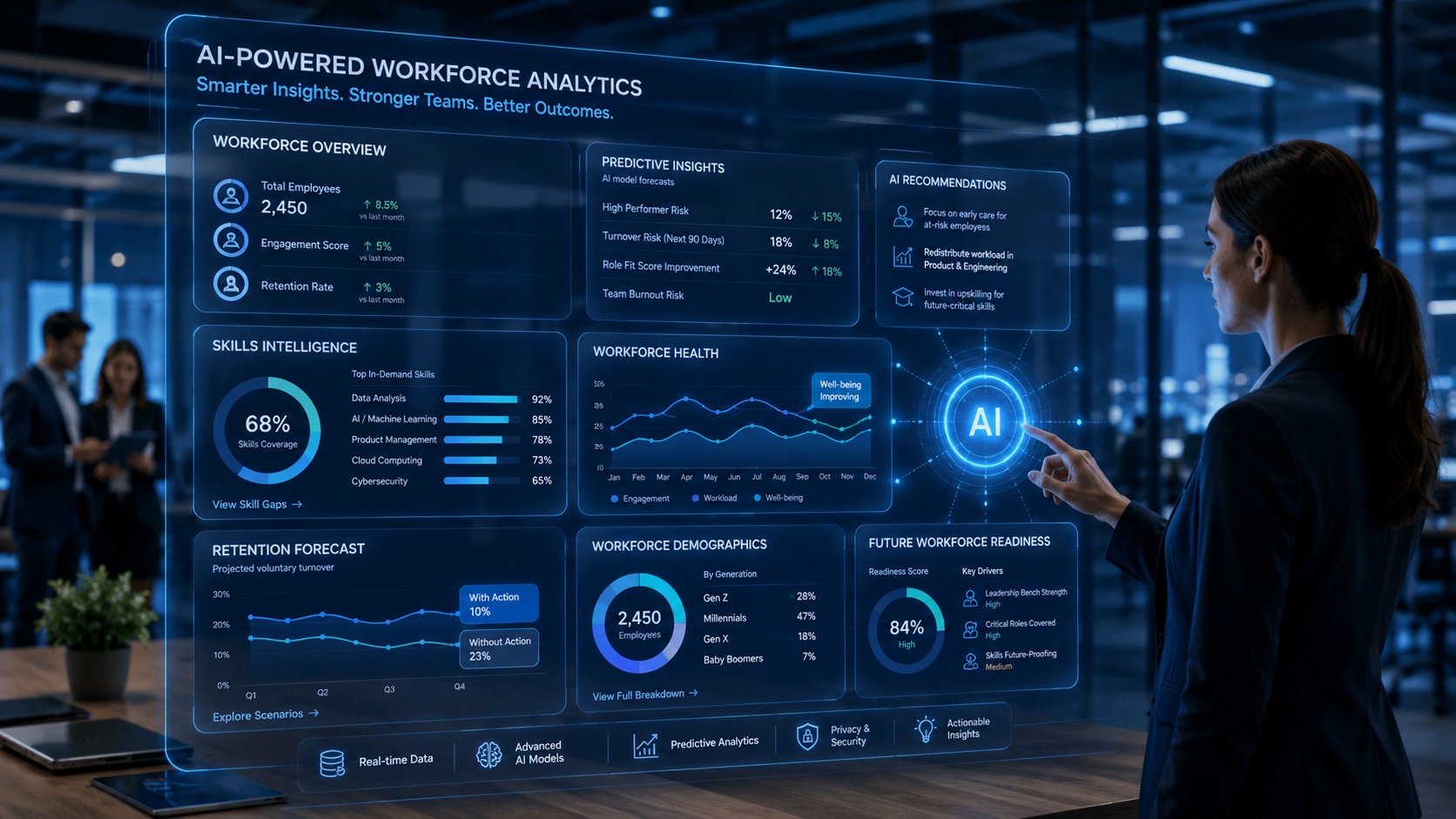
The future of workforce analytics is becoming increasingly proactive.
Artificial intelligence is helping organizations identify skill gaps without relying solely on employee self-assessments. Project participation, work outputs, and collaboration patterns can reveal capabilities that traditional systems overlook.
Employee listening is evolving as well.
Many organizations are moving beyond annual surveys toward continuous feedback models. Frequent pulse surveys provide a more accurate picture of workforce sentiment.
Leadership expectations are changing, too.
Workforce discussions are increasingly reaching executive and board-level conversations. CEOs and CFOs want clearer visibility into how workforce investments influence financial performance.
Technology will continue advancing, but trust will become even more important.
As workforce analytics becomes more powerful, organizations must balance insight generation with transparency, privacy, and ethical data practices.
The future is not simply better reporting.
It is smarter recommendations that help leaders make better decisions faster.
Your Workforce Has the Answers. Analytics Helps You Hear Them.
The company in our opening example didn’t lose an employee because of bad luck.
It lost visibility into a problem that data could have revealed much earlier.
Every expensive decision carries risk. The organizations that consistently outperform competitors are often the ones that reduce uncertainty before making those decisions.
Workforce analytics is not about reducing employees to numbers. It is about understanding people well enough to support them, develop them, and help them succeed.
Start with one important question about your workforce. Identify the data that can answer it. Build from there.
FAQs
What is workforce analytics, and how is it different from HR analytics?
It focuses on workforce-wide decisions and business outcomes such as productivity, retention, and performance. HR analytics often focuses more narrowly on HR process efficiency and operational metrics.
What data is used?
Common data sources include payroll information, recruitment metrics, performance reviews, engagement surveys, absenteeism records, learning data, and workforce demographics.
How do small businesses benefit?
Even simple people data analysis can improve hiring decisions, identify retention risks, and establish productivity benchmarks that support growth.
What are the most important metrics to track?
Key metrics include employee turnover rate, time-to-fill, engagement score, internal mobility rate, absenteeism rate, and productivity per employee.
How long does implementation take?
Basic dashboards can often be implemented within a few weeks. Predictive models typically require one to three months, depending on data readiness and complexity.
Quick Search Our Blogs
Type in keywords and get instant access to related blog posts.