
Modern software applications are no longer simple, single-server programs. Today, they span multiple cloud environments, microservices, APIs, and distributed components all operating simultaneously. In this landscape, a performance monitoring application has become an operational necessity, not a luxury. Application performance monitoring (APM) gives engineering and operations teams the visibility they need to ensure applications run reliably, respond quickly, and deliver a consistent experience to every user. This blog explains what APM is, why it matters, and precisely how a performance monitoring application works, from data collection to root cause analysis.
Listen To The Podcast Now!
What Is Application Performance Monitoring?
Application performance monitoring is the practice of tracking, measuring, and managing the performance and availability of software applications in real time. A performance monitoring application continuously collects data from running systems, surfaces performance issues, and helps teams identify and resolve problems before they impact end users.
At its foundation, APM relies on telemetry, the automated collection of data from systems covering three primary signals: metrics, logs, and distributed traces. Together, these signals provide a complete picture of how an application behaves under real-world conditions.
Application monitoring, as a broader term, encompasses infrastructure-level checks such as server uptime and network availability. Application performance monitoring goes deeper it focuses specifically on the behavior of the application itself: how fast it responds, where it fails, and why performance degrades. Understanding this distinction is important when selecting the right tool for your organization.
Why Application Monitoring Is Important

The cost of application downtime or poor performance is measurable and significant. Slow page loads reduce conversion rates. API failures break downstream services. Undetected errors erode user trust. A performance monitoring application helps organizations avoid all of this by providing early warning signals and actionable data.
Key reasons APM is essential in modern operations:
- Prevents downtime: A performance monitoring application detects anomalies before they escalate into outages, enabling proactive intervention.
- Improves user experience: By monitoring response times and error rates in real time, teams can ensure users consistently receive fast, reliable service.
- Reduces Mean Time to Resolution (MTTR): When an issue does occur, a performance monitoring application accelerates root cause analysis, cutting the time engineers spend diagnosing problems.
- Supports cloud-native and microservices architectures: Distributed systems introduce complexity that traditional monitoring cannot address. A purpose-built performance monitoring application is essential for these environments.
How Does Application Performance Monitoring Work?
A performance monitoring application operates through a structured pipeline collecting raw data from applications, transmitting it to a central platform, analyzing it in real time, and surfacing actionable intelligence. Here is a step-by-step breakdown of how that process works.
1. Data Collection: Metrics, Logs, and Traces
Every performance monitoring application begins with data collection. Three types of telemetry data form the observability foundation:
Metrics are numeric measurements captured at regular intervals. They include indicators such as CPU utilization, memory consumption, request latency, response times, and error rates. Metrics are efficient to store and ideal for dashboards and threshold-based alerting.
Logs are time-stamped records of events within the application error messages, transaction records, warnings, and system events. Logs provide narrative context that metrics alone cannot offer. When a performance monitoring application flags a latency spike, logs help engineers understand what was happening in the system at that moment.
Traces follow the journey of a single request as it moves through multiple services, containers, or functions. Distributed tracing is particularly powerful in microservices environments, where a single user action may trigger calls to dozens of independent services. A performance monitoring application uses traces to pinpoint exactly which service or component introduced a delay or error.
Together, metrics, logs, and traces form the three pillars of observability — the comprehensive framework that modern performance monitoring applications are built upon.
2. Instrumentation of Applications
Before a performance monitoring application can collect data, the application itself must be instrumented. Instrumentation is the process of embedding data collection mechanisms into the application code or runtime environment.
There are three primary approaches:
- Agent-based instrumentation: A lightweight software agent is installed alongside the application. It automatically captures telemetry without requiring developers to modify application code. This is the most common approach and is used by most enterprise-grade performance monitoring applications.
- SDK-based instrumentation: Developers integrate a monitoring SDK directly into the application codebase. This approach offers greater control and flexibility but requires manual effort.
- OpenTelemetry: An open-source, vendor-neutral framework that has become the industry standard for instrumentation. OpenTelemetry allows organizations to instrument applications once and send telemetry to any compatible performance monitoring application, avoiding vendor lock-in.
The choice of instrumentation method depends on the application’s language, architecture, and the level of control the team requires.
3. Data Transmission and Aggregation
Once collected, telemetry data must be transmitted from the instrumented application to the performance monitoring application’s central backend. This transmission typically occurs in near real time, using lightweight protocols designed to minimize overhead.
In distributed architectures where an application may run across hundreds of containers or cloud instances, the performance monitoring application aggregates data from all sources into a unified view. This aggregation is critical: without it, engineers would be forced to examine logs and metrics from individual services in isolation, making it nearly impossible to understand system-wide behavior.
A modern performance monitoring application correlates data across services automatically. When a trace shows that a particular API call is slow, the platform can surface the corresponding logs and metrics from that exact service and time window, reducing the manual effort required to investigate.
4. Real-Time Monitoring and Dashboards
With data flowing into the platform, a performance monitoring application presents it through real-time dashboards. These dashboards give engineering, operations, and product teams a live view of system health and application behavior.
Typical KPIs displayed on a performance monitoring application dashboard include:
- Response time (p95 and p99): The time taken to respond to requests at the 95th and 99th percentiles is particularly important for understanding the experience of users under high load.
- Error rate: The percentage of requests resulting in errors, categorized by type and service.
- Throughput: The volume of requests processed per unit of time, indicating system load.
- Latency: The delay introduced at each step of a transaction, often visualized as a trace waterfall.
A performance monitoring application also establishes performance baselines, the normal operating parameters of the application, and continuously compares live data against these baselines to identify deviations.
5. Alerting and Anomaly Detection
A performance monitoring application does not merely display data; it actively notifies teams when something goes wrong. Alerting is configured based on thresholds or anomaly detection models.
Threshold-based alerting triggers notifications when a metric exceeds a defined limit, for example, when error rate rises above 2% or response time crosses 500 milliseconds. These alerts are straightforward to configure but may generate noise if thresholds are set too broadly.
AI-based anomaly detection is increasingly common in advanced performance monitoring applications. Rather than relying on fixed thresholds, machine learning models learn the normal behavior of the application and flag statistically significant deviations even when the values stay within manually defined limits. This approach catches subtle degradations that threshold-based alerting would miss.
Alerts from a performance monitoring application are routed to the appropriate teams via email, messaging platforms such as Slack, or incident management tools such as PagerDuty, ensuring fast response times.
6. Root Cause Analysis
When an incident occurs, the most valuable function of a performance monitoring application is root cause analysis (RCA). This is the process of tracing a performance problem back to its origin — the specific service, code path, query, or dependency responsible for the issue.
A performance monitoring application supports RCA through several mechanisms:
- Distributed traces show the full request journey, revealing which service introduced latency or returned an error.
- Correlated logs provide detailed event context around the time of failure.
- Dependency maps visualize relationships between services, making it easy to see how a failure in one component cascades to others.
The result is faster, more accurate diagnosis and faster resolution. Engineering teams spend less time guessing and more time fixing.
Key Metrics Tracked by a Performance Monitoring Application
A performance monitoring application tracks a broad set of metrics depending on the application type and business requirements. The most universally relevant include:
- Response time (p95, p99): Critical for understanding user experience at scale.
- Error rate: A direct indicator of application reliability.
- CPU and memory utilization: Infrastructure-level health indicators.
- Throughput: Requests per second, indicating system load and capacity.
- Latency spikes: Sudden increases in response time that may signal database issues, network congestion, or service degradation.
Effective use of a performance monitoring application involves tracking these metrics in combination rather than in isolation, since performance issues rarely stem from a single cause.
Application Monitoring vs. Application Performance Monitoring
These terms are often used interchangeably, but they represent different levels of capability.
Application monitoring typically refers to basic availability checks, such as whether the server is up. Is the service responding? These checks are valuable but limited in scope. They confirm that a problem exists but offer little insight into why.
Application performance monitoring operates at a deeper level. A performance monitoring application examines how the application behaves, not just whether it is reachable. It tracks individual transactions, identifies slow queries, maps service dependencies, and provides the instrumentation needed to diagnose complex performance issues in distributed systems.
For organizations operating at scale, basic application monitoring is insufficient. A full performance monitoring application is required to maintain the reliability and quality that users expect.
Application Performance Monitoring in Cloud and Microservices Environments
Cloud-native and microservices architectures present unique monitoring challenges. A single user request may pass through an API gateway, multiple backend services, a caching layer, and a database all within milliseconds. Any one of these components can become a bottleneck.
A performance monitoring application designed for modern architectures addresses these challenges by:
- Providing end-to-end distributed tracing that follows requests across service boundaries.
- Monitoring containerized workloads running on platforms such as Kubernetes, where services are ephemeral and constantly changing.
- Tracking API dependencies and third-party service performance.
- Scaling automatically to accommodate dynamic, elastic workloads without manual configuration.
Without a purpose-built performance monitoring application, the complexity of cloud-native environments makes meaningful observability nearly impossible to achieve.
EmpCloud: Operational Performance Intelligence Layer
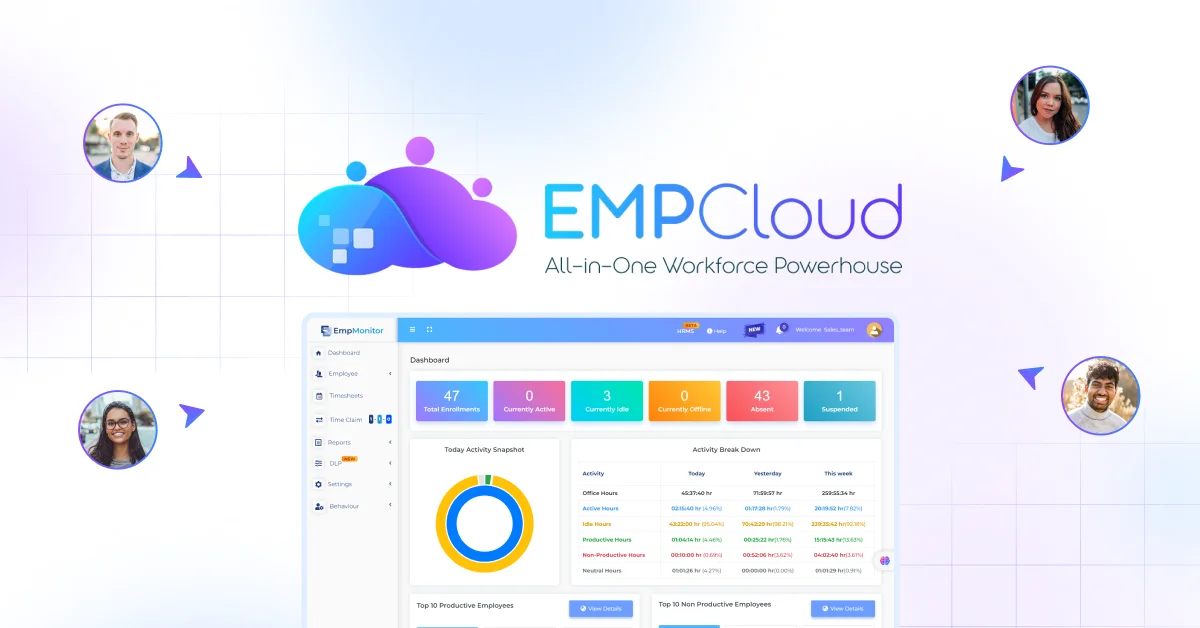
EmpCloud extends visibility beyond traditional Application Performance Monitoring (APM), which focuses on system and application metrics, by providing insights into workforce and operational performance.
It is a cloud-based workforce management platform that includes HRMS, payroll, attendance tracking, recruitment, and performance analytics. Through real-time dashboards and productivity insights (via EmpMonitor), it helps organizations understand team activity, workflow efficiency, and operational bottlenecks.
Key points:
- Provides real-time workforce and operational dashboards
- Supports HRMS functions like payroll, attendance, and recruitment tracking
- Offers productivity analytics through EmpMonitor for work pattern analysis
- Helps identify workflow delays and operational bottlenecks
- Enables performance tracking and goal-based evaluation
- Assists in data-driven workforce planning and resource allocation
Unlike APM tools that monitor application behavior (latency, errors, throughput), EmpCloud focuses on how work is executed across teams and processes. In this way, it complements APM by connecting technical performance with operational productivity.
Also Read:
Best Practices for Application Performance Monitoring

To derive maximum value from a performance monitoring application, organizations should follow these established best practices:
- Prioritize user experience metrics: Start by monitoring the metrics that directly reflect what users experience — response times, error rates, and availability. These are the most important signals a performance monitoring application can surface.
- Implement distributed tracing from the outset: In microservices environments, tracing is indispensable. Configure distributed tracing early, before complexity grows.
- Set meaningful, context-aware alerts: Overly sensitive alerts generate noise; overly permissive alerts miss real issues. Calibrate thresholds carefully and use anomaly detection where possible.
- Avoid metric overload: A performance monitoring application can collect vast quantities of data. Focus on the metrics that are genuinely actionable and align with business and reliability objectives.
- Integrate logs, metrics, and traces: The most powerful use of a performance monitoring application comes from correlating all three data types providing context that no single signal can offer alone.
Conclusion
A performance monitoring application is one of the most critical investments an engineering organization can make. By continuously collecting telemetry, aggregating data across distributed services, visualizing system health in real time, and enabling rapid root cause analysis, a performance monitoring application transforms reactive firefighting into proactive, intelligent operations management.
The process instrumentation, data collection, aggregation, real-time monitoring, alerting, and RCA forms a complete observability loop that keeps applications healthy, users satisfied, and engineering teams equipped with the information they need to act decisively.
As cloud architectures grow more complex and user expectations continue to rise, the role of the performance monitoring application will only become more central to how organizations build, operate, and scale their software. Choosing the right performance monitoring application today is an investment in reliability, agility, and long-term operation.
FAQs:
- What is the difference between APM and observability?
APM is a subset of observability focused on application performance, while observability includes logs, metrics, traces, and system-wide visibility. - How does APM differ from application monitoring?
Application monitoring checks uptime and availability, while APM analyzes performance, latency, errors, and request flows. - What is OpenTelemetry in APM?
OpenTelemetry is an open-source framework for collecting and exporting telemetry data (metrics, logs, traces) from applications. - Does APM slow down applications?
Modern APM tools use lightweight agents and sampling techniques, so performance overhead is minimal. - How do companies choose between Datadog, New Relic, and Dynatrace?
Selection depends on scale, pricing model, and depth of observability features.
Quick Search Our Blogs
Type in keywords and get instant access to related blog posts.