
**Start a free trial today to write employment verification letter fast →
Most rejections happen for simple reasons when you write employment verification letter responses: missing letterhead, unauthorized pay details, or no contact name. To get approved fast, include:
- employer’s letterhead
- the date and recipient
- the employee’s name and role
- start and end dates
- status (full-time/part-time)
- salary if authorized
- a clear closing statement
- a real phone/email for follow-up
You’ll also learn to write employment verification letter templates that pass lender, landlord, and agency checks in 2026.
Here’s the short answer:
- use official letterhead
- state precise facts
- match the requester’s checklist
- keep salary data out unless the employee gave written consent
- sign, add your title, and provide a work email and direct line
That’s it. Clean, fast, and verifiable.
Moreover, this guide takes you from first request to final file storage. You’ll get step-by-step instructions, ready-to-copy templates, and guardrails to avoid legal mistakes. As a result, you’ll save time and reduce back-and-forth.
 , signature, and HR contact; light brand-neutral colors; 2026 calendar visible in the corner)
What Is an Employment Verification Letter and When Do You Need One?
An employment verification letter is a short, signed statement from an employer that confirms a person’s job details. It proves the individual works (or worked) for the company and may confirm job title, dates, status, and, if allowed, compensation. You’ll use it to write employment verification letter responses that satisfy third-party checks.
The purpose is simple: help a lender, landlord, agency, or new employer confirm facts fast.
Therefore, the letter should be factual, brief, and on official letterhead.
It is not a reference or character letter. It is a factual record.
When You Need One
Here are five common scenarios where requesters ask for a verification letter:
- Mortgage or loan applications: Underwriters confirm job and income before approval.
- Rental applications: Landlords check job stability and, at times, pay range.
- Immigration processes: Case officers confirm current or past employment.
- New employer requests: Background checks confirm role, tenure, and status.
- Government benefits: Agencies confirm eligibility tied to employment.
In each case, match the recipient’s checklist. For example, a mortgage underwriter may require exact base salary and pay cadence, while a landlord may only want employment status and title. As a result, you only disclose what’s requested and authorized.
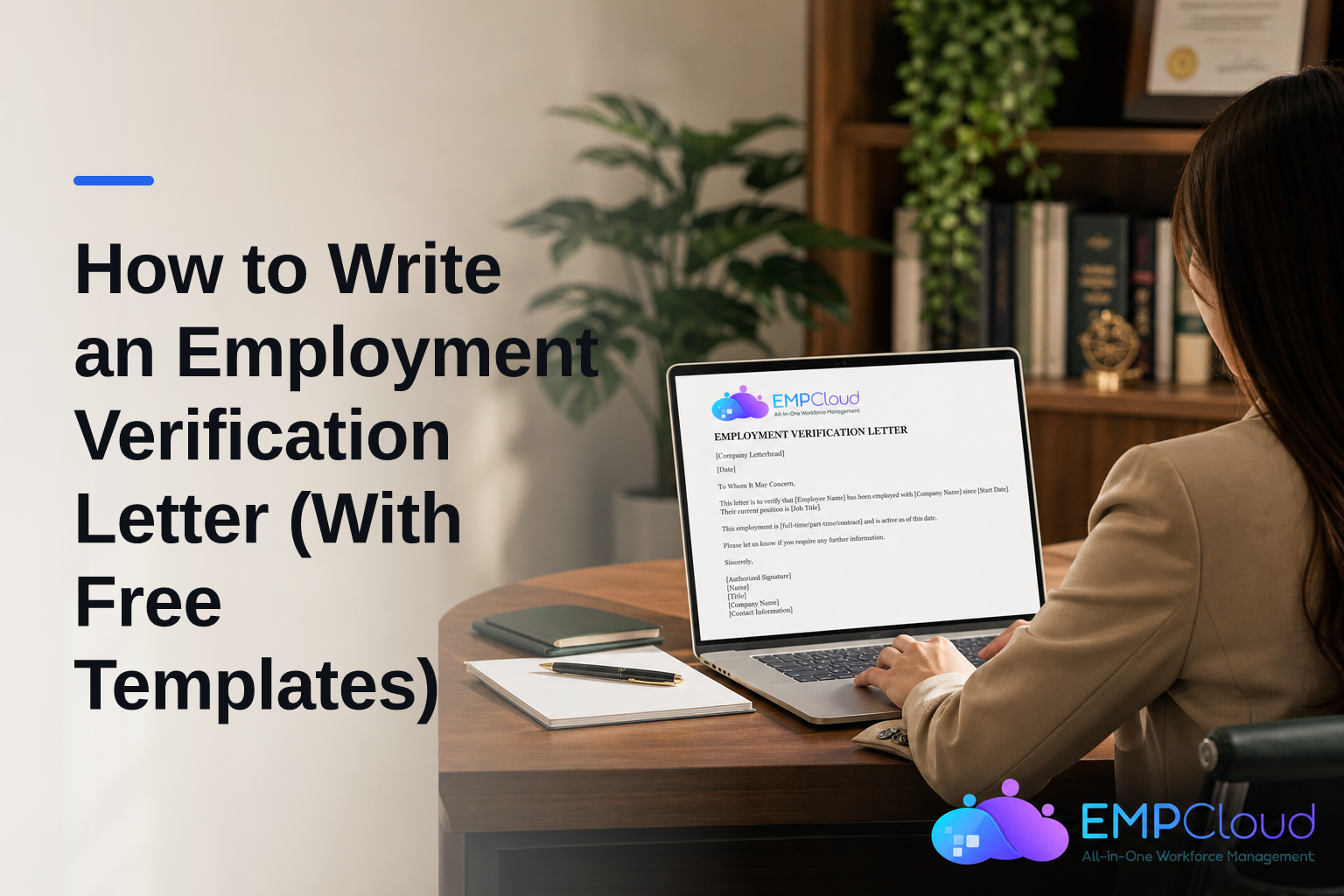
Basic Employment Verification Letter Template
Copy, paste, and customize on company letterhead:
[Company Letterhead]

[Date]

[Recipient Name]
[Organization]
[Address]
[City, State ZIP]

Re: Employment Verification for [Employee Full Name]

To Whom It May Concern,

This letter confirms that [Employee Full Name] is/was employed by [Company Name] as a [Job Title] from [Start Date] to [End Date or “present”]. Their employment status is [full-time/part-time/contract].

[If authorized:] Their current/base salary is [$X per year/hour], paid [frequency], excluding variable compensation.

If you need more information, please contact me at [Your Work Email] or [Your Direct Phone].

Sincerely,

[Your Name]
[Your Title]
[Company Name]
[Company Address]
How to Write an Employment Verification Letter: Step-by-Step
Follow these seven steps to draft a letter that gets accepted on the first pass. For each step, keep your facts precise and your tone neutral.
In addition, confirm salary disclosure in writing before you include it.
- Use company letterhead
- Print or export the letter on official letterhead (logo, address, phone, website). This proves authenticity.
- Date and recipient info
- Add the date and the requester’s name, organization, and mailing address or email. Therefore, the letter is traceable.
- Employee details
- Include full legal name and, if needed, the last four digits of SSN or employee ID when the requester provides that requirement.
- Employment dates and title
- State start date and, if applicable, end date. Then add the exact job title and employment status (full-time/part-time/contract/intern).
- Salary info (if authorized)
- Add base pay, pay frequency, and currency only with written consent from the employee. Do not include bonuses unless the requester requires them and the employee approves.
- Closing statement
- Offer a concise confirmation, such as “This letter is provided at the request of the employee for verification purposes.
- Signature and contact
- Sign with wet ink or an accepted e-signature, include your printed name, title, work email, phone, and company address.
Tip: Before you write employment verification letter content, ask the requester for their checklist or form. Matching their format avoids delays.

Copy-Paste Templates for Common Scenarios
Mortgage or Loan (income requested and authorized)
[Company Letterhead]
[Date]

[Loan Officer Name]
[Bank/Lender Name]
[Address]
[City, State ZIP]

Re: Verification of Employment, [Employee Full Name]

Dear [Loan Officer Name],

This letter confirms that [Employee Full Name] is employed by [Company Name] as a [Job Title]. Employment began on [Start Date] and is [ongoing/ended on End Date]. Status: [full-time/part-time].

With the employee’s written authorization, we confirm base pay of [$X per year/hour], paid [frequency]. This excludes variable compensation such as bonuses or commissions unless otherwise noted: [list or “none”].

Please contact me at [Work Email] or [Direct Phone] for any follow-up.

Sincerely,
[Your Name], [Title]
[Company Name]
Rental Application (no income disclosed)
[Company Letterhead]
[Date]

[Leasing Office or Landlord Name]
[Property Name]
[Address]
[City, State ZIP]

Re: Employment Verification, [Employee Full Name]

To Whom It May Concern,

[Employee Full Name] has been employed by [Company Name] since [Start Date] as a [Job Title]. Status: [full-time/part-time]. This letter confirms employment only and does not disclose compensation.

For verification, reach me at [Work Email] or [Direct Phone].

Sincerely,
[Your Name], [Title]
[Company Name]
Immigration (past employment)
[Company Letterhead]
[Date]

[Immigration Officer or Case Office]
[Agency or Consulate]
[Address]
[City, State ZIP]

Re: Employment Verification for [Applicant Full Name]

Dear Officer,

This letter confirms that [Applicant Full Name] was employed by [Company Name] as a [Job Title] from [Start Date] to [End Date]. Status during tenure: [full-time/part-time/contract]. Primary work location: [City, State/Country].

For any additional records, please contact [Work Email] or [Direct Phone].

Sincerely,
[Your Name], [Title]
[Company Name]
Also Read!
5 Common Employment Verification Letter Mistakes That Cause Rejections
First, including unauthorized salary data can violate privacy laws and company policy. Only disclose pay with written consent and a clear purpose. Moreover, under the GDPR Article 5 (data minimization), you should share only what’s necessary for the stated purpose. Even if you’re outside the EU, the principle is sound: least data, lowest risk.
Second, missing company letterhead makes the letter look unverified. As a result, underwriters and landlords may reject it at once. Always place your logo, address, and official contact details at the top.
Titles, Dates, and Contact Details
Third, vague or inflated job titles trigger extra checks. For example, “Engineer” vs. “Software Engineer II” can hold up a background report. Therefore, use the exact title in your HRIS or last offer letter.
Fourth, outdated employment dates create risk. A new employer or agency needs precise start and end dates. Incorrect dates may look like a misrepresentation, which can slow hiring or loan approval.
Fifth, no contact for follow-up is a dead end. Always include a direct work email and phone number. Furthermore, confirm that your voicemail and inbox can accept messages from external domains. A quick reply can be the difference between same-day approval and a one-week delay.
Quick Fixes Before You Send
- Get written salary disclosure consent from the employee.
- Match the exact job title and dates in your system.
- Place content on official letterhead and sign.
- Add a clear contact line and email.
- Save a PDF copy and file it in the employee record.
Tools and Resources for simplifying Employment Verification
You can reduce back-and-forth by using HR platforms that auto-generate verification letters from clean records. BambooHR, Gusto, and ADP can pull core fields like title, dates, and status into a letter template. As a result, you’ll spend less time hunting for details and more time confirming requests.
Tools like EmpCloud are another option if you also care about record security and exit workflows.
- full employee profiles, attendance, leave, and policy management
- Streamlined document handling for a paperless exit process
- Protected record management with centralized storage and encryption
- HRMS for employee management
In addition, EmpCloud is SOC 2 compliant and trusted by 1500+ businesses operating in 15+ countries while managing 50,000+ employees. That matters when letters include sensitive pay data and identity details. Therefore, using strong security and clear audit trails reduces risk and supports compliance in 2026 and beyond.
Finally, digital signature tools such as DocuSign or Adobe Acrobat Sign ensure authenticity and speed.
Confirm with the requester whether they accept e-signed PDFs or require wet signatures.
Verification Letter Tools: What to Check
- Can you lock templates so only authorized fields change?
- Do you store signed letters with version history?
- Can managers request HR to write employment verification letter drafts inside the same system?
What to Do After You've Written Your Verification Letter
- First, get the authorized signer’s approval. In many companies, HR or a designated officer must sign employment verifications. Therefore, confirm who is allowed to sign before you send the letter.
- Second, store a copy in the employee’s digital file. Use secured document storage with encryption so you can prove what was sent and when. Moreover, keep a log of the requester, the purpose, and the fields disclosed (especially if salary was included).
Intake, Self-Service, and Reviews
Third, set up a simple intake process for future requests. For example, create a shared inbox ([email protected]), a short request form, and a service-level target (e.g., 2 business days). As a result, you’ll reduce ad hoc requests to managers and keep control of sensitive disclosures.
Fourth, consider a self-service portal for current staff. With the right approval rules, employees can trigger a request and upload the lender’s or landlord’s form. In fact, that can cut cycle time from days to hours.
Fifth, review retention and compliance rules at least once a year. In 2026, more agencies and lenders accept e-signed letters, but they still expect accurate details and secure handling. Therefore, schedule a policy check each quarter to stay aligned with law and practice.
After You Write the Letter: Quick Checklist
- Signed by authorized person
- Saved as PDF in the HR file
- Logged requester and purpose
- Replied within SLA with a direct contact line
- Archived with encryption and access controls

Key Takeaways
- Use official letterhead, exact job title, dates, and a real contact; add salary only with written consent.
- Match the requester’s checklist. Therefore, you avoid delays and rework.
- Avoid five rejection triggers: unauthorized salary, no letterhead, vague titles, wrong dates, and no contact details.
- Tools can auto-fill letters from secure records. As a result, you ship faster with lower risk.
- Archive every letter in an encrypted system with an audit trail.
What to Do This Week
Draft a standard template on letterhead, get legal/privacy to approve salary wording, and publish a 2-step intake process for requests. Then add three scenario templates (loan, rental, immigration) to your HR drive, and run a 15-minute drill with your team to practice. By Friday, you’ll be able to write employment verification letter responses in minutes, not hours.
Quick Search Our Blogs
Type in keywords and get instant access to related blog posts.