The short answer is this: document issues, review contracts and local laws, communicate clearly in a private meeting, give written notice, pay what is owed on time, cut access that day, and finish offboarding with care. In 2026, doing this well protects both your team and your brand. The WARN Act in the U.S. requires 60 days’ notice for many mass layoffs by employers with 100+ employees. That single rule hints at how to handle termination employment right way: follow the law, keep records, and treat people with respect.
You might feel anxious if this is your first termination. The person leaving may be anxious too. Your goal is a fair, compliant, and dignified exit. With a plan, you can do that in one clean pass and avoid risk.

What Is Termination of Employment and When Does It Apply?
Termination of employment is the end of the work relationship between an employer and an employee. It can be voluntary or involuntary. From your seat as a manager, the label matters because it drives notice, pay, benefits, references, and legal exposure.
Voluntary termination happens when the employee resigns or retires. In most places, that means you confirm the last day, line up knowledge transfer, and arrange final pay. Involuntary termination happens when the company ends the employment. That could be for performance, misconduct, redundancy, or a reduction in force.
In at‑will systems, an employer can end employment for any lawful reason (not a protected one), with or without cause. For background, see this overview of at‑will employment. By contrast, “for cause” terminations rely on clear, documented reasons that meet policy or legal standards. In the UK and many EU countries, redundancy is a distinct legal category tied to job elimination, not the person’s performance.
Core legal terms you’ll hear
- Resignation: The employee leaves by choice; you confirm details and offboard.
- Layoff/Redundancy: The role is gone; rules on notice and severance may apply.
- At‑will: Lawful ends with or without stated cause (not for illegal reasons).
- For cause: Serious policy breach or gross misconduct that you can prove.
From the employee’s view, clarity, respect, and timely pay matter most. From your view, compliance, records, and security matter too. To handle termination employment right way, you need to match the reason to the right legal path, then follow it step by step.
Step-by-Step Guide to a Compliant Employee Termination Process
A fair process protects everyone. Use this simple flow to reduce risk and keep dignity high. These steps also help you keep pace with laws, contracts, and IT security on the same day.
- Document performance issues — Write dates, facts, coaching given, and outcomes. Keep emails and notes in the file.
- Review employment contract/local laws — Check notice terms, probation, severance triggers, and protected classes or leaves.
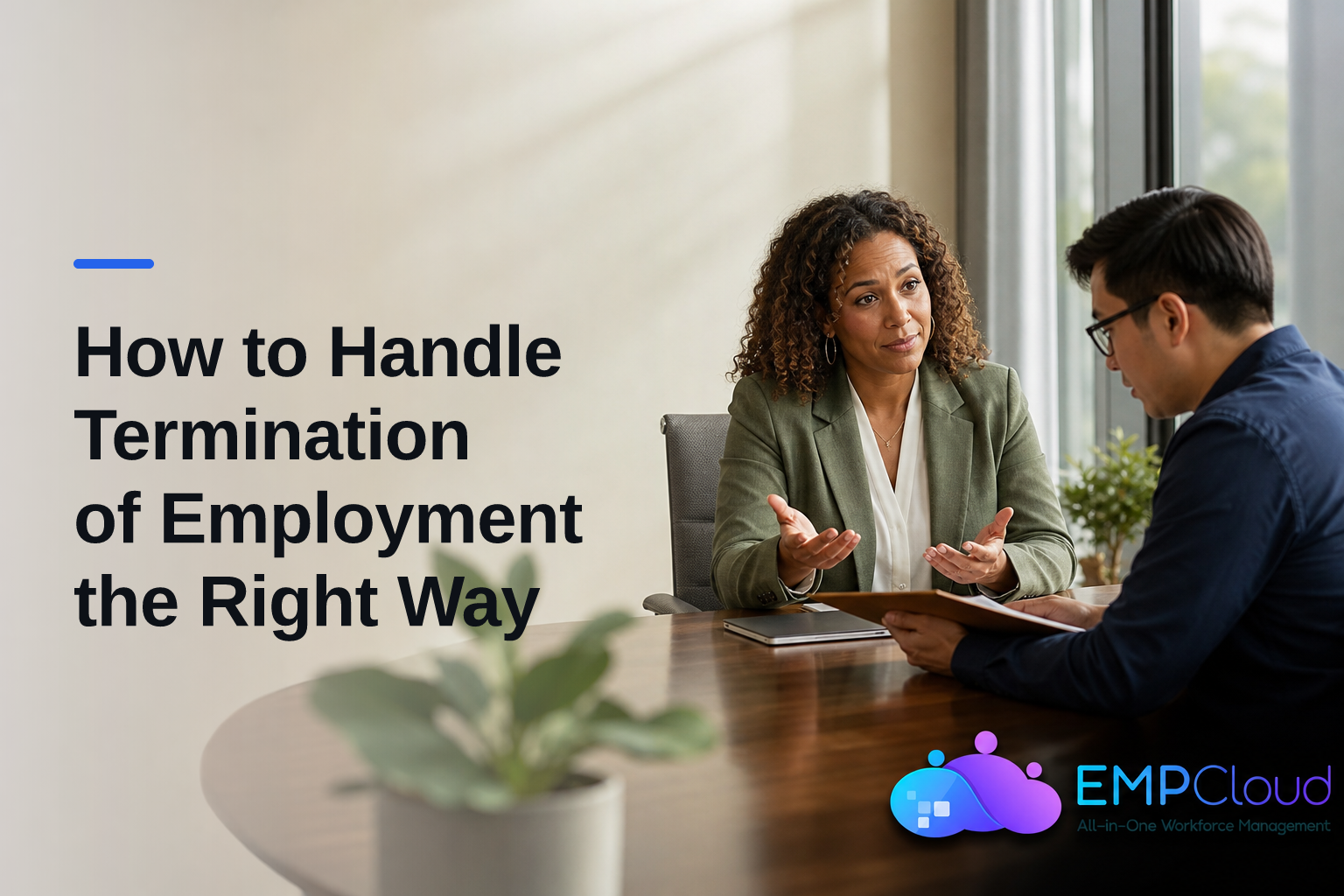
- Conduct the termination meeting — Meet in private with HR. Be brief, kind, and direct. Avoid debate. Offer next steps.
- Provide written notice — Hand a letter with the last day, reason (if required), any notice or pay in lieu.
- Calculate final pay and benefits — Include wages, unused leave per policy, benefits, and reimbursements with exact math.
- Revoke system access — End accounts, SSO, and badge access that day. Use automatic integration with IT.
- Manage knowledge transfer — List tasks, files, and handoffs. Track progress to close key gaps before the last day.
- Complete offboarding checklist — Collect assets, update records, and send COBRA/benefit info as required in your area.

As a result, your paperwork matches your decision, IT risk drops to near zero, and pay is clean. Moreover, following an exit checklist makes the process repeatable. Therefore, to handle termination employment right way every time, run this same list and log each step.
If you operate in the United States, confirm layoff notice duties under the WARN Act guidance.
Also Read!
Common Mistakes Employers Make When Terminating Employment
Rushing the exit is the fastest way to create risk. You can avoid most issues with a little prep and a same‑day close on pay and access.
Specifically, skipping documentation is the first trap. For example, firing after months of vague feedback invites a dispute. Without dates and details, you’ll struggle to show fair process. Moreover, timing matters. Ending someone’s role right after they raise a safety concern looks retaliatory, even if it’s not.
Red flags to avoid in 2026
- No documentation: “We talked about it” will not hold up. Keep dated notes.
- Missing notice: Failing to give legally required notice or pay in lieu can trigger fines.
- Bad final pay: Shorting unused leave or expenses risks wage claims and penalties.
- Late access cuts: A live account after exit is a data risk and a trust hit.
- No exit interview: You lose insights that could reduce future churn.
- Retaliatory timing: Ending soon after a complaint can be seen as payback.
In addition, managers miss simple coordination. Automated reminders and notifications for timely offboarding help you stay on track when you juggle HR, IT, and payroll. Furthermore, when you generate detailed offboarding reports, you can show auditors the exact times, people, and steps taken. To handle termination employment right way, treat timing, notice, and records as non‑negotiable.
Tools and Resources That Simplify Employee Offboarding
You can do this work with email and spreadsheets, but tools cut misses. Think in three layers. First, HRIS platforms store profiles, contracts, leave balances, and roles. Second, offboarding checklists guide steps, handoffs, and asset returns. Third, payroll tools handle final pay, taxes, and reimbursements with the right cutoff dates.
Choosing and connecting your stack
Tools like EmpCloud, Zoho, Keka, and BambooHR aim to reduce manual steps. EmpCloud offers automated integration for access revocation, final pay calculation, and offboarding reports. It also adds streamlined document handling for a paperless exit process, protected record management with centralized storage and encryption, and asset return management with smooth record‑keeping.
As social proof, EmpCloud is trusted by 1500+ businesses, operates in 15+ countries, and manages 50,000+ employees. As a security marker, it is SOC 2 compliant. There is also a Free tier available, which makes it easy to pilot a clean exit process.
On the other hand, if you already have an HRIS, you may only need an exit checklist app and IT ticket automations. However, if you’re building your stack in 2026, pick tools that connect HR, IT, and payroll out of the box. That way you handle termination employment right way with less swivel‑chair work.
What to Do After the Termination Is Complete
The exit meeting is not the end. You still have to stabilize the team, protect data, and learn from the experience. Therefore, plan a short, clear note to the group. Share how work will continue. Thank the person for their contributions if it’s appropriate and lawful in your area.
Update your org chart and systems the same day. Moreover, set owners for the departed person’s projects. As a result, customers and peers see continuity, not chaos.
In addition, finish records work. Store the letter, checklists, and handover notes in secured document storage with encryption. Keep records for your legal retention period.
Post‑exit checklist to keep you on track
- Reassign key tasks and update SLAs in writing.
- Close or transfer shared drives and calendars.
- Confirm asset returns and log serial numbers.
- Run exit data analysis: attrition trends, time to backfill, handover gaps.
- Generate detailed offboarding reports for leadership and audits.
Furthermore, schedule a retro with HR and IT. What slowed you down? Which steps worked well? If you keep tuning your process in 2026, you’ll handle termination employment right way with less stress next time.

Key Takeaways
- Plan, document, and follow the law. Then communicate with respect in a private, brief meeting.
- Give written notice, pay every dollar owed, and cut system access on the same day.
- Use checklists, automatic integrations, and reports to reduce misses and show compliance.
- Keep learning: store records securely and review exit data to improve the next offboarding.
What to Do This Week
Block two hours to build your exit checklist. Add steps for documentation, legal review, meeting, written notice, final pay, access, handover, and reports. Then do a dry run with HR and IT. If you want help turning that plan into clicks, start with a tool that links HR, payroll, and access in one place.
Create a free account now →
Quick Search Our Blogs
Type in keywords and get instant access to related blog posts.