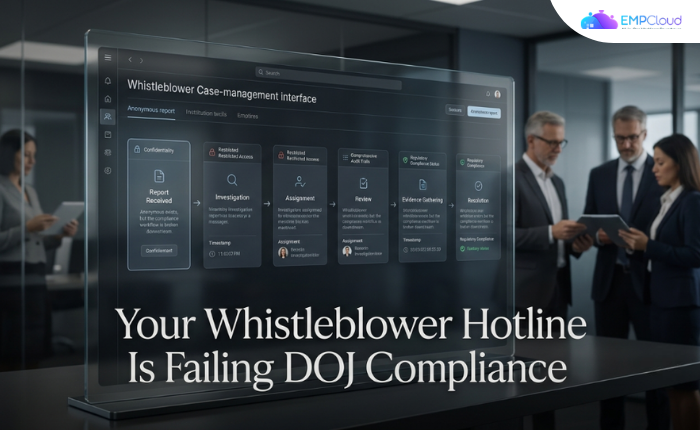
Ninety-three percent of employers now offer an anonymous reporting channel. Most of them are still failing whistleblower compliance — they just don’t know it yet.
Here’s what I’ve watched play out across organizations in fintech, telecom, and professional services: collecting reports is not the same as managing them. The moment a report lands in an unmanaged shared inbox — or worse, an email thread that HR forwards to a line manager — the entire compliance program collapses. Not metaphorically. Legally.
The DOJ’s Evaluation of Corporate Compliance Programs is unambiguous: a whistleblower system must be genuinely operational, demonstrably confidential, and traceable through resolution with a full audit trail showing reports moved, investigators were assigned, and outcomes were documented. A hotline that routes into an unmanaged inbox satisfies none of those requirements and removes your program from the DOJ’s leniency calculus entirely. That’s not a technicality. That’s the difference between a penalty and a settlement.
In a hurry? Listen to the blog instead!
Why the Gap Exists at All
The instinct to “just set up a form” is understandable. Procurement is under pressure. Compliance wants a checkbox ticked. Someone finds a SaaS tool, spins up an intake form, and declares the program live.
But intake is only the first three seconds of a much longer workflow. What happens after the report arrives is where compliance lives or dies — and that’s precisely where most programs go dark.
Three specific failure points appear repeatedly. First: confidentiality collapses at the investigation stage when case notes end up in shared drives or email threads that aren’t access-controlled. Second: there’s no chain of custody on the report itself — no timestamped, role-restricted access log covering who saw it, when, and what action was taken. SOC 2 and ISO 27001 both require exactly these logs as proof of data protection. Third: HR data lives in silos. When an investigator needs context — this employee’s attendance pattern, their recent performance review, whether they were passed over for a promotion three months ago — they’re manually cross-referencing systems that don’t talk to each other. That cross-referencing takes time, introduces human error, and in a confidential investigation, every additional person who touches a spreadsheet is a leak waiting to happen.
The Numbers Make the Problem Harder to Ignore
This isn’t a niche concern. NAVEX’s 2025 Whistleblowing & Incident Management Benchmark Report tracked 2.15 million reports across 4,077 organizations covering 69 million employees — with report volume at record levels for the second consecutive year. The SEC received approximately 27,000 whistleblower tips in FY 2025 alone.
Meanwhile, 55% of employees experienced or witnessed misconduct in 2025, a near seven-year high — yet 46% of those who did not report cited fear of retaliation as the reason (SHRM, 2025). That number tells you everything about the trust deficit beneath the surface of most compliance programs. Employees aren’t refusing to use the system because nothing is happening. They’re refusing because they don’t believe the system will protect them.
Employees who are aware of genuinely anonymous reporting options are 1.8x more likely to report misconduct. That uplift doesn’t come from the existence of a hotline. It comes from employees trusting that the hotline actually works.
What “Actually Works” Means Operationally
Three requirements. Non-negotiable.

1. The Report Moves — Visibly
Every stage of the report’s lifecycle needs to be logged: receipt, assignment, acknowledgment, investigation milestones, and closure. Not in a spreadsheet. In a system that stamps each action with a timestamp and an authenticated user ID. The FCA’s Q4 2025 whistleblowing data found that 281 reports contained 788 separate allegations — nearly three per report. A system that can’t track individual allegations within a single report can’t manage complexity at that level. Most generic compliance forms can’t.
2. Access Is Restricted and Logged
Confidentiality doesn’t mean “only HR can see it.” It means only the specific individuals authorised for a specific report can see it, and every access event is recorded. Role-based access control isn’t a nice-to-have here — it’s the technical mechanism that makes confidentiality provable. Without it, you cannot demonstrate to a regulator that the reporter’s identity was protected from anyone who might have a conflict of interest.
3. Context Is Available Without Breaking Confidentiality
This is the one most platforms get wrong. Investigators need context: tenure, department, attendance history, performance patterns, reporting relationships. Pulling that context manually from separate systems expands the circle of people who know a report exists. The solution isn’t to restrict context — it’s to make context available within the same controlled environment as the report itself.
Where an Integrated HRMS Changes the Equation

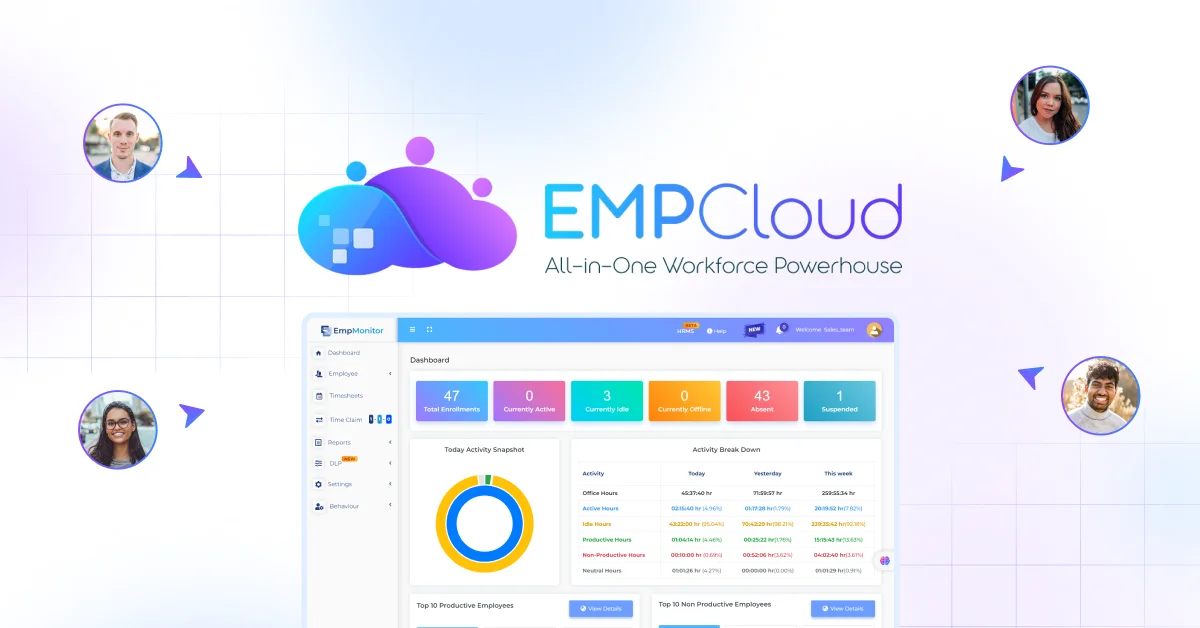
This is where the architecture of an HRMS matters more than the feature checklist. EMPCloud‘s AI agent includes a Feedback Stream tool that tracks whistleblower reports confidentially. Because it sits inside the same platform as attendance, payroll, performance, and project data, investigators can pull contextual information without ever leaving the controlled environment or expanding the access circle.
The Smart SQL natural-language analytics tool means an investigator can ask, in plain English, for attendance patterns or performance history on a team — without involving an analyst or exporting data to an unsecured environment. The OAuth2/OIDC authorization layer with RBAC and multi-tenant isolation means that access to case data is role-restricted by design, not by policy memo. Those are meaningfully different things when a regulator asks for your access logs.
For a deeper look at how HR data gaps compound risk across the employee lifecycle, the pattern is consistent: siloed data is always the first thing that makes a compliance failure worse than it had to be.
The AI Chatbot Angle Nobody Is Acting On Yet
A 2025 report from Case IQ — AI and Whistleblowing: Through the Employee Lens — found that while phone remains a top reporting channel, AI chatbots rank as a close second in employee comfort scores. Channel preference is part of trust. If your only anonymous option is a phone line staffed during business hours, you are self-selecting for a narrow subset of reporters and a narrow subset of misconduct types.
The practical implication: your whistleblower program needs to meet employees where they are, in the channel they trust, at the time they’re ready to report. An AI-assisted intake option doesn’t replace human review. It provides the always-on, low-friction entry point that converts the moment of willingness into an actual report before that moment passes.
The IRS Timeline Is a Warning, Not a Benchmark
The IRS admits its whistleblower award processes average over 10 years to resolve. That number circulates as a curiosity. It should circulate as a warning. It’s what happens when a reporting system isn’t built for case management at scale.
Your internal program can’t afford a 10-year resolution timeline. Reporters lose faith. Witnesses move on. Evidence degrades. And if a regulator examines the program, a case sitting unactioned in an inbox for months isn’t a compliance program — it’s documentation of non-compliance.
The Practical Checklist Before Your Next Compliance Review
- Map every touchpoint after intake. Who touches the report? In what system? With what access controls? If the answer involves email at any stage, that stage is a liability.
- Verify your access logs are timestamped and role-restricted. Not just “HR only.” Specific roles, specific individuals, specific reports — and every access event recorded.
- Test the context problem. Ask an investigator how they would pull contextual HR data for an active case without the request passing through someone who might have a conflict. If the answer involves a second system or a manual export, the architecture isn’t working.
- Check your channel coverage. Web form, AI chat, phone — at minimum. Employees who won’t pick up a phone may readily use an AI interface. The channel mix determines who reports and who stays silent.
- Document the full lifecycle for a closed case. Can you produce, on demand, a complete audit trail from receipt to resolution with timestamps, assigned investigators, and documented outcomes? If not, the DOJ framework is already telling you what comes next.
The compliance gap in whistleblowing isn’t a technology gap. It’s an architecture gap. Most programs were designed around intake and stopped thinking there. The regulation — and the actual risk — lives downstream. Closing that gap requires a system that treats the report as the beginning of a managed workflow, not the end of a form submission.
If your current setup doesn’t give you a clean answer to every item on that checklist, it’s worth seeing what a purpose-built, integrated platform can do. Start your free 15-day EMPCloud trial and see how the Feedback Stream tool and Smart SQL analytics work together inside a single access-controlled environment — before a regulator asks the questions you can’t currently answer.
FAQs: –
- What makes a whistleblower hotline DOJ compliant?
A DOJ-compliant whistleblower program needs more than anonymous reporting. It should provide confidentiality, restricted access, documented investigations, and a complete audit trail from report intake through resolution. - Why do whistleblower reporting systems fail DOJ scrutiny?
Common gaps include unmanaged email-based workflows, weak access controls, missing audit trails, and siloed HR data that makes confidential investigations difficult to manage. - How should companies protect whistleblower report confidentiality?
Companies should use role-based access controls, authenticated user IDs, timestamped access logs, and a controlled environment that limits report visibility to authorized investigators. - Can an HRMS help manage whistleblower investigations?
Yes. An integrated HRMS can connect confidential whistleblower cases with relevant employee data while maintaining role-based access, reducing manual exports and limiting unnecessary exposure of sensitive information. - What should HR check before a whistleblower compliance review?
HR should verify that every report has a documented lifecycle, access is restricted and logged, investigators can securely access relevant employee context, and closed cases have a complete audit trail.
Quick Search Our Blogs
Type in keywords and get instant access to related blog posts.