

Most payroll errors don’t happen when you run payroll. They happen three months earlier, when someone in finance decided to split an employee’s CTC a certain way—and nobody flagged that the structure would fail a statutory audit.
That’s the compliance trap. Payroll professionals consistently rank ensuring local compliance as their single biggest challenge—above automation, vendor management, and data quality combined. Annual changes in tax codes, PAYE and National Insurance bands, and statutory payments create a moving target that most HR teams audit too infrequently to track reliably. This isn’t a new problem people are solving. It’s a chronic one they’re managing badly.
Here’s what the compliance conversation usually misses: teams treat it as a filing problem—submit forms on time, remit deductions correctly. The real exposure sits earlier in the process, inside the salary structure itself.
Why Your Salary Structure Is a Hidden Liability

Take India. The New Labour Codes require that wages—basic pay plus dearness allowance—constitute the dominant share of total remuneration, with any excess allowances pulled back into the statutory base for PF and gratuity calculations. That single rule invalidates a decade’s worth of salary structuring strategy used across the subcontinent.
For years, the playbook was simple: keep basic pay low, load the package with allowances (HRA, conveyance, special allowance), and reduce the statutory base. It looked clean on a CTC sheet. Employees often preferred it because take-home went up. Finance liked it because employer contributions stayed down.
The new wage definition closes that gap. Any structure where basic plus DA falls below the statutory floor now carries a miscalculated base—and companies still running those structures accumulate a latent liability with every pay cycle. The problem isn’t that HR hasn’t heard about the codes. It’s that nobody has mapped which employees actually fail the test.
India is one example. Legislatures across Southeast Asia are introducing mandatory pay transparency and digital payslip requirements. Malaysia’s Employment Act amendments changed overtime calculation thresholds. The pace of regulatory change has outstripped the pace at which most HR teams audit their salary structures—and payroll compliance bodies confirm that keeping pace with local rules is getting harder, not easier.
The Three Checks Most HR Teams Skip
The gap isn’t usually ignorance of the law. It’s that compliance checks are event-driven—hire, promote, annual review—rather than continuous. Three structural checks tend to get skipped:
1. The Wage Composition Ratio Check
Every salary structure should be tested against the wage definition in every jurisdiction the employee is based in. This sounds obvious. In practice, it happens once at hire and then again never—unless there’s a promotion that changes the CTC. Employees who’ve received increments loaded into special allowances to avoid revising the basic slab are the ones most likely to fail a statutory audit. The fix is a quarterly ratio review, not an annual one.
2. The Allowance Recharacterisation Audit
When a jurisdiction’s law changes the definition of “wages,” some allowances that were legitimately excluded from the statutory base get pulled back in. Companies need a running map of which components feed which statutory calculation—not just a payslip template. Without it, a legal amendment triggers a cascade of manual recalculations that payroll teams have to run retroactively.
3. The Multi-Entity Divergence Check
For businesses operating across states or countries, the same job title can carry meaningfully different compliance requirements depending on where the employee sits. A regional sales lead in one state might face different overtime rules, different minimum wage floors, and different leave entitlement calculations than a counterpart in another. Running a single payroll configuration across all entities isn’t just a compliance risk—it’s a litigation risk if an employee ever challenges their entitlements.
Where the Payroll Chain Actually Breaks
Most payroll teams know their salary structures imperfectly because the data feeding payroll is itself imperfect. Time and attendance errors occur at a rate of 1,139 incidents per 1,000 employees—meaning the average organisation has more attendance errors than it has staff. Compliance calculations built on inaccurate attendance data compound the problem: you’re applying the right rule to the wrong number.
The structural issue is that attendance capture and payroll calculation often live on different platforms, with a manual handoff between them. Consider what this looks like for a telecom operator running a distributed field workforce: engineers log hours through a mobile app that has no live connection to the central HRMS. At payroll cut-off, someone must manually pull, format, and reconcile that data before salary calculations can begin. Under deadline pressure, that reconciliation is where clean data becomes dirty data. A field worker who clocked in via a mobile app disconnected from the central HRMS is invisible to payroll until someone manually reconciles the data—reconciliation almost never happens cleanly under deadline pressure. The compliance exposure isn’t a single dramatic failure. It’s dozens of small mismatches accumulating quietly across every pay cycle, in every region, until an audit makes them visible at once.
For environments like NBFCs, the stakes are categorically higher. In NBFC environments, where compliance precision is non-negotiable, self-reported hours create liability—that handoff risk isn’t an operational inconvenience, it’s a regulatory exposure. A pan-India NBFC with branch staff across multiple states needs to track minimum wage variations at the state level. It must manage PF and ESI applicability by headcount and salary thresholds. It has to monitor wage composition requirements simultaneously. That’s not a spreadsheet problem. It’s a systems problem.
What a Connected System Actually Changes

EMPCloud keeps attendance, leave, and payroll in the same platform rather than bridging separate tools. Face recognition biometric attendance feeds directly into the payroll workflow—no manual export, no CSV reconciliation, no opportunity for data to diverge between capture and calculation. The biometric event ties to a verified identity and writes to the same data store payroll reads from, removing the export/import hand-off step entirely. For field workforces, geo-location tracking and activity monitoring fills the gap that a fixed biometric device can’t.
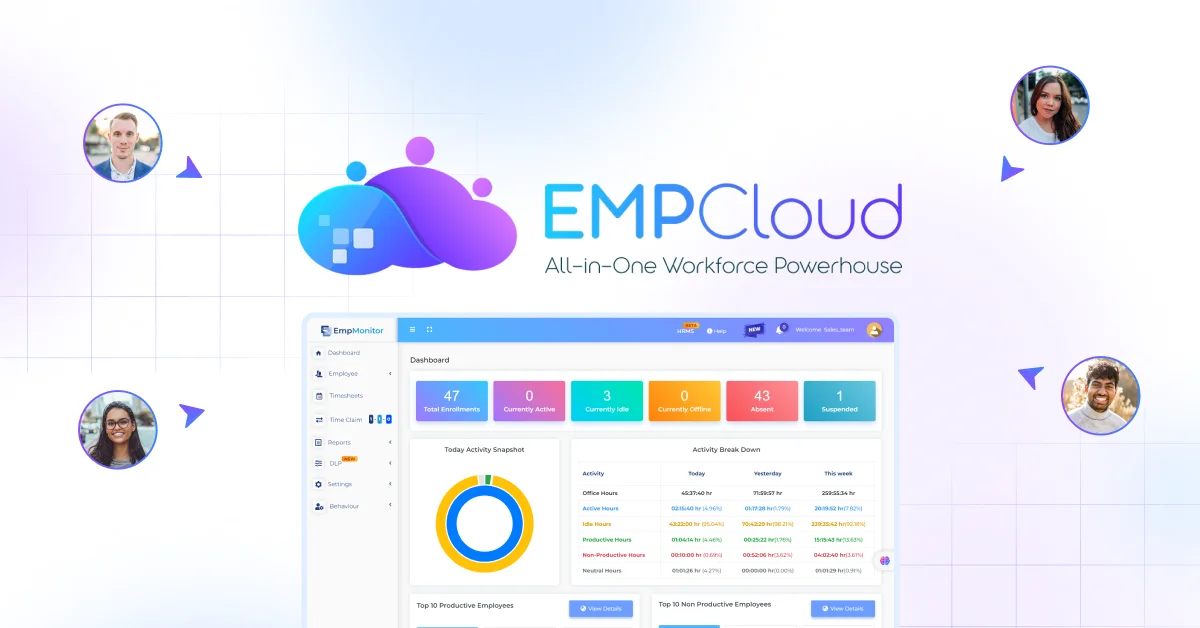
The compliance layer works the same way. Rather than maintaining a separate compliance calendar and manually updating payroll rules when legislation changes, the platform applies compliance updates as part of the payroll cycle itself. The six-step payroll chain—load records, sync attendance daily, run salary checks, apply compliance updates, create final payout, employees access payslips—is a closed loop, not a hand-to-hand relay race.
The AI layer adds something specific. EMPCloud runs 41 AI tools across 7 providers, spanning recruiting, payroll, attendance, performance, and learning modules. One of them—the Smart SQL natural-language analytics tool—lets HR query data across every module in plain English without writing a single line of SQL or raising an IT request. That matters most for ad hoc compliance checks, which are the ones that normally get deferred. A question like “Show me every employee where basic pay falls below the statutory wage floor” should return an answer in under thirty seconds. Without that capability, it’s a half-day data pull—which is exactly why the check keeps getting skipped.
Cross-module interrogation that used to require three separate reports now happens in a single conversation. Attendance, leave, payroll, and performance in one place means the compliance picture isn’t fragmented by which team owns which spreadsheet.
See how EMPCloud’s payroll workflow handles the full compliance chain end-to-end → our payroll software guide walks through what to look for in a connected system.
The Sector Question: Who Has the Most to Lose
Not all compliance failures carry the same consequence. In IT and telecom, the reputational and contractual risk of a payroll irregularity in a client-facing workforce is significant but usually manageable. In NBFCs, compliance failures can trigger regulatory scrutiny that touches the core business licence—the stakes are categorically different.
For startups scaling quickly, the compliance risk is different again—not because the rules are more complex, but because the team managing compliance hasn’t grown at the same rate as headcount. A 15-person company might have one person handling payroll alongside three other responsibilities. By the time they hit 80 employees across two states, the manual approach has structural cracks that no amount of effort can paper over.
A Practical Framework for Auditing Your Current Exposure
Running payroll manually or on disconnected systems? Do these five things before the next pay cycle:
- Map every salary component and classify it as either wage (feeds statutory base) or excluded. Do this for every jurisdiction you operate in, using the current legal definition—not the one from three years ago.
- Run the wage composition test for every employee. Flag anyone where basic plus DA falls below the statutory threshold for their jurisdiction. That’s your immediate liability list.
- Audit the attendance handoff. Where does attendance data enter the payroll system? Is it automated or manual? If manual, what’s the error rate? The five attendance data columns that determine whether a payroll run is clean are employee name, date, check-in time, check-out time, and leave category—a blank in any one is a silent error. Fixing the structure upstream is always cheaper than correcting payslips after the fact.
- Check your leave approval cut-off process. An absent employee whose leave wasn’t formally approved before the payroll cut-off gets coded as unpaid absent by default. That’s a correction that costs time every single cycle. Formalising the approval workflow eliminates the failure mode, not just the symptom.
- Set a quarterly compliance review cadence—not annual. Legislation in most jurisdictions now changes faster than annual review cycles can catch.
The payroll errors that create real problems aren’t usually the dramatic ones—a wrong bank account, a missed pay run. They’re the structural ones that run quietly for months or years before someone asks the right question. Understanding your full payroll management process end-to-end is the prerequisite for knowing where your exposure actually sits.
EMPCloud operates across 15+ countries, manages 50K+ employees, and serves 200+ companies. The compliance variation across that footprint is exactly why a connected, AI-assisted platform matters more than any single feature. Compliance isn’t a checkbox. It’s a continuous process—and it has to be treated like one.
Start your free 15-day EMPCloud trial and run your first compliance audit without needing to call a consultant.
Frequently Asked Questions
1. Why does your salary structure create payroll compliance risks?
A salary structure can create compliance risks when basic pay, allowances, and other components don’t align with statutory wage definitions. Even if payroll is processed correctly, an incorrect structure can create liabilities that accumulate over multiple pay cycles.
2. How do I know if my employees’ salary structures are compliant?
Start by checking the wage composition for every employee against the applicable statutory requirements. You should also review how allowances are classified and whether the same salary structure is being applied across jurisdictions with different compliance rules.
3. What salary components can affect payroll compliance?
Basic pay, dearness allowance, HRA, conveyance, special allowances, and other components can affect how the statutory wage base is calculated. Changes in wage definitions can also cause previously excluded allowances to become part of the statutory base.
4. Can inaccurate attendance data cause payroll compliance problems?
Yes. When attendance data is incomplete, inaccurate, or manually transferred into payroll, even the correct compliance rules can be applied to incorrect figures. Connecting attendance, leave, and payroll data can reduce these handoff errors.
5. How can HR teams continuously monitor salary structure compliance?
HR teams can move beyond annual compliance reviews by conducting quarterly checks on wage composition, allowance classification, attendance-to-payroll data, and differences across entities or jurisdictions. A connected payroll system can make these checks easier to run consistently.
Quick Search Our Blogs
Type in keywords and get instant access to related blog posts.