
The global average payroll accuracy rate is only 78%. Roughly one in five payroll runs contains an error serious enough to be noticed. And 18% of employees report experiencing payroll mistakes multiple times within a single year. Not once. Multiple times.
That number doesn’t come from negligent companies. It comes from companies that set up payroll correctly — once — and then assumed the job was done.
It isn’t.
In a hurry? Listen to the blog instead!
The Real Problem Isn’t Calculation. It’s Regulatory Drift.
Most HR leaders treat payroll compliance as a configuration task. You set up the tax tables, wire in the leave rules, confirm the statutory contribution rates, and move on. That logic made sense when regulations changed every budget cycle. It breaks completely now.
Between 2025 and 2026 alone, over 30 countries updated payroll, employment tax, or mandatory benefits rules — minimum wage increases, revised social contribution rates, new leave entitlements. These aren’t theoretical risks. Each is a live obligation that must be tracked and applied at the payroll level, not flagged in a legal newsletter and quietly forgotten.
Growing companies are especially exposed. At 40 employees, one HR manager can manually cross-check regulatory changes against the payroll setup. At 200 employees across three states or two countries, that same manual process is how you end up with a penalty notice instead of a clean audit. The headcount scaled. The compliance infrastructure didn’t.
Businesses using automated payroll systems report 70% fewer compliance issues and 31% fewer errors overall. That gap — between manual and automated compliance — widens every year regulators accelerate.
The Specific Mistake: Auditing Payroll in Isolation

Here’s what happens most often. A company invests in payroll software. Salaries go out on time. Then a quarterly audit reveals overtime miscalculations, incorrect leave deductions, or misclassified allowances. The payroll team is confused — the module was configured correctly.
The error wasn’t in payroll. It was in the data feeding payroll.
Attendance records with unresolved exceptions. Leave balances that weren’t synced after a policy change. Performance bonuses approved outside the system and entered manually. Each upstream error propagates invisibly into the payroll run. By the time the payslip is generated, the damage is done and the audit trail is fractured across three spreadsheets and two inbox threads.
This is why multi-state payroll errors so often trace back to attendance and leave data problems, not payroll logic itself. The calculation is fine. The inputs are wrong.
What a Cross-Module Compliance Workflow Actually Looks Like

EMPCloud is built on the premise that payroll accuracy is an upstream data problem, not a downstream calculation problem. The platform connects attendance, leave, performance, and payroll into a single data environment — so a discrepancy surfaces where it originates, not after it’s been baked into a salary figure.
Practically, that means a few things.
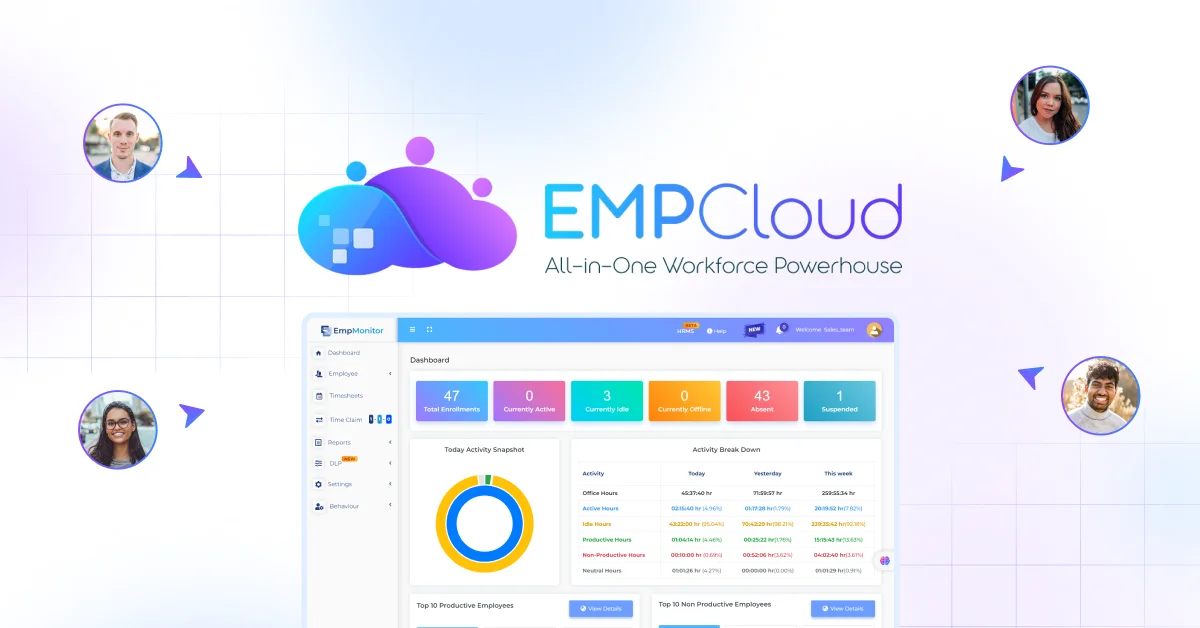
Face recognition biometric attendance tracking feeds directly into the payroll calculation cycle. No manual timesheet export, no CSV upload, no reconciliation step where attendance and payroll live in different systems and someone has to bridge them. The attendance record is the payroll input.
For field teams, geo-location tracking and activity monitoring serve the same function. A field sales rep’s attendance record isn’t dependent on badge swipes at a fixed location — it reflects actual movement and activity, which is what compliance actually requires.
Then there’s the audit question HR managers ask every quarter and spend too long answering. What does leave liability look like across departments? Are overtime patterns consistent with what payroll is disbursing? Is anyone’s attendance pattern an outlier that could signal a classification problem?
EMPCloud’s Smart SQL natural-language analytics tool lets you ask those questions in plain English — no SQL training, no BI tool, no waiting for a data analyst to write a query. You pull data from attendance, leave, payroll, and performance in a single conversation. The answer comes back in seconds, not in the next sprint cycle.
That’s not a convenience feature. It’s a compliance control. The faster you can interrogate your own data, the faster you catch drift before it becomes a penalty.
A Practical Pre-Payroll Audit Framework
Run this check before every payroll close — it takes less time than the remediation if you skip it.
- Attendance exception review. Any unresolved biometric exceptions or missing geo-check-ins from the pay period need to be adjudicated before payroll runs, not after. Unresolved exceptions default to the system’s fallback rule — and that fallback is often wrong for edge cases.
- Leave balance reconciliation. Confirm that leave approvals from the current period are reflected in the payroll input. Leave taken but not approved, or approved but not synced, produces overpayments and underpayments in roughly equal measure.
- Policy version check. If any statutory rate — minimum wage, overtime threshold, contribution ceiling — changed during the period, confirm the system’s configuration reflects the new rate. With regulatory velocity at its current pace, this should be a standing checklist item, not an annual task.
- Cross-module anomaly scan. Run a natural-language query across attendance and payroll data looking for employees whose pay-period hours and attendance records diverge beyond a threshold you define. Outliers aren’t always errors — but they’re always worth investigating before disbursement.
None of these steps require special technical skills if your HRMS surfaces them natively. They do require that attendance, leave, and payroll live in the same data environment — which is the architectural decision that most compliance failures trace back to when you dig far enough.
The Scale Question Nobody Asks Until It’s Urgent
EMPCloud manages 50,000+ employees across 200+ companies in 15+ countries. That range — from early-stage startups to multi-country corporations — is instructive. The compliance problem isn’t a large-company problem. It’s a scaling problem.
The moment a company adds a second payroll jurisdiction — a second state, a second country, a second employment classification — the manual compliance model starts to crack. Implementing a unified workforce management solution at that inflection point costs dramatically less than retrofitting one after a compliance failure.
The seat-based licensing model and multi-tenant isolation in EMPCloud’s architecture mean you’re not paying enterprise prices to solve a startup-scale problem. The platform grows with the headcount. The compliance infrastructure doesn’t need to be rebuilt at each stage.
For companies in sectors with heightened compliance exposure — NBFCs, telecom, IT — the case is sharper still. Regulatory requirements in those verticals aren’t stable, and audit consequences of payroll non-compliance tend to be more visible than in less scrutinized industries. Getting the data architecture right early is the lowest-cost compliance decision you’ll make.
Know Which Side of That Average You’re On
The 78% global accuracy figure is an average. It includes well-run HR teams with good tooling. It also includes companies running payroll on disconnected systems, reconciling attendance manually, and treating regulatory updates as someone else’s problem until an audit makes it theirs.
If you’ve never run a cross-module data audit — attendance against payroll, leave against disbursements — you don’t actually know which side of that average you’re on. Most companies that discover they’re below it find out from an auditor, not from their own systems.
For a deeper look at the patterns behind recurring payroll errors, the post on payroll management process and best practices covers the structural decisions that separate clean payroll runs from messy ones.
The free trial is 15 days. The first cross-module data audit you run inside a unified system — where attendance, leave, and payroll speak to each other without a human intermediary — tends to be clarifying. Start your free EMPCloud trial and find out where your compliance gaps actually live.
Quick Search Our Blogs
Type in keywords and get instant access to related blog posts.