Workplace friction is no longer an occasional fire to put out. It is a steady, rising pressure that most HR teams are managing with the same headcount they had five years ago. HR Acuity’s Tenth Annual Employee Relations Benchmark Study, released in 2026, puts a number on what many HR leaders already feel: employee relations case volumes have climbed to 145.5 issues per 1,000 employees, just short of the decade high, while discrimination, harassment, and retaliation allegations reached an all-time peak of 15.5 issues per 1,000 employees.
Part of this is coming from outside the office. Economic anxiety, political division, and an ongoing mental health strain are all spilling into daily workplace interactions, and HR teams are absorbing the fallout. At the same time, the employee engagement tools available to both employees and investigators have changed. Employees are increasingly using AI to write more detailed, more legally precise complaints, which means every case now demands a sharper, more defensible response from HR.
This shift means employee relations can no longer run on instinct, informal conversations, and whoever on the team happens to be free that week. It needs to run on a documented process, consistent data, and practices built for the way work actually happens now. Below are 15 updated practices that help HR employee relations teams move from reactive troubleshooting to a more predictable, evidence-based function.
What Are Employee Relations? The 2026 Definition
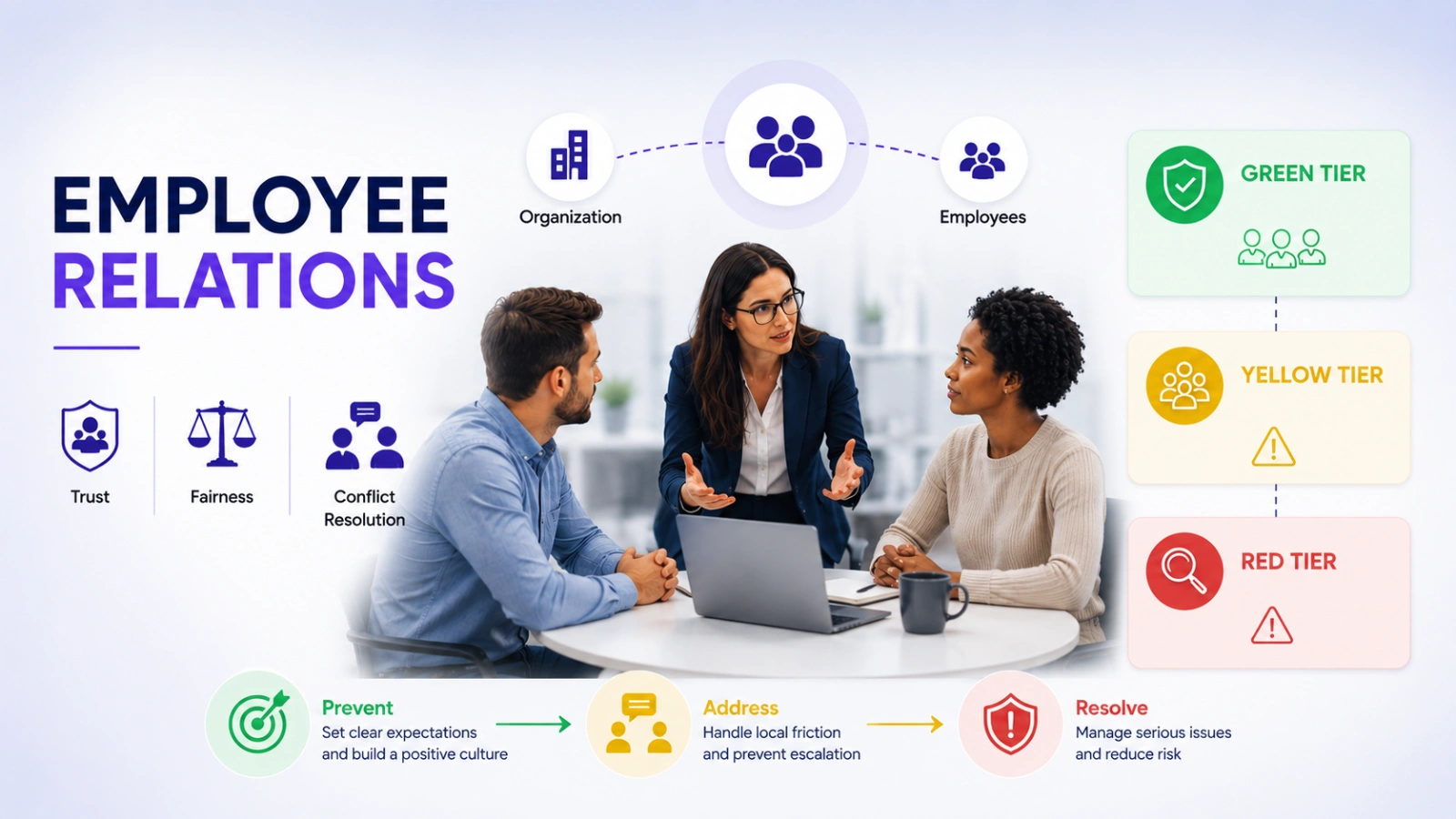
Employee relations is the part of HR responsible for managing the relationship between an organization and its employees, specifically the trust, fairness, and conflict resolution that keep that relationship functional. It covers everything from informal disagreements between coworkers to formal investigations into serious misconduct.
It helps to separate this from core HR.
Core HR runs the administrative lifecycle of employment: payroll, benefits enrollment, leave tracking, and compliance record-keeping.
Employee relations performance management, by contrast, deals with the friction points that show up once people are actually working together: unclear expectations, disputes, performance disagreements, and policy violations.
Where core HR keeps the system running, employee relations keeps the system trustworthy.
Most ER work falls into three tiers:
Green tier: setting clear, upfront expectations about behavior and culture, so fewer issues start in the first place
Yellow tier: handling localized friction such as leave-related tension, small disputes between coworkers, or performance gaps before they escalate
Red tier: managing full investigations, serious misconduct claims, and situations with real legal or compliance exposure
A mature ER function spends most of its energy in the green and yellow tiers. A stretched one spends most of its time firefighting in the red tier, which is exactly the pattern the 2026 data shows across the industry.
To better understand how employee feedback improves workplace performance, check out What Is Employee Feedback? Everything You Need to Know in 2026
Why Data Dictates Modern Employee Relations Management
For a long time, employee relations ran largely on judgment calls. A manager’s gut sense of a situation, a quiet conversation, a verbal warning. In 2026, that approach carries real legal risk. Regulators and courts increasingly expect organizations to show a documented, consistent process behind every employee relations decision, not just a reasonable-sounding explanation after the fact.
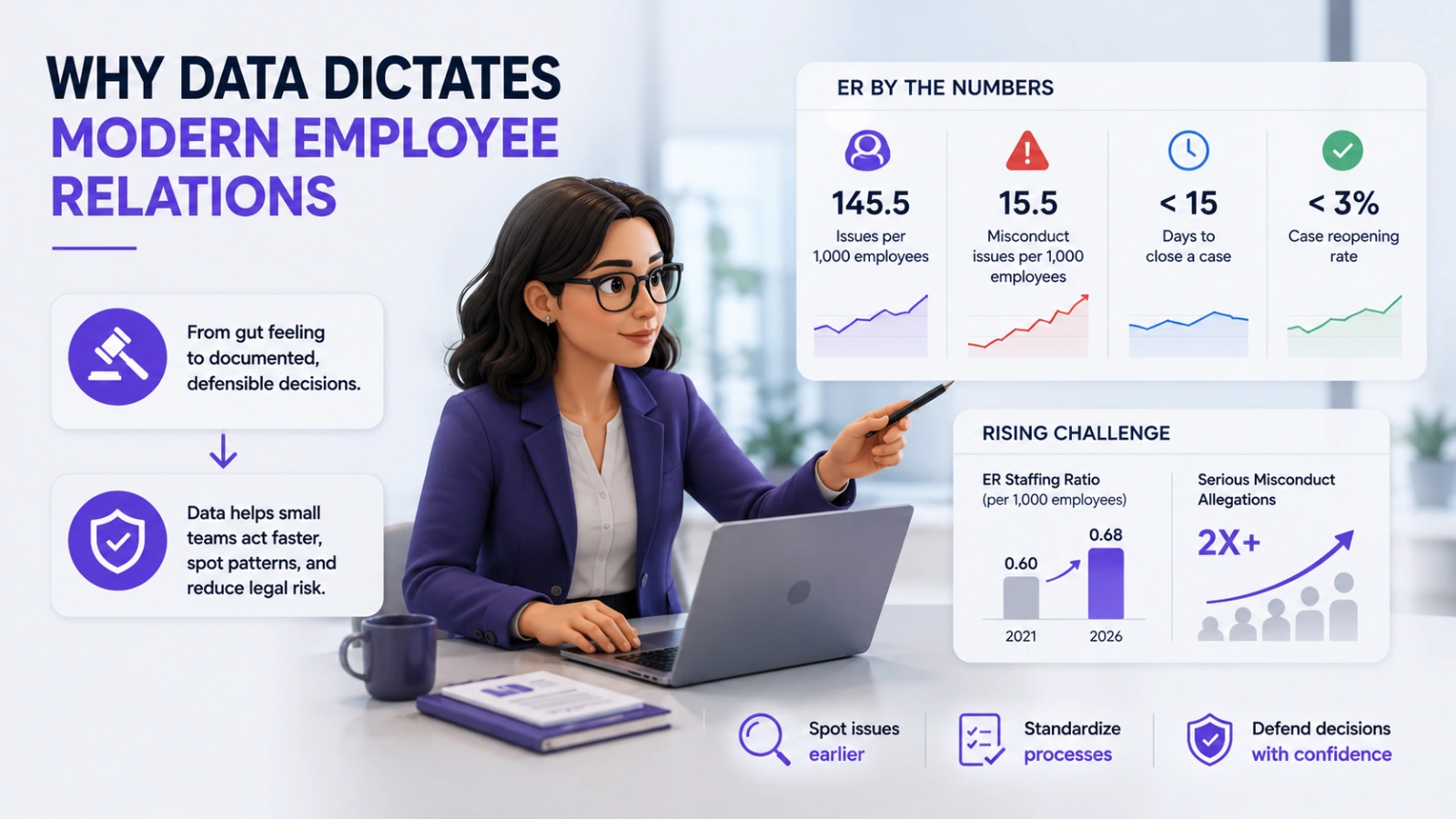
The staffing numbers make the challenge clearer. According to the HR Acuity benchmark study, the average employee relations staffing ratio has barely moved, edging from 0.6 to 0.68 professionals per 1,000 employees, even as serious misconduct allegations have more than doubled since 2021. Case volume and complexity are both rising while the people handling them are not. That gap is exactly what data and clear metrics are meant to close: they let a small team triage faster, spot patterns earlier, and defend their decisions later.
Here is a snapshot of where the benchmarks stand:
| Core Metric | 2026 Industry Benchmark | Why It Matters |
| Harassment/discrimination rate | 15.5 issues per 1,000 employees | Tracks systemic culture, health, and legal exposure |
| Average time to close a case | Under 15 days is considered optimal | Long cases wear down employee trust and psychological safety |
| Substantiation rate | Typically 16% to 24% | Rates well below 12% often signal a culture where people are afraid to speak up |
| Case reopening rate | Below 3% | Measures whether resolutions actually hold |
Source: HR Acuity Tenth Annual Employee Relations Benchmark Study, 2026
15 Best Practices for HR Employee Relations in 2026
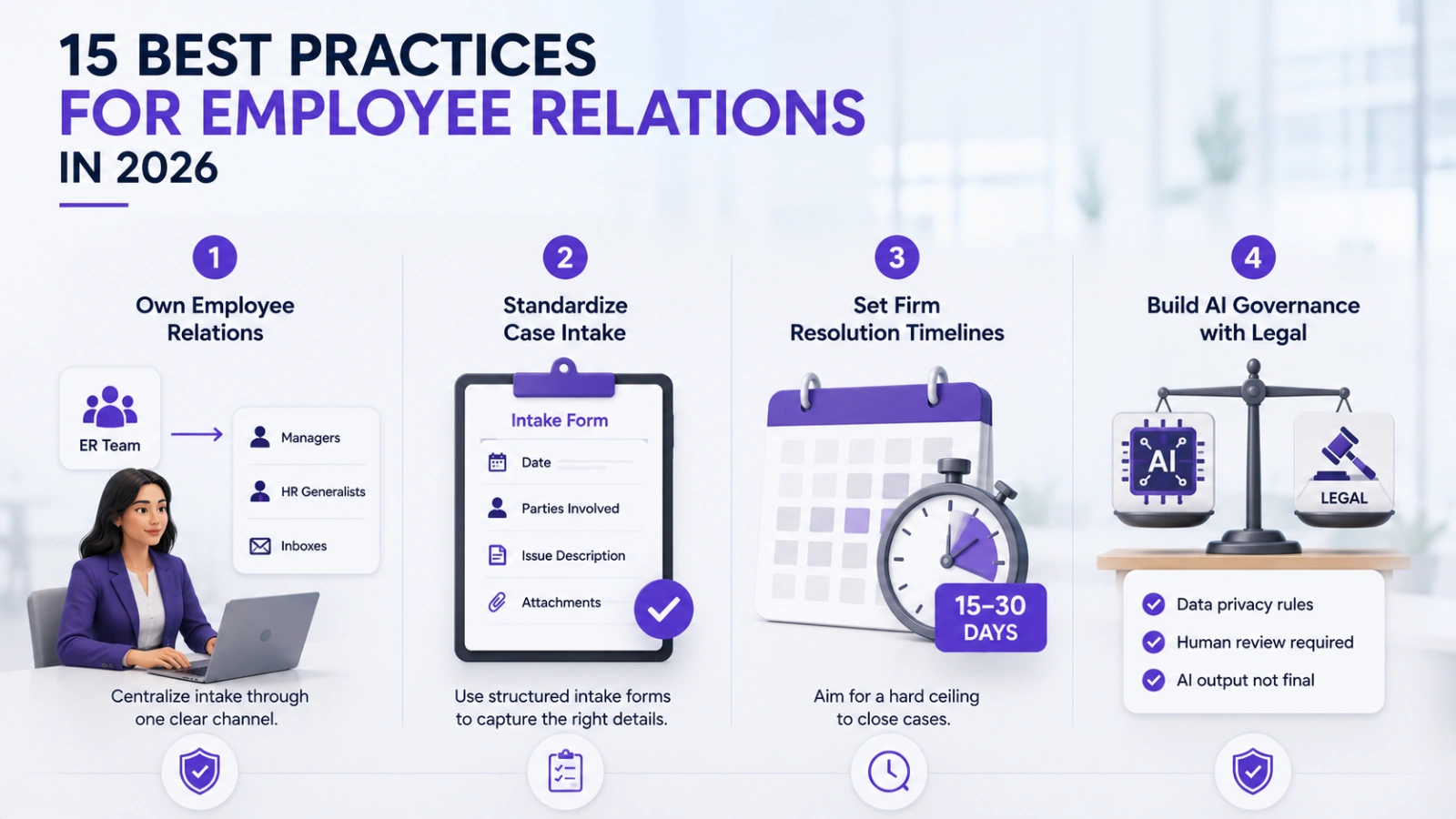
Infrastructure, Governance, and Compliance
- Set up employee relations as its own defined function, not a side task.
Centralize intake through one clear channel instead of letting complaints scatter across managers, HR generalists, and inboxes. When ER has its own defined lane, cases get routed correctly, and nothing falls through the cracks.
- Standardize case intake with required documentation fields.
Loose email threads and Slack messages do not hold up under legal scrutiny. Every case should start with the same structured intake form, capturing dates, parties involved, and a clear description of the issue, so nothing critical gets left out.
- Set firm resolution timelines.
Aim for a hard ceiling of 15 to 30 days per case. Investigations that drag on erode trust quickly, and employees start assuming the worst the longer a case sits open.
- Build AI governance rules together with legal.
With 70% of ER teams now using AI to draft reports or transcribe interviews, according to the HR Acuity study, organizations need clear rules on data privacy and a human reviewing every AI-assisted output before it becomes part of an official record.
Adapting to Modern Technical and Societal Shifts
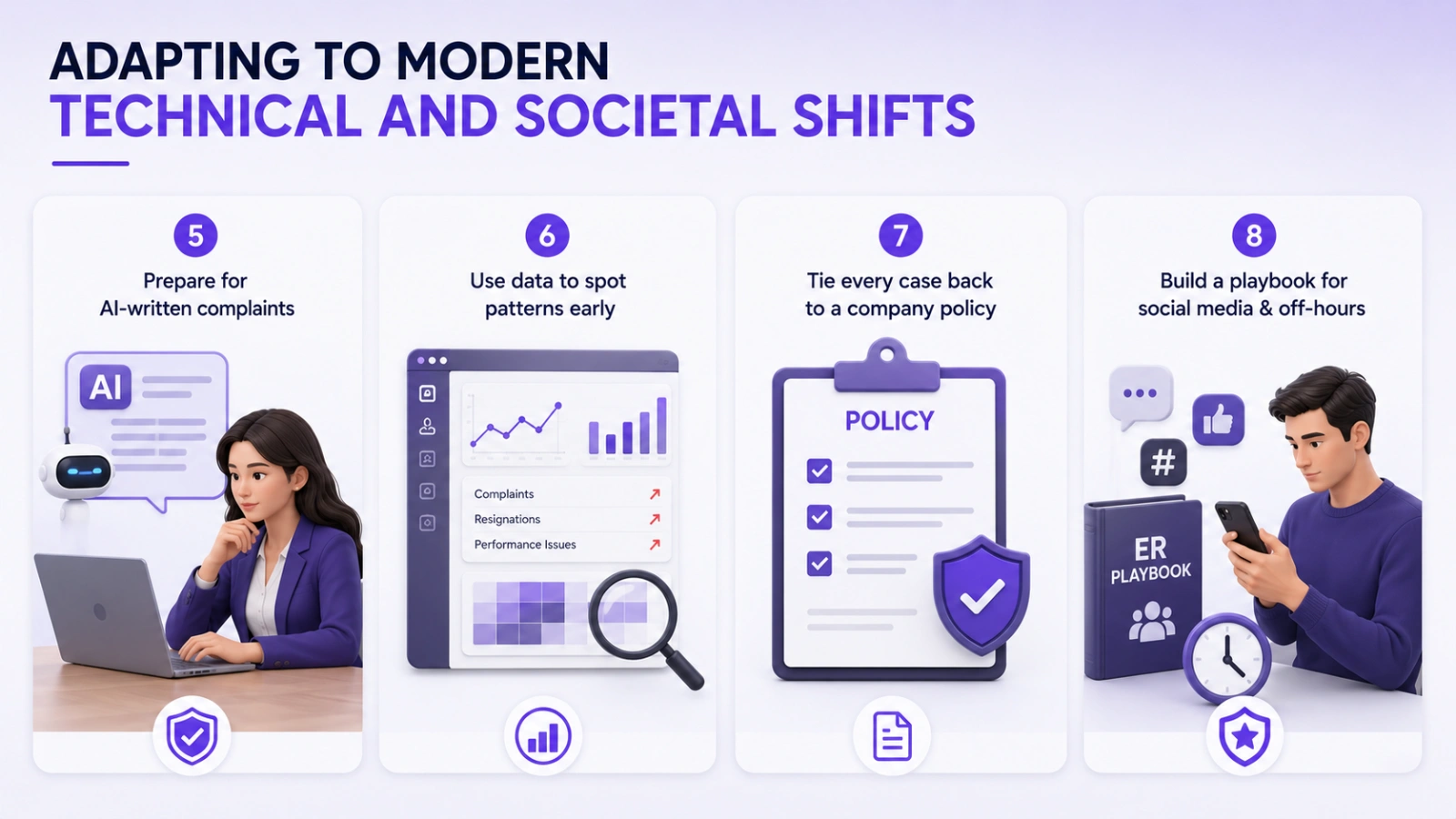
- Prepare for AI-written employee complaints.
Employees are increasingly turning to tools like ChatGPT to draft detailed, legally structured grievances. HR teams need objective, well-documented processes that can handle a dense, well-argued complaint just as rigorously as a short verbal one.
- Use employee relations data to spot patterns before they escalate.
Regularly reviewing case metrics by department or location can surface a spike in complaints, resignations, or performance issues before it turns into a bigger cultural problem or a wave of departures.
- Tie every closed case back to a specific company policy.
This does two things: it keeps investigations objective, and it shows you exactly which policies are vague, outdated, or inconsistently applied across the organization.
- Build a clear playbook for social media and off-hours incidents.
Cases tied to social media activity have roughly doubled since 2024. HR needs defined guidelines for when and how the organization responds to conduct that happens outside working hours but still affects the workplace.
Manager Enablement and Leadership Accountability
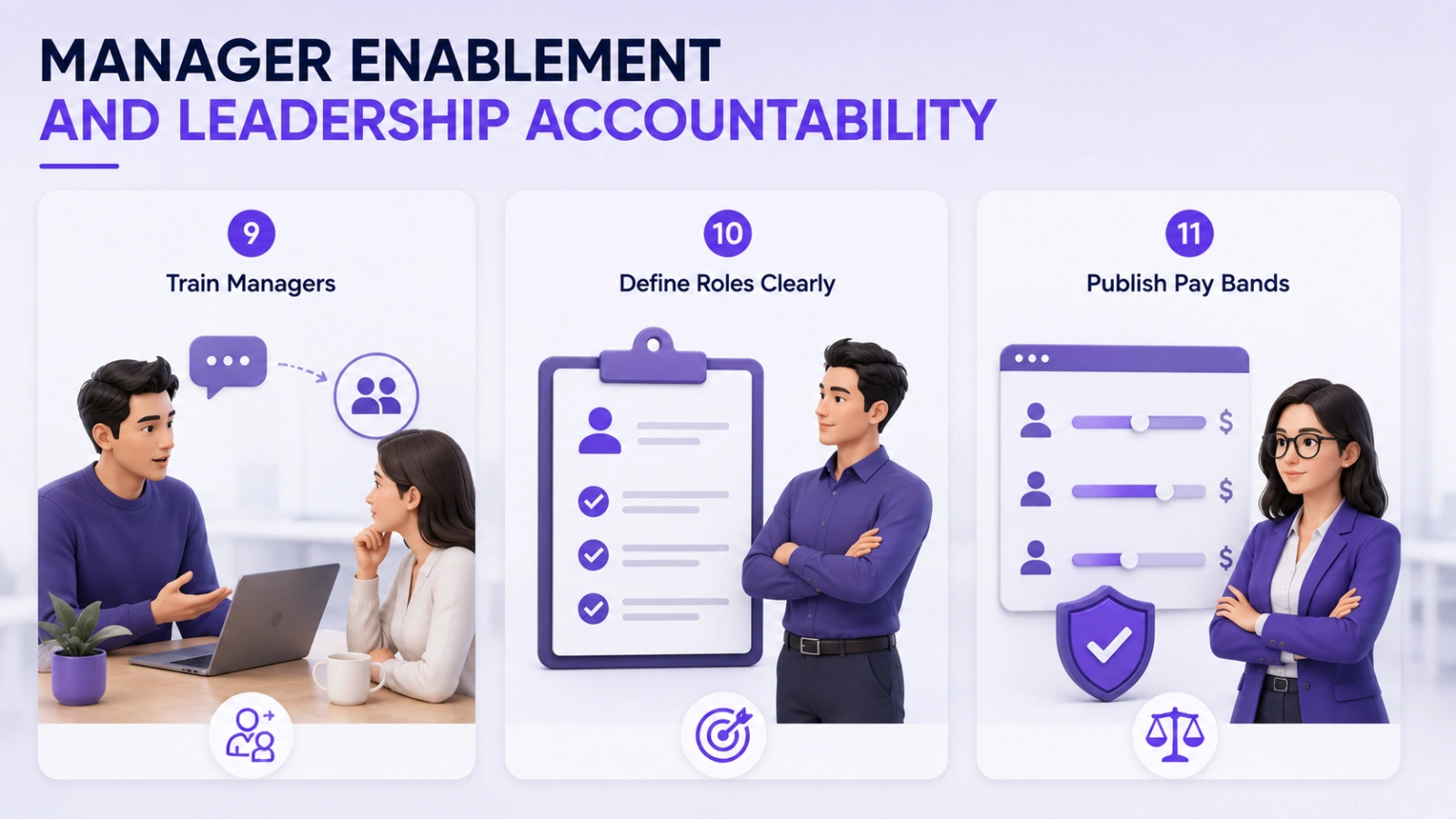
- Train managers to defuse issues early.
Give frontline managers basic conflict resolution skills so small misunderstandings get resolved on the spot instead of turning into formal HR cases weeks later.
- Build roles around clear capabilities, not vague responsibilities.
A large share of employee-manager friction comes down to overlapping duties and fuzzy performance expectations. Clear role definitions remove a lot of that friction before it starts.
- Publish clear, structured pay bands.
As pay transparency laws continue to expand globally, publishing internal salary ranges removes a major source of compensation-related disputes and rebuilds a layer of trust around fairness.
Choosing the right monitoring software starts here: Top Application Monitoring Tools to Watch in 2026
Psychological Safety and Structural Wellbeing
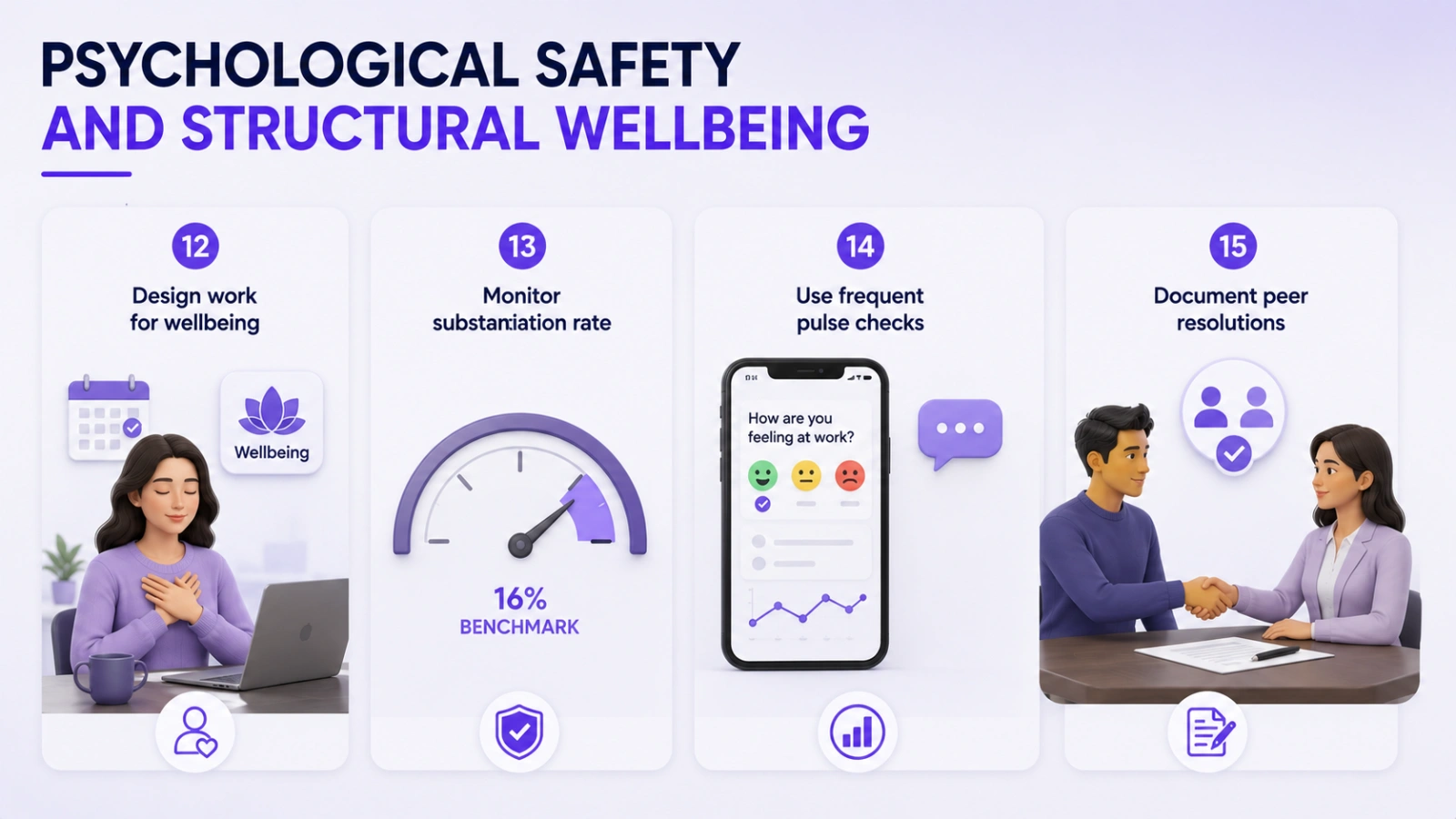
- Treat employee wellbeing as part of how work is designed, not a side program.
A wellness app does little if workloads and schedules are unsustainable. Real progress means redesigning workloads and building in actual recovery time, not just offering a subscription to a meditation app.
- Watch your substantiation rate closely.
If it drops well below the 16% benchmark, that is often a sign people are afraid to report issues in the first place, not that fewer issues exist.
- Replace annual surveys with short, frequent pulse checks.
A once-a-year engagement survey is too slow to catch problems while they are still manageable. Monthly or even more frequent micro-surveys give a much more current read on morale and friction.
- Put peer-to-peer resolutions in writing.
When two employees work out a dispute directly, document the agreed-upon next steps and have both parties sign off. A verbal handshake tends to unravel; a written agreement holds.
Selecting the Right Employee Relations Management Software
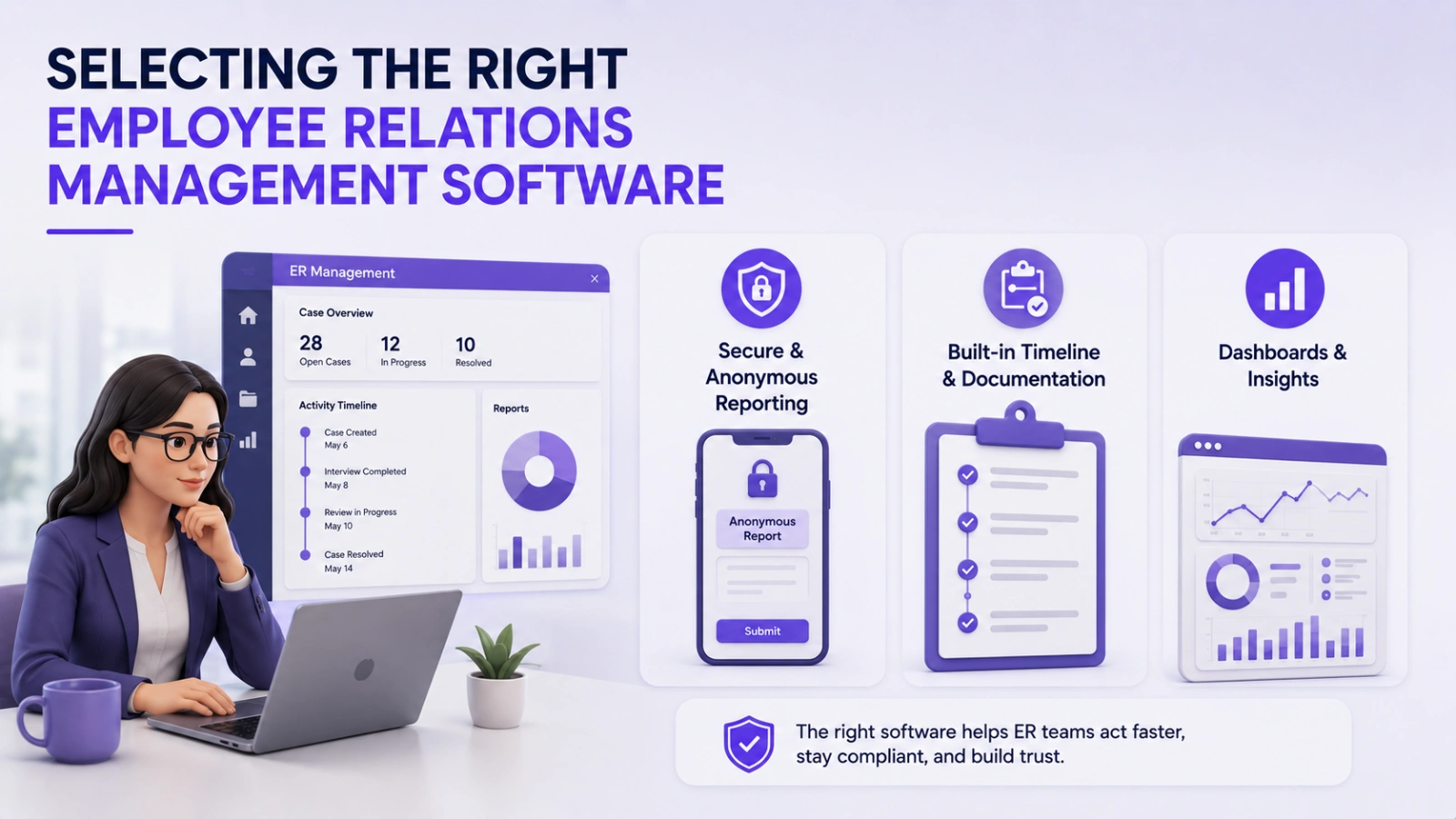
General HR platforms are built for the administrative side of the job: payroll runs, benefits enrollment, time-off requests. They are not built for the sensitivity and complexity of a live investigation, which is why so many ER teams end up needing dedicated case management software.
When evaluating a platform, prioritize a few things. Look for secure, encrypted channels for anonymous reporting, since a large share of serious issues never get raised if employees do not trust the reporting process. Look for built-in timeline and documentation tools that create a defensible record automatically instead of relying on someone to remember to log it. And look for dashboards that let you track metrics across departments and locations, so patterns surface before they turn into bigger problems.
What Is EmpCloud?
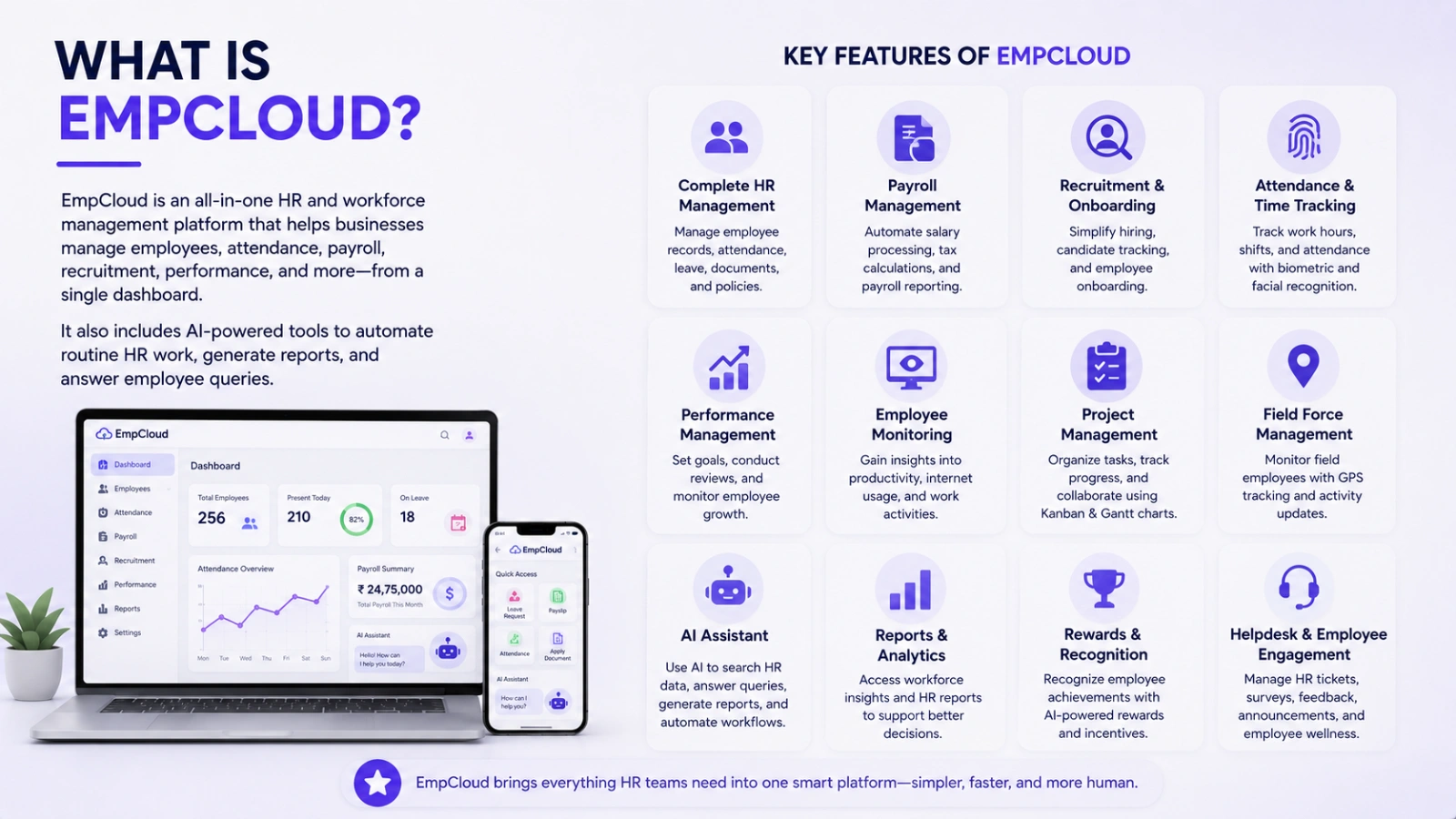
EmpCloud is an all-in-one HR and workforce management platform that helps businesses manage employees, attendance, payroll, recruitment, performance, and other HR tasks from a single dashboard. It also includes AI-powered tools to automate routine HR work, generate reports, and answer employee queries.
Key Features of EmpCloud
- Complete HR Management – Manage employee records, attendance, leave, documents, and company policies in one place.
- Payroll Management – Automate salary processing, tax calculations, and payroll reporting.
- Recruitment & Onboarding – Simplify hiring, candidate tracking, and employee onboarding.
- Attendance & Time Tracking – Track work hours, shifts, and attendance with biometric and facial recognition support.
- Performance Management – Set goals, conduct performance reviews, and monitor employee growth.
- Employee Monitoring – Gain insights into productivity analytics, internet usage, and work activities.
- Project Management – Organize tasks, track progress, and collaborate using Kanban boards and Gantt charts.
- Field Force Management – Monitor field employees with GPS tracking and activity updates.
- AI Assistant – Use AI to search HR data, answer employee questions, generate reports, and automate HR workflows.
- Reports & Analytics – Access workforce insights and HR reports to support better business decisions.
- Rewards & Recognition – Recognize employee achievements with AI-powered reward and incentive tools.
- Helpdesk & Employee Engagement – Manage HR support requests, surveys, employee feedback, announcements, and employee wellness.
This explanation is concise, easy to understand, and fits naturally into a comparison or “employee relations software” section of your blog.
Conclusion
Employee relations in 2026 is not a back-office function anymore. It is one of the clearest early-warning systems a company has for culture, risk, and retention. The organizations doing this well are not necessarily the ones with the biggest ER teams; they are the ones treating case data as a strategic asset instead of a filing cabinet.
FAQs
1. What are the most common employee relations issues in the workplace?
Some of the most common employee relations issues include workplace conflicts, communication breakdowns, harassment complaints, discrimination claims, absenteeism, performance disputes, policy violations, pay concerns, and manager-employee disagreements. Identifying these issues early helps organizations prevent larger workplace conflicts.
2. Who is responsible for employee relations in an organization?
Employee relations are typically managed by the HR department, but it is a shared responsibility. HR creates policies and handles investigations, while managers are responsible for maintaining healthy team relationships, resolving minor conflicts, and ensuring fair treatment of employees.
3. What skills are important for an employee relations manager?
An employee relations manager should have strong communication, conflict resolution, active listening, problem-solving, negotiation, investigation, employment law knowledge, and decision-making skills. They should also be able to remain objective while handling sensitive workplace situations.
4. How do you measure the success of an employee relations program?
Organizations can evaluate employee relations success by tracking indicators such as employee turnover, grievance frequency, absenteeism, engagement scores, conflict resolution time, employee satisfaction, retention rates, and internal promotion rates. Reviewing these metrics regularly helps identify areas for improvement.
Quick Search Our Blogs
Type in keywords and get instant access to related blog posts.