
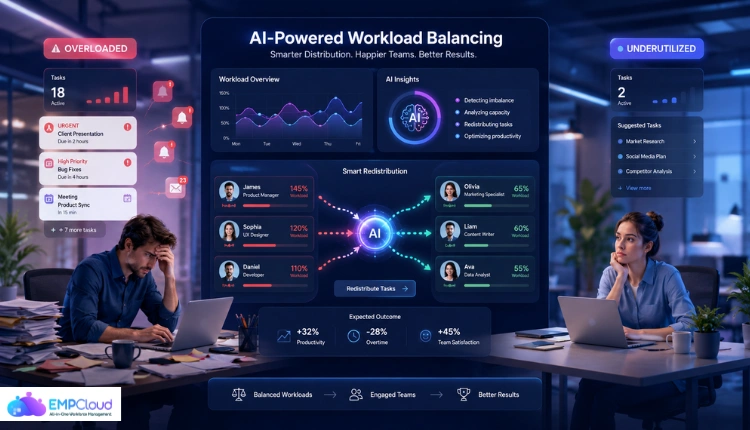
When the Work Pile Isn’t Shared Equally, Everyone Pays
Picture two people on the same team. One is buried – three deadlines this week, back-to-back meetings, and a growing list of “urgent” requests. The other is coasting, waiting for meaningful work that never quite arrives. Neither knows the other’s reality. And yet, somehow, both are disengaged.
Poor workload balancing doesn’t just burn people out. It quietly erodes morale, stalls output, and – eventually – pushes good employees toward the exit. This post breaks down the strategies that actually work and how to put them into motion.
Read Aloud!
What Is Workload Balancing?
Workload balancing is the ongoing process of distributing tasks and responsibilities across a team so no one is consistently overloaded while others sit underused. It’s not a one-time delegation decision. It’s a continuous practice that applies to individuals, teams, and cross-functional groups alike.
The keyword is ongoing. Assigning tasks isn’t the same as balancing workloads. One is a moment; the other is a system.
The Real Cost of Imbalanced Workloads (It’s More Than Burnout)
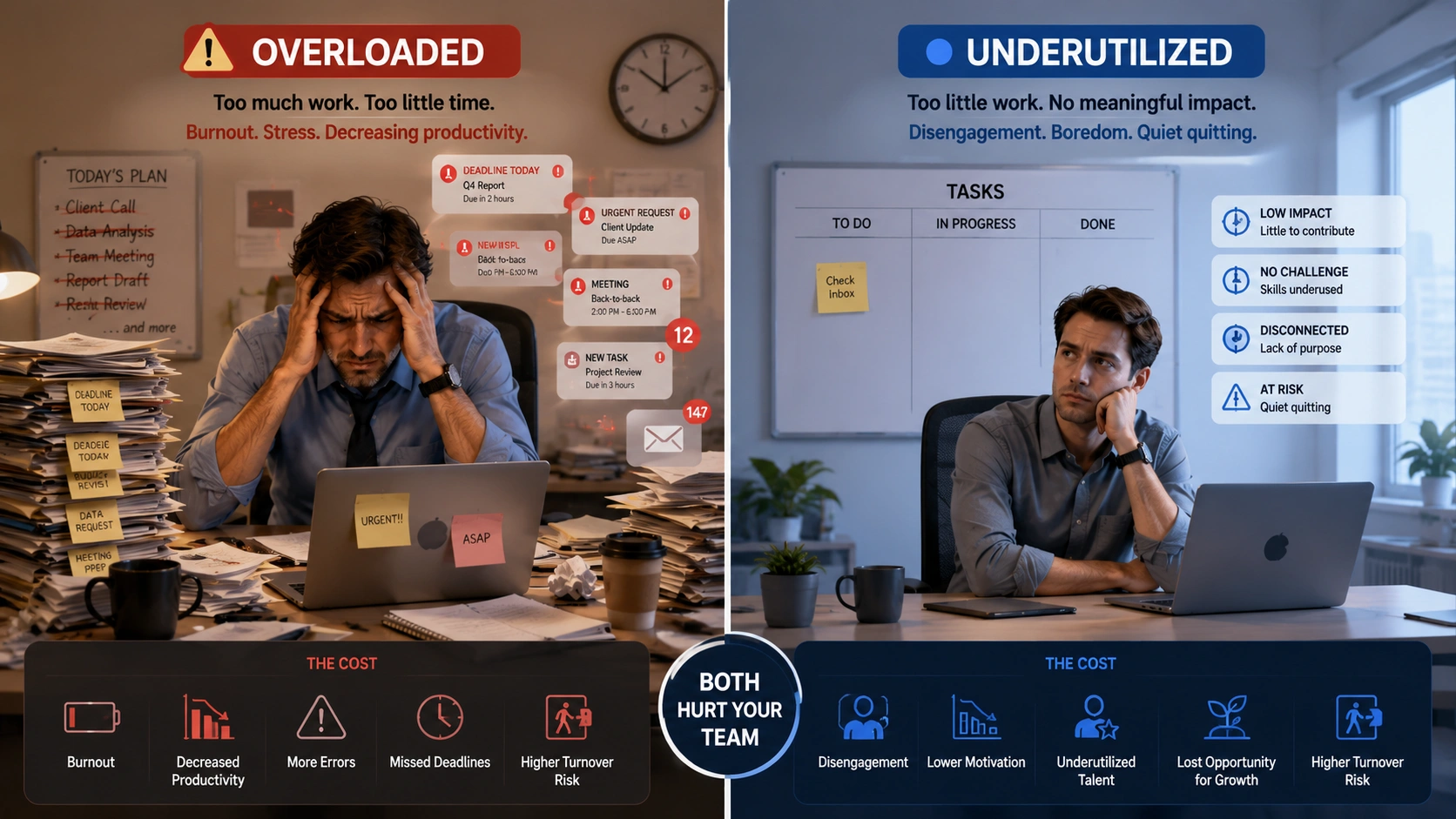
Burnout gets most of the attention – and fair enough. But the damage runs deeper than exhaustion.
When one person carries too much, decision fatigue sets in fast. Quality drops. Deadlines slip. And because overloaded employees rarely wave a flag, the problem compounds quietly until someone quits or breaks down.
According to Gallup research, disengagement and burnout are among the strongest predictors of turnover. But here’s what most conversations miss: the underutilized employee is equally at risk. Sitting idle isn’t relaxing – it breeds disconnection, a sense of irrelevance, and eventually, quiet quitting.
Imbalance also damages team trust. When people notice that the same colleagues always get crushed while others float, resentment follows. That’s not a culture problem. That’s a workload distribution problem wearing a cultural costume.
Workload Balancing Strategies That Actually Work
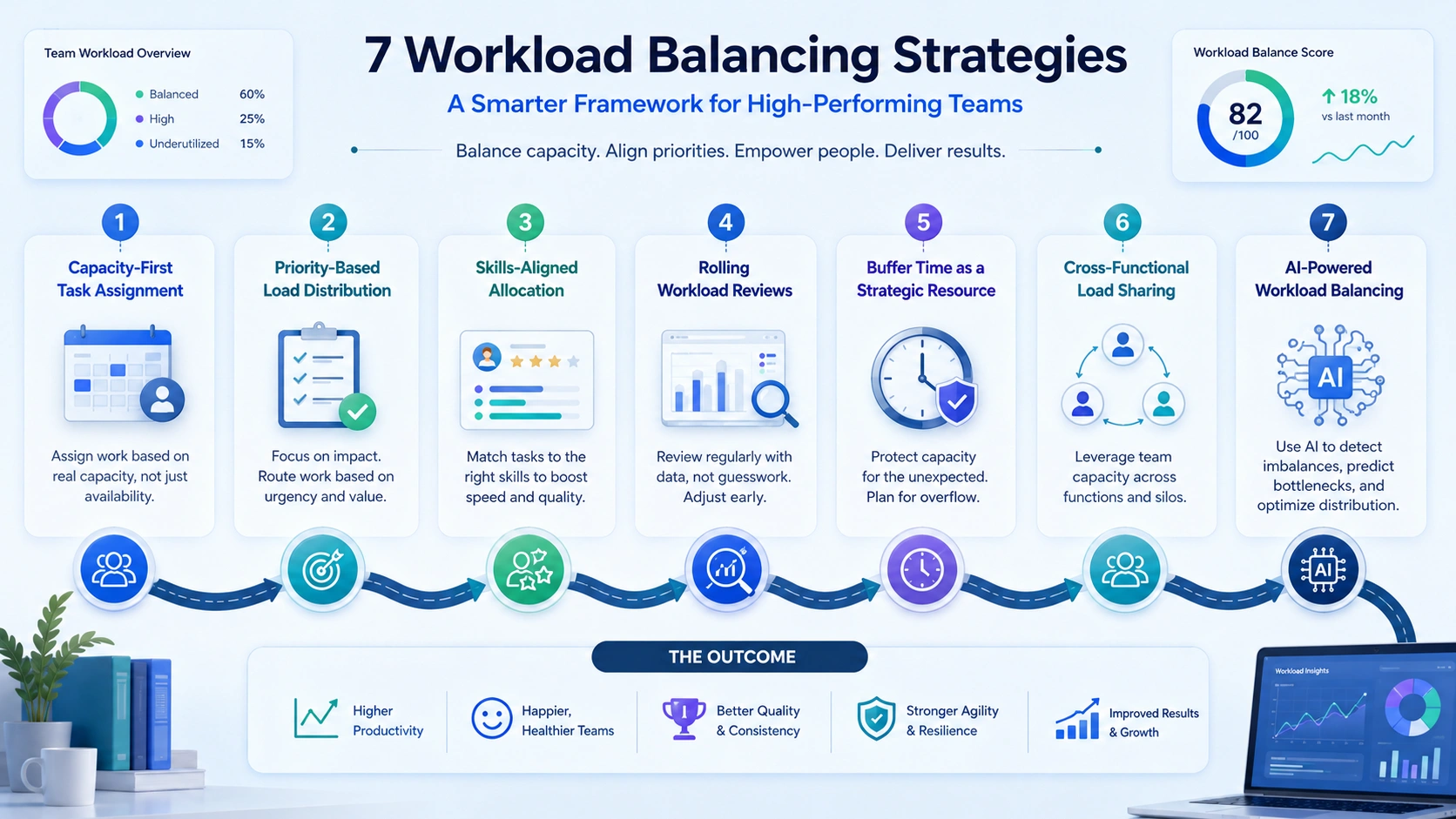
Capacity-First Task Assignment
Most managers assign work based on who’s available, not who actually has bandwidth. Those aren’t the same thing. A full calendar doesn’t mean someone is at capacity – and an empty calendar doesn’t mean they’re free.
Real capacity considers active task load, complexity of current work, and upcoming deadlines. Before assigning anything, ask: “What does this person’s week actually look like, not just their schedule?”
Priority-Based Load Distribution
Not all tasks are equal. An urgency-impact matrix (think Eisenhower grid) helps route work to the right people based on what actually matters – not just what landed in someone’s inbox first.
This also prevents a common pattern: high-performers absorbing every “important” task simply because they’ve proven they can handle pressure. That’s how top talent gets burned out while others remain unchallenged.
Skills-Aligned Allocation
Matching tasks to the right skills reduces completion time and cuts down on rework. It sounds obvious, but teams under pressure default to whoever is “available” rather than whoever is suited.
Cross-training matters here, too. When more people can handle a wider range of tasks, you have more flexibility to balance workloads without bottlenecking around a few specialists.
Rolling Workload Reviews
Weekly check-ins only work if they’re built around actual data – not just verbal status updates. What you want to track: task count, estimated complexity, current blockers, and whether anything has shifted in priority.
The goal isn’t another meeting. It’s a structured, brief review that surfaces imbalances before they become crises. Teams that do this consistently catch overload early, reassign proactively, and avoid the scramble that kills morale.
Buffer Time as a Strategic Resource
Teams that don’t plan for overflow always drown in it. Buffer time – deliberately protected capacity – isn’t wasted time. It’s what lets a team absorb the unexpected without collapsing.
Think of it less as “free time” and more as a shock absorber. A team running at 100% capacity is already one surprise away from falling behind.
Cross-Functional Load Sharing
Sometimes, an imbalance lives between teams, not within them. One department is slammed while another has capacity. Silos prevent that capacity from being used well.
Cross-functional load sharing – borrowing bandwidth across teams – works when there are clear ownership handoffs and enough process clarity to avoid confusion. Without that, well-intentioned help just creates new problems.
AI-Powered Workload Balancing
AI workload balancing tools represent a genuine shift in how teams can manage distribution. Rather than relying on gut feel or self-reporting, AI analyzes historical patterns, flags emerging bottlenecks, and surface workload trends that are nearly impossible to catch manually.
This isn’t about replacing managerial judgment. It’s about giving managers better information, faster. When you can see load patterns across a team in real time, redistribution becomes proactive rather than reactive.
How to Choose the Right Strategy for Your Team
No single strategy fits every team. Before picking an approach, answer three questions:
- Is the imbalance visible or invisible? If you have utilization data, task logs, or completion rates, you can measure them. If you’re going on gut feel and occasional complaints, start with rolling reviews to build visibility first.
- Is the problem structural or behavioral? Structural problems (unclear roles, poor processes, missing tools) need process fixes. Behavioral patterns (habits, assumptions, communication gaps) need culture and coaching interventions.
- What’s your team’s scale? Under 10 people? Capacity-first assignment and weekly reviews are usually enough. Larger, cross-functional teams need more systematic approaches – skills mapping, load-sharing protocols, and likely a workload balancing tool to manage complexity.
Map your answers and start with the strategy that addresses your most urgent constraint. Trying to implement all seven at once is its own form of overload.
Also Read!
How Do Time Management Methods Improve Productivity Today?
The Architecture of Attention: Reclaiming Productivity from Office Distractions
Mistakes That Make Workload Balancing Backfire
Even well-intentioned efforts fall apart in predictable ways.
Treating workload as task count. Ten simple tasks are not equal to two complex ones. Counting tasks without weighing complexity skews every assessment you make.
Balancing only after someone breaks. Reactive balancing is too late. By the time someone complains or resigns, the damage is done. Systems need to catch an imbalance early.
Over-relying on self-reporting. People underreport overload – especially high performers who don’t want to appear incapable. Self-reporting is a useful context, not reliable data.
Ignoring invisible work. Meetings, admin tasks, mentoring, and emotional labor don’t show up on project trackers. But they consume real time and real energy. Leave them out of the equation, and your workload picture is always incomplete.
Applying the same strategy to remote and in-office teams. Remote work shifts the visibility problem entirely. Async work, timezone gaps, and digital communication all change how imbalance shows up and how to address it.
How EmpCloud Makes Workload Balancing Smarter and Simpler
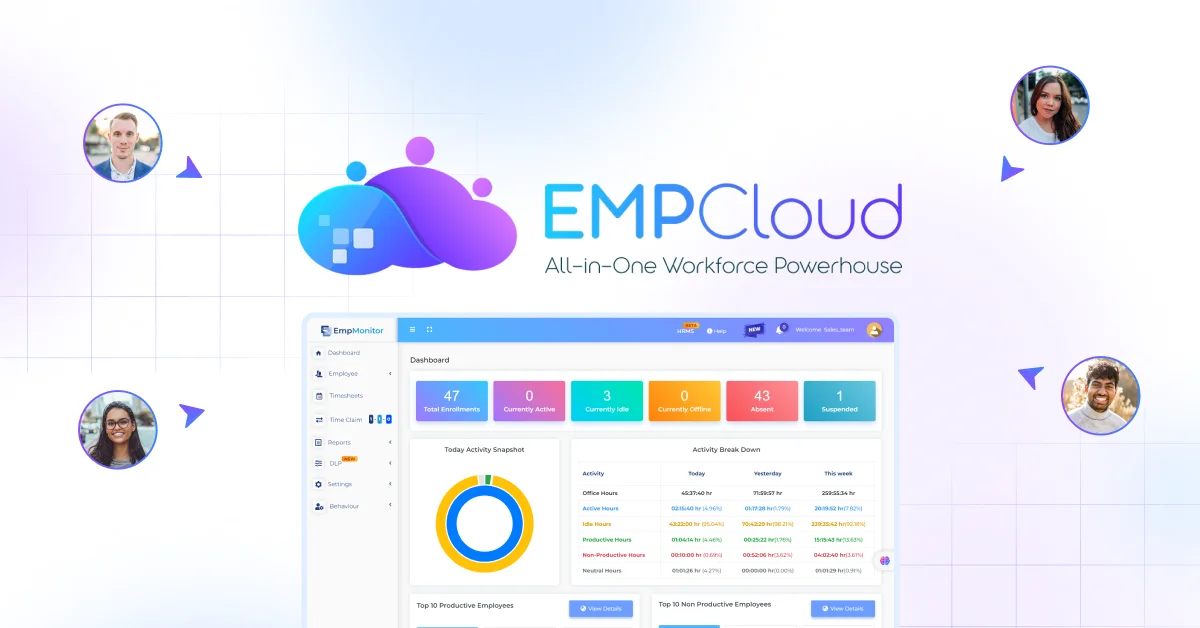
Managing workload manually works on a small scale. But as teams grow, the variables multiply, and the margin for error shrinks fast. That’s where EmpCloud earns its place.
EmpCloud is built specifically for the kind of complexity that makes workload balancing hard in practice:
- Real-time visibility into employee activity, productivity, and work patterns across teams
- Centralized dashboards that help managers monitor workloads and identify uneven task distribution
- Time tracking and attendance monitoring for better resource planning and capacity management
- Productivity insights that highlight where teams may be overloaded or underutilized
- Project and task tracking features that improve accountability and workload transparency
Instead of guessing who has bandwidth, EmpCloud gives you the data to know.
The Future of Workload Balancing: Where AI Changes Everything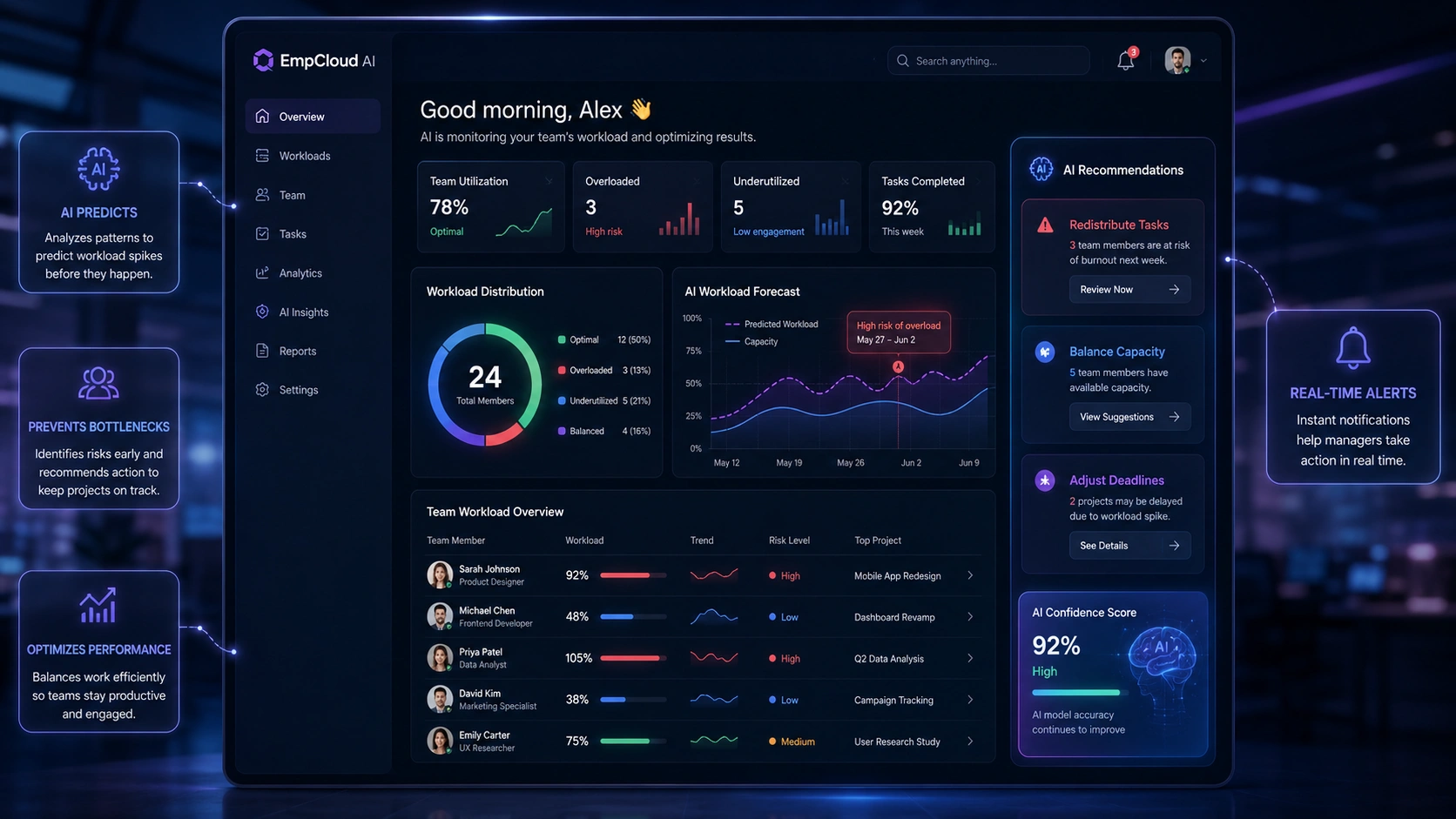
The shift happening right now isn’t just about automation. It’s about moving from reactive management to proactive systems.
AI workload balancing doesn’t just tell you who’s overloaded today. It flags who’s trending toward overload next week. That predictive layer changes how managers operate – less firefighting, more strategic oversight.
The best version of this isn’t AI replacing human judgment. It’s humans setting priorities while AI handles the pattern recognition. Managers decide what matters; the system surfaces where the risk is.
One reframe worth holding onto: the goal of workload balancing has never been equal hours. It’s been a sustainable output per person. AI, done well, is the first tool built specifically to optimize for that.
Balance Isn’t a Perk – It’s a Performance Strategy
Teams that distribute work well don’t just feel better. They perform better, sustain longer, and recover faster from disruption. Workload balancing isn’t about fairness as a courtesy – it’s fairness as a competitive advantage.
Pick one strategy from this list and put it into practice this week. Start small. Build visibility. Adjust as you go. And if you’re ready to stop managing this by intuition, EmpCloud gives you the system to do it properly.
Your team isn’t a set of resources. Treat the work accordingly.
Frequently Asked Questions
What’s the difference between workload balancing and task management?
Task management organizes what needs to be done. Workload balancing determines who carries how much of it. One is about structure; the other is about equity and capacity.
How do you measure if a team’s workload is unbalanced?
Look at utilization rates, task completion velocity, patterns in missed deadlines, absenteeism, and stress signals. A spike in any one of these often points to a distribution problem.
What are the signs that workload is distributed unfairly?
Watch for the same people consistently working late, others rarely assigned meaningful tasks, frequent complaints about being overwhelmed, or rising disengagement among previously strong performers.
Can workload balancing improve employee retention?
Yes, meaningfully. Burnout from overload is one of the top drivers of voluntary turnover. Gallup consistently links workload-related stress to higher attrition rates.
How often should workload be reviewed and rebalanced?
Weekly is the right cadence for most teams. Larger or fast-moving teams may need a mid-week check. The key is consistency – sporadic reviews don’t build the visibility you need.
Quick Search Our Blogs
Type in keywords and get instant access to related blog posts.