

The 9/80 work schedule starts with a question most companies never think to ask: what if the same 80 hours didn’t have to happen across ten days? Not fewer hours. Not a different way of measuring performance. Just a smarter arrangement of the time that was already there.
For most of us, the five-day work week feels permanent. Eight hours, two days off, and start Monday again. It’s so deeply routine that it feels like a rule rather than a choice. But it’s neither. It’s a convention, and conventions can change.
This one compresses 80 hours into nine working days instead of ten. The result is one full Friday off every other week, 26 three-day weekends a year, and zero change to annual output. For a lot of employees, that single shift does more for how work feels than most pay raises ever have.
The catch is in the details. The wrong payroll setup and every cycle silently generate overtime. Missed state compliance and liability builds without anyone noticing. This guide covers all of it, and how the schedule works, who it actually suits, what the legal picture looks like, and how to launch it without creating problems you’ll spend months fixing.
Listen To The Podcast!
What Is a 9/80 Work Schedule?
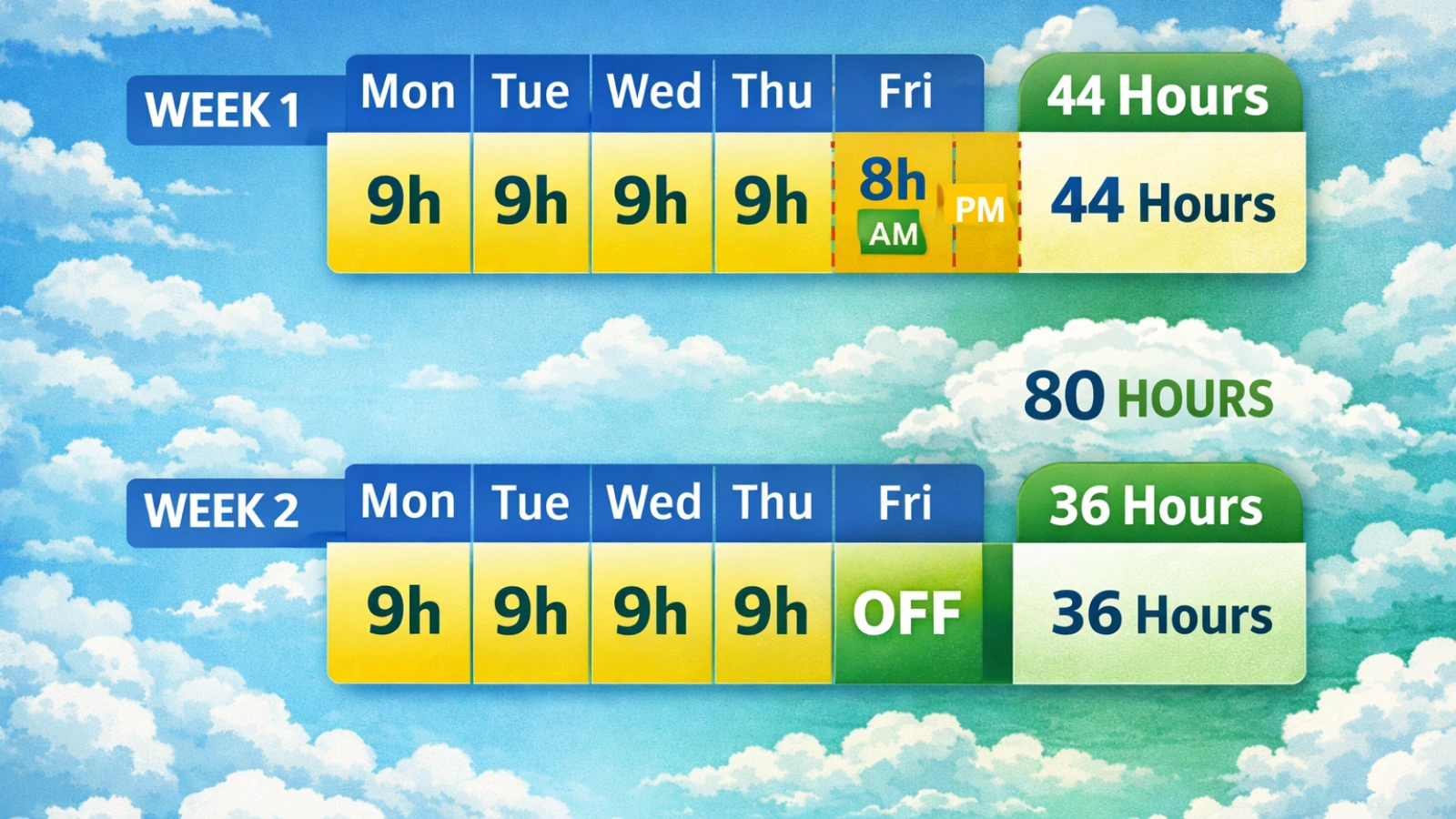
The arrangement is built around a simple trade: employees work slightly longer hours across nine days and get the tenth day off entirely.
Week one totals 44 hours: four nine-hour days plus one eight-hour day, which is the shared Friday. Week two totals 36 hours: four nine-hour days with Friday completely free. Add those together, and you get exactly 80 hours, the same as any two standard weeks.
Where most explanations stop short is the legal mechanism that holds everything together. To stay compliant under federal overtime law, employers must define the legal workweek as starting at the midpoint of that shared Friday, typically noon. The morning hours close out week one at exactly 40 hours. The afternoon hours open in week two. Since neither week individually exceeds 40 hours, no federal overtime is triggered.
The 9/80 work schedule only works legally because of that boundary. Set it wrong, say leaving the workweek running Sunday to Saturday in the payroll system, and every cycle generates unintended overtime.
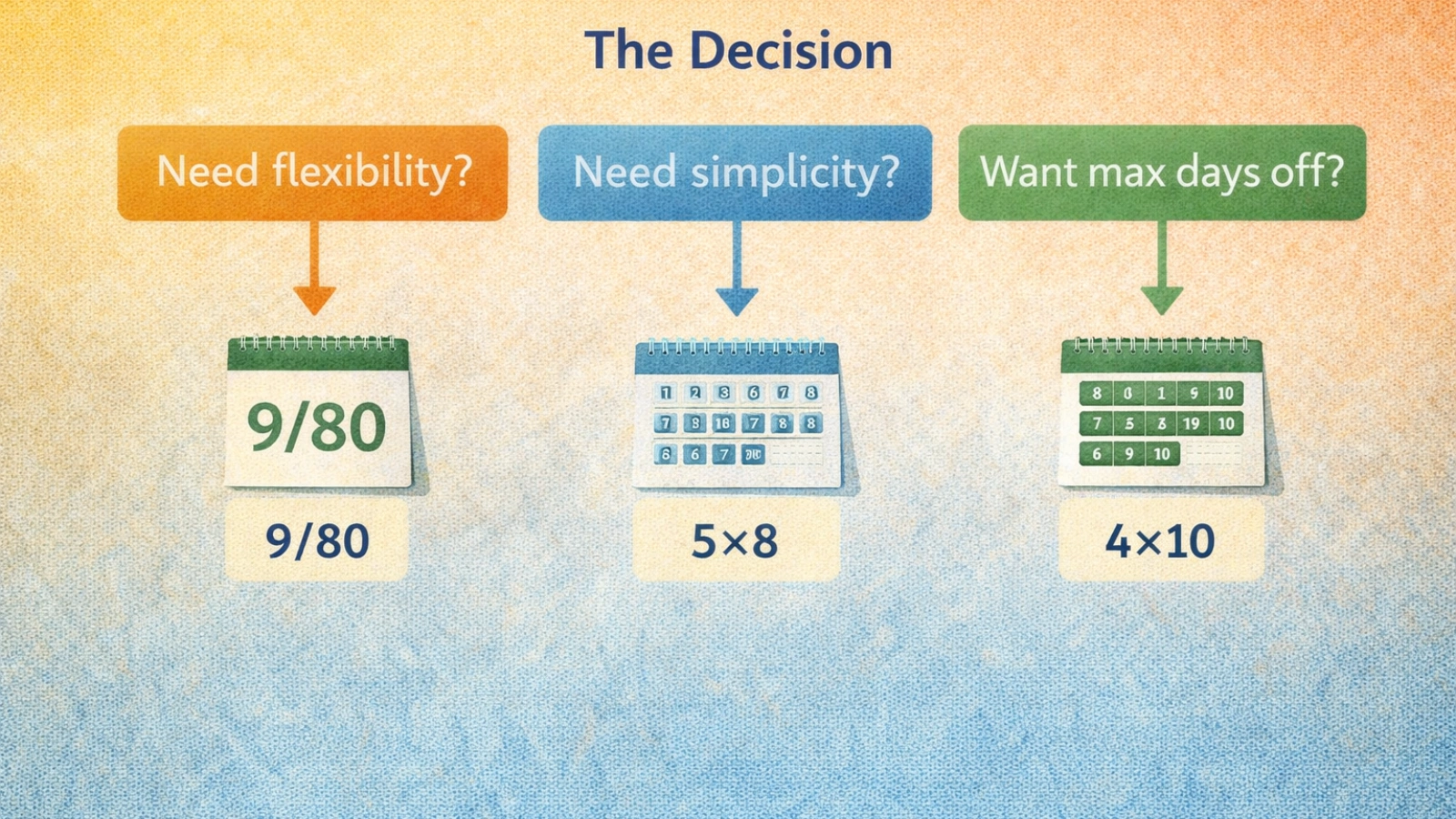
When comparing this to other compressed formats, the differences become clearer. A traditional five-day, eight-hour schedule runs all ten working days across two weeks with no structural days off beyond the standard weekend. The 9/80 trims to nine days, with nine-hour days on eight of them and an eight-hour day on the shared Friday.
The four-ten schedule goes further: four ten-hour days every week, with every Friday off. The four-ten delivers more days off, but those daily hours are genuinely difficult to sustain across many roles and life situations. The 9/80 work schedule hits the middle ground, a meaningful gain in flexibility without pushing daily hours into territory that accumulates into fatigue over time. Both formats keep the annual total at exactly 2,080 hours.
In practice, a typical week looks like four days running from eight in the morning to five-thirty in the evening, followed by a Friday that ends at four-thirty with the workweek splitting at noon. Week two mirrors the first four days, then stops. Friday is completely free, with no half-days, no check-in expectations.
The 9/80 work schedule fits best in environments where results matter more than physical presence at a specific desk on a specific day. Engineering teams, government agencies, aerospace contractors, and technology companies were among the earliest adopters. Customer service teams, healthcare workers, retail staff, and any function that genuinely needs five-day coverage face a harder path. Staggered rotations can solve the coverage problem, but they require deliberate planning before the schedule launches rather than figuring it out later.
The Real Benefits of the 9/80 Work Schedule
Twenty-six extra days off per year sounds significant because it is. But the nature of the time matters as much as the amount. A full weekday off is structurally different from an extra Saturday. Banks are open. Doctors have slots available. Contractors can show up.
Employees who use that day for genuine rest or personal restoration tend to return the following Monday with more capacity than colleagues spending their weekends catching up on everything the workweek didn’t leave room for.
When the 9/80 work schedule gives people built-in breathing room, the downstream effects are measurable. Gallup’s research on workforce engagement consistently links schedule flexibility to lower absenteeism and stronger retention. People who aren’t grinding through five-day weeks with no structural relief call in sick less and stay in roles longer. That’s not a soft claim; it shows up in turnover data.
There’s also a quieter benefit worth acknowledging: fewer commutes. One less round trip every two weeks adds up to real time and money recovered across a year.
From the employer’s side, the business case is more substantive than it might initially seem. In a hiring environment where candidates compare flexibility benefits alongside or sometimes before compensation details, the 9/80 work schedule offers something concrete.
Every other Friday off by design is a specific, verifiable commitment. That’s different from vague flexibility claims in job postings. Retention is where the financial case becomes undeniable. Voluntary turnover is expensive in ways that don’t always surface clearly in budgets, including recruiting costs, onboarding time, and lost productivity.
Challenges and Risks Worth Planning For
At the federal level, overtime is calculated weekly. When the workweek boundary is correctly set at Friday noon, neither week exceeds 40 hours, so compliance is straightforward, provided the setup is correct.
The complications emerge at the state level. California, Alaska, and Nevada apply daily overtime thresholds. Any employee working more than eight hours in a day earns overtime for those additional hours, regardless of weekly totals.
Every nine-hour workday on a standard 9/80 work schedule generates one hour of daily overtime in these states unless a formal alternative workweek arrangement is approved. The liability accumulates per employee, per day, per cycle.
Coverage is another common concern. If half the team has Friday off, who handles operations? The typical solution is a staggered A and B rotation. One group takes week-one Fridays off, the other takes week-two Fridays off. This ensures continuous coverage.
However, this becomes difficult in small teams or specialized roles where responsibilities cannot be easily shared.
A nine-hour day is 12.5 percent longer than an eight-hour one. For many knowledge workers, this is manageable. For others, especially those with long commutes or caregiving responsibilities, it can lead to fatigue over time.
How to Implement a 9/80 Work Schedule
Implementation is primarily operational rather than cultural. Most employees welcome the change. The complexity lies in execution.
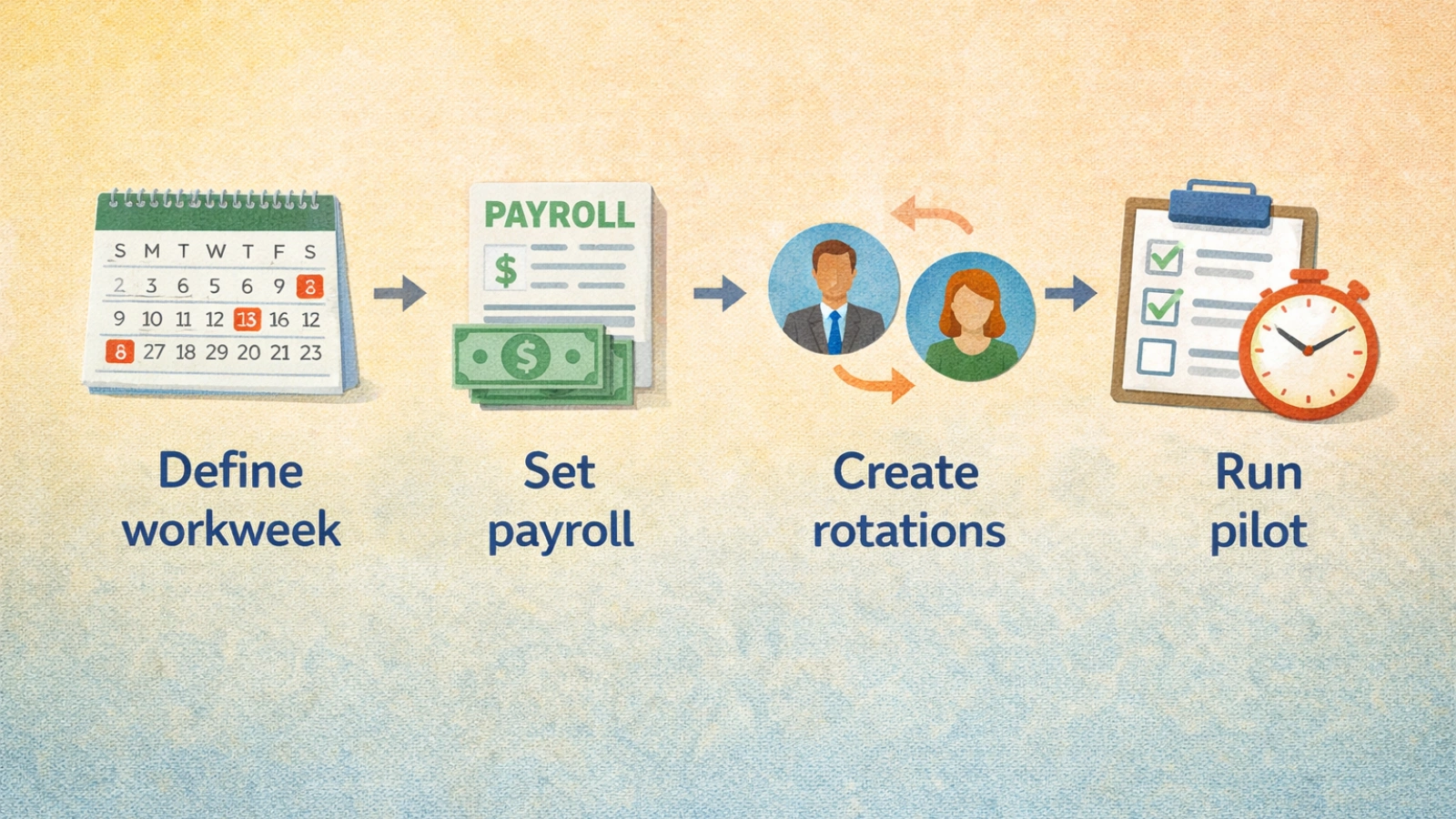
Start by defining the legal workweek clearly, setting it at Friday noon, and documenting it across payroll systems and policies. Audit roles for eligibility, considering exempt status and location-based labor laws.
Next, design A and B rotations to ensure coverage. Update PTO policies to reflect actual hours worked, and clarify holiday rules. Configure payroll systems before the first cycle begins.
Run a 90-day pilot with one team. Collect feedback at 30, 60, and 90 days. Measure absenteeism, overtime, and employee satisfaction. Use this data to refine the approach before scaling.
Also Read!
Common Mistakes That Derail the 9/80 Work Schedule
The most serious mistake is setting the wrong workweek definition in payroll systems. This can unintentionally trigger overtime every cycle.
Skipping a pilot phase is another common issue. Not all teams adapt equally well, and problems are easier to fix in a controlled test environment.
Failing to update PTO policies creates confusion and dissatisfaction. Employees quickly notice discrepancies between eight-hour and nine-hour deductions.
Finally, treating the rollout as complete after launch is a mistake. Continuous monitoring and adjustments are necessary to keep the system running smoothly.
Managing a 9/80 Work Schedule with EmpCloud

Managing this schedule requires precise coordination. Many HR management systems struggle with non-standard workweeks, rotating schedules, and hourly PTO tracking.
EmpCloud simplifies these challenges. It allows custom workweek configurations, including Friday noon boundaries, ensuring compliance at the system level.
It also supports A and B rotations, tracks PTO accurately, and flags overtime risks in specific states. Hybrid scheduling features provide visibility across remote and in-office teams.
Pilot analytics offer insights into absenteeism, overtime, and adherence from the start, helping organizations make informed decisions.
What HR Leaders Often Overlook
While employers often focus on operational benefits, the success of a 9/80 schedule depends on employee experience.
Employees mainly worry about sustainability, whether longer workdays will lead to fatigue, and if their scheduled off-days will actually be respected. They also need clarity on how PTO (Paid Time Off) is calculated, since confusion around leave policies can quickly create frustration.
Organizations that clearly communicate rules, document policies, and respect boundaries see better adoption and higher satisfaction. When employees trust the system, they are more likely to embrace it.
A 9/80 schedule works best because it offers structured, predictable time off, which is often more valuable than informal flexibility.
Getting the 9/80 Work Schedule Right
The 9/80 work schedule delivers meaningful flexibility without increasing labor costs. It offers employees 26 additional days off annually through smarter scheduling.
For organizations, success depends on precision: correct workweek definitions, updated policies, compliance awareness, and proper infrastructure.
Start with a pilot. Measure results. Refine before scaling.
When implemented correctly, the 9/80 work schedule becomes one of the most valued benefits an organization can offer.
Frequently Asked Questions
Is the 9/80 work schedule legal?
Yes, in most U.S. states, provided the workweek is defined correctly.
How does overtime work?
Overtime applies after 40 hours per workweek federally, but some states have daily thresholds.
What is the difference from a four-ten schedule?
Four-ten offers weekly Fridays off but requires longer days. The 9/80 offers every other Friday off with shorter daily hours.
Can it work for hybrid teams?
Yes, it aligns well with hybrid work models.
How should PTO be calculated?
Based on actual scheduled hours: nine for full days, eight for split Fridays.
Quick Search Our Blogs
Type in keywords and get instant access to related blog posts.