
In 2019, a mid-sized e-commerce company in Austin, Texas watched its Google traffic collapse by 61% in a single weekend. No algorithm warning. No penalty notice. Just silence where clicks used to be. The owner had spent $4,200 a month for 14 months with an SEO vendor who promised “premium link building.” What she got was a network of spammy forum posts, recycled anchor text, and links from sites that hadn’t seen real human visitors since 2016. She needed a real seo firm — not a reseller of someone else’s shortcuts. Her story isn’t rare. It’s practically a genre.
According to a 2023 BrightEdge research report, organic search drives over 53% of all website traffic across industries. Yet a significant share of businesses investing in SEO see flat or declining results year after year. The problem isn’t Google. The problem is a deeply broken vendor ecosystem that profits from confusion.

The Hidden Cost of a Bad SEO Partner
Most people think bad SEO just means “rankings didn’t improve.” That’s the polite version.
The real version looks like this: you burn $30,000 over two years. Your backlink profile picks up algorithmic penalties. Your competitors, who hired better, climb past you. And when you finally switch vendors, the new team spends the first three months cleaning up the mess the old one left behind.
Nearly half of all small business owners report they have no idea what their SEO agency actually does each month, according to survey data published by Search Engine Journal. They get a PDF. Maybe a keyword rank table. A few green arrows that don’t correlate to anything in their bank account.
That’s not a reporting problem. That’s a power imbalance dressed up as a service agreement.
The agencies profiting most from this confusion share a few common traits. They subcontract heavily. They use templated audits. They pitch “domain authority” as if it’s a business metric. And when results don’t materialize, they blame the algorithm.
What a Real SEO Firm Actually Looks Like in Practice
Let’s be specific. A credible SEO operation does several things that most vendors skip entirely.
First, it audits before it acts. An SEO audit isn’t a upsell — it’s the foundation. Without knowing your site’s technical health, crawl structure, on-page signal quality, and backlink toxicity, any subsequent work is guesswork. Any firm that jumps straight to link building without a diagnostic layer is telling you exactly how they operate. Listen to them.
Second, it builds links that make contextual sense. The phrases surrounding a backlink matter. Google’s Reasonable Surfer patent, widely discussed in SEO research circles since its filing, signals that link context — not just the link itself — carries ranking weight. A link buried in a low-relevance paragraph on a dormant blog is not the same as an editorial mention in an active niche community. The difference shows up in your rankings within months.
Third, it manages its own execution. This is where most agencies quietly fail their clients.
The Subcontracting Problem Nobody Talks About
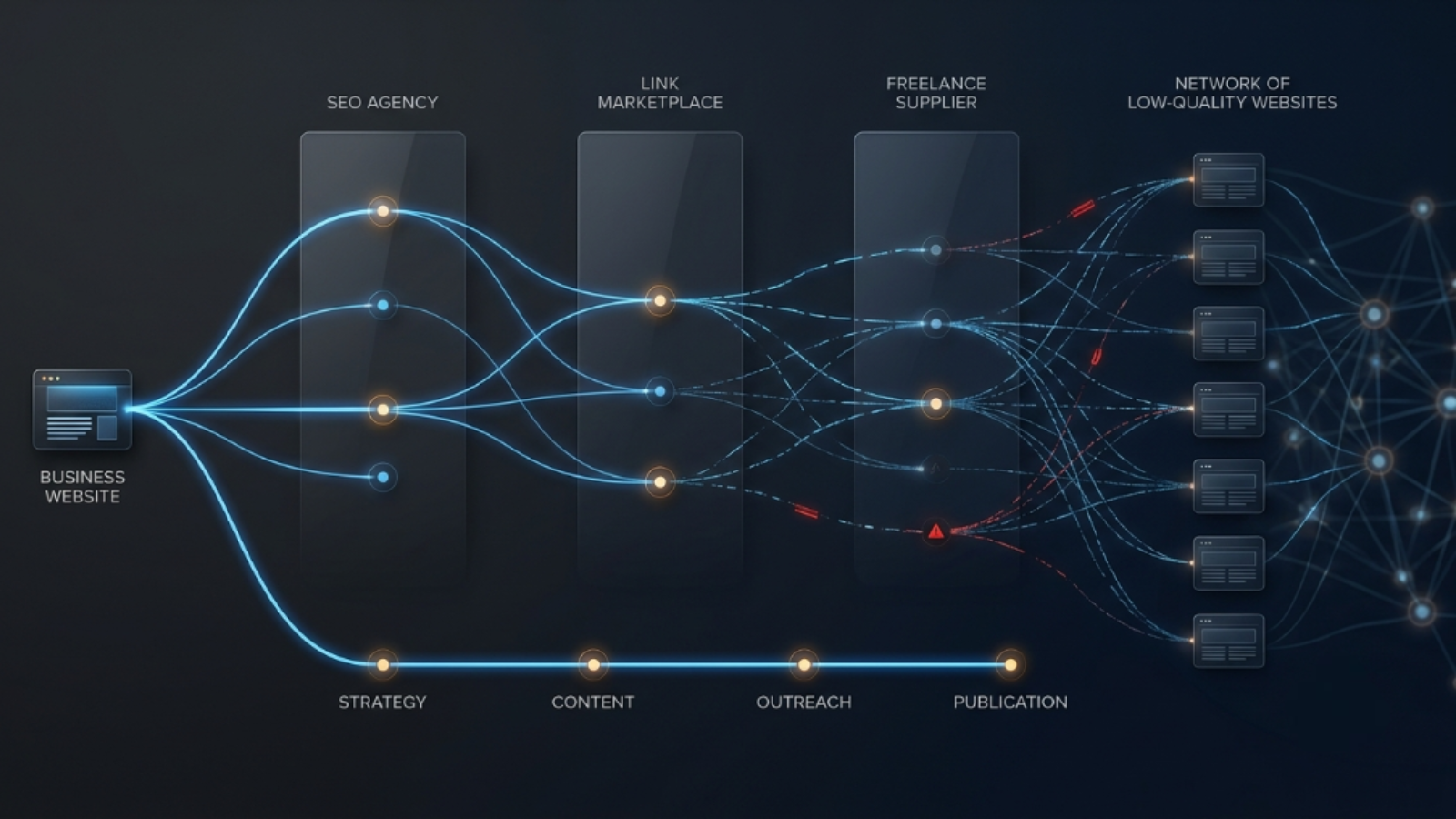
Here’s how it actually works at a lot of SEO shops. You hire Agency A. Agency A logs into a marketplace and orders links from Freelancer B, who sources placements from Site Owner C, who has six blogs running on the same IP address. By the time a backlink lands on your profile, four different parties have touched it — and not one of them has read your website.
Quality degrades at every handoff. Editorial standards disappear. Anchor text ratios get ignored. And the agency you’re paying has zero visibility into what’s actually being placed on your behalf.
This isn’t speculation. A 2022 study from Ahrefs found that a significant portion of “guest post” links sold through third-party networks land on sites with no organic traffic of their own. You’re essentially paying for a link that nobody will ever follow.
The fix is structural, not tactical. You need a team that builds, writes, outreaches, and places in-house. No handoffs. No resold packages. Direct oversight from strategy through delivery.
Anchor Text Diversity Isn’t Optional in 2025
If your link profile reads like someone copied and pasted the same phrase 40 times, Google noticed years ago. Anchor text diversity isn’t a nice-to-have — it’s the difference between sustainable rankings and a manual action waiting to happen.
A well-structured link profile mixes branded anchors, naked URLs, generic phrases, and contextual keyword variations. Each serves a different algorithmic purpose. Exact-match anchors, used sparingly, signal topical relevance. Branded anchors build entity authority. Generic anchors reduce footprint risk.
Getting this right requires strategy, not just volume. And it requires different link types working together — outreach-based guest posts for editorial authority, crowd marketing placements for organic discovery signals, Quora and Reddit contributions for topical relevance in community contexts, and foundation links for baseline profile diversity.
One documented case study shows what a structured, diversified approach actually produces: a 4X increase in organic traffic and a 156% increase in ranked keywords for a client in the coworking space niche. Those numbers came from combining multiple link types under a single coordinated strategy — not from buying bulk packages and hoping for the best.
The White-Label Problem Agencies Won’t Admit
If you run a marketing agency, this section is specifically for you.
White-label SEO is how most agencies scale. You take on 15 clients, you can’t build a full SEO department overnight, so you partner with a fulfillment provider who does the work under your brand. Smart model. Except most “white-label” programs are cosmetic.
They slap your logo on a report template. They give you a single point of contact who manages 300 other agency accounts. Bulk pricing sounds attractive until you realize the deliverables are priced that way because the quality matches the cost. And when a client asks a specific question about their campaign, you’re waiting 48 hours for an answer you’re then going to translate and pass along.
A genuinely reseller-friendly program looks different. It means unbranded, client-ready reporting that protects your agency relationship. It means bulk pricing that scales with your volume without compressing your margin. It means dedicated support you can actually reach — not a ticket queue. And it means an account infrastructure that treats you as a business partner, not a middleman.
Over 2,000 SEO specialists have built that kind of partnership with Crowdo. That’s not a marketing number — it’s a signal about what industry professionals actually require from a vendor once they’ve seen what bad looks like.
What Resellers Should Demand Before Signing Any Contract
Ask three questions before you commit to any white-label provider.
- Who physically writes and places the content? If the answer isn’t “our in-house team,” ask the next question before you stop listening.
- Can you show me the editorial process for guest post placements? A real answer includes site vetting criteria, content approval workflows, and anchor text review protocols.
- What does reporting look like, and can I see a sample? If the report is a screenshot of a rank tracker and nothing else, you have your answer.
These aren’t trick questions. They’re baseline qualifications. The fact that most vendors stumble on them tells you something important about the industry.
How to Match Your SEO Needs to the Right Engagement Model

Not every business needs the same thing. A local service business competing in a single metro area has different requirements than an e-commerce site competing nationally across hundreds of product categories.
If you’re starting from near-zero organic presence, a full SEO audit followed by a fully managed engagement is usually the right move. You need a diagnostic before you need a prescription. Jumping into link building without understanding your site’s technical baseline is like repainting a house with a foundation problem.
If you’re in a growth phase with some rankings already, targeted link building packages — outreach guest posting, crowd marketing links, Quora and Reddit promotion — can accelerate the trajectory without overhauling your entire strategy.
If you’re an agency building a white-label stack, start with a pilot. Take two or three clients, run a 90-day engagement, and evaluate the reporting quality, communication responsiveness, and actual ranking movement. Don’t commit volume before you’ve validated the operation.
The businesses that plateau year over year on organic traffic almost always share one characteristic: they stayed with a vendor too long out of inertia, ignoring warning signs that were visible in month three. A flat ranking curve, opaque reporting, and boilerplate strategy documents aren’t temporary problems. They’re the product.
Stop Rewarding the Opacity
The SEO industry has a transparency problem. It’s not structural — it’s a choice. Vendors profit from keeping clients confused about what’s working, because confusion extends contracts.
Demanding clarity isn’t unreasonable. Asking where your links are placed, what the editorial standards are, who on the team owns your campaign, and what the performance benchmarks look like — these are basic accountability questions. Any firm that can’t answer them directly is telling you something important.
The Austin business owner from the beginning of this piece eventually found a firm that did the opposite. Transparent reporting. In-house execution. A real audit before any link was built. Within 11 months, she had clawed back her rankings and exceeded her pre-penalty traffic levels.
The difference wasn’t budget. She was spending less the second time around. The difference was structure, accountability, and a partner who treated her organic channel as a revenue asset — not a retainer renewal opportunity.
That’s the standard. Anything less is a compromise you’ll eventually pay for twice.
Quick Search Our Blogs
Type in keywords and get instant access to related blog posts.