

A pay band is rarely just a number. What appears as a single figure in an offer letter reflects multiple decisions, such as role value, experience, internal equity, market demand, business affordability, and long-term workforce planning.
To manage these decisions consistently, organizations rely on compensation structures. One of the most widely used structures is the pay band.
It is a defined salary range assigned to a role, job family, or level. Instead of deciding compensation from scratch each time, organizations establish boundaries that guide hiring, salary adjustments, promotions, and workforce budgeting.
Structured pay is not a recent concept. Government systems have used graded salary frameworks for decades. As private organizations scaled and roles became more specialized, similar frameworks were adopted to prevent inconsistency, salary inflation, and inequitable decision-making.
For employees, it provides context. For managers, they offer guardrails. For leadership teams, they create predictability in compensation planning.
Understanding how pay bands work helps individuals interpret job offers more accurately, evaluate career growth realistically, and recognize how salary decisions are made behind the scenes.
Listen to the Podcast
What Is a Pay Band?
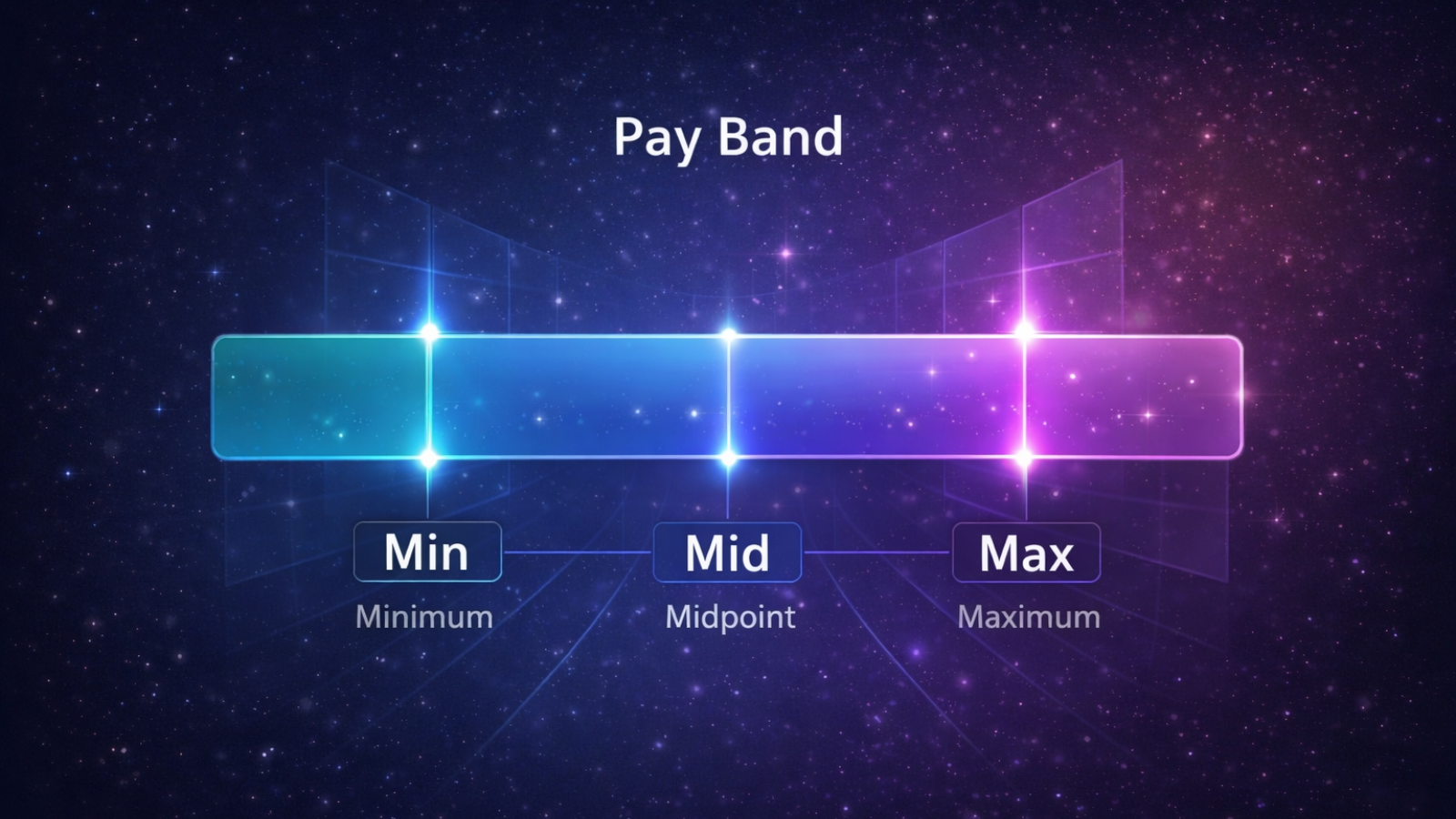
It is a defined salary range with three key points: minimum, midpoint, and maximum.
The minimum reflects entry-level capability for the role.
The midpoint represents the expected market rate for a fully competent employee.
The maximum indicates the upper boundary before a role change is required.
Rather than a fixed salary, it operates like a corridor. Employees may earn different amounts while remaining within the same band. Differences typically reflect experience, performance, skill scarcity, and market positioning.
For example, a software engineer role might have a band of ₹6 to ₹12 LPA. An early-career hire may begin closer to the minimum, while someone with specialized expertise could be placed near the midpoint.
Pay bands exist because compensation must remain flexible without becoming arbitrary. Labor markets shift, skills evolve, and employee performance changes over time. A single salary figure cannot reflect that complexity.
A common misconception is that it restricts earning potential. In practice, they make growth more visible. Employees can see the range, understand positioning, and identify what triggers movement within or beyond the band.
Pay Band and Grade Pay
Pay band and grade pay are often confused because traditional public sector compensation combined both concepts.
Grade pay refers to a fixed amount associated with a role’s classification or rank. It emphasized hierarchy and standardization.
The distinction is straightforward:
It defines the overall salary range.
Grade pay indicates the level of responsibility within that hierarchy.
Two roles could sit inside the same band while carrying different grade pay values due to differences in scope or authority.
As organizations became more dynamic, many moved away from rigid grade pay layers. Modern frameworks retain hierarchy but express it through levels, role architecture, and competency expectations rather than fixed additions.
Pay Matrix and Pay Levels
Some compensation systems evolved beyond broad pay bands into structured pay matrices and defined levels.
A pay matrix outlines salary progression through steps tied to tenure, performance, or promotion milestones. Movement becomes incremental rather than discretionary.
Pay levels represent stages in a career path. Each level carries expectations around complexity, autonomy, and impact.
This approach addresses one limitation of wide pay. When ranges are large, employees may struggle to understand progression speed. Levels introduce visible milestones.
Many mature organizations combine both models. It provides flexibility for market hiring while levels create clarity around progression.
How Pay Bands Are Designed
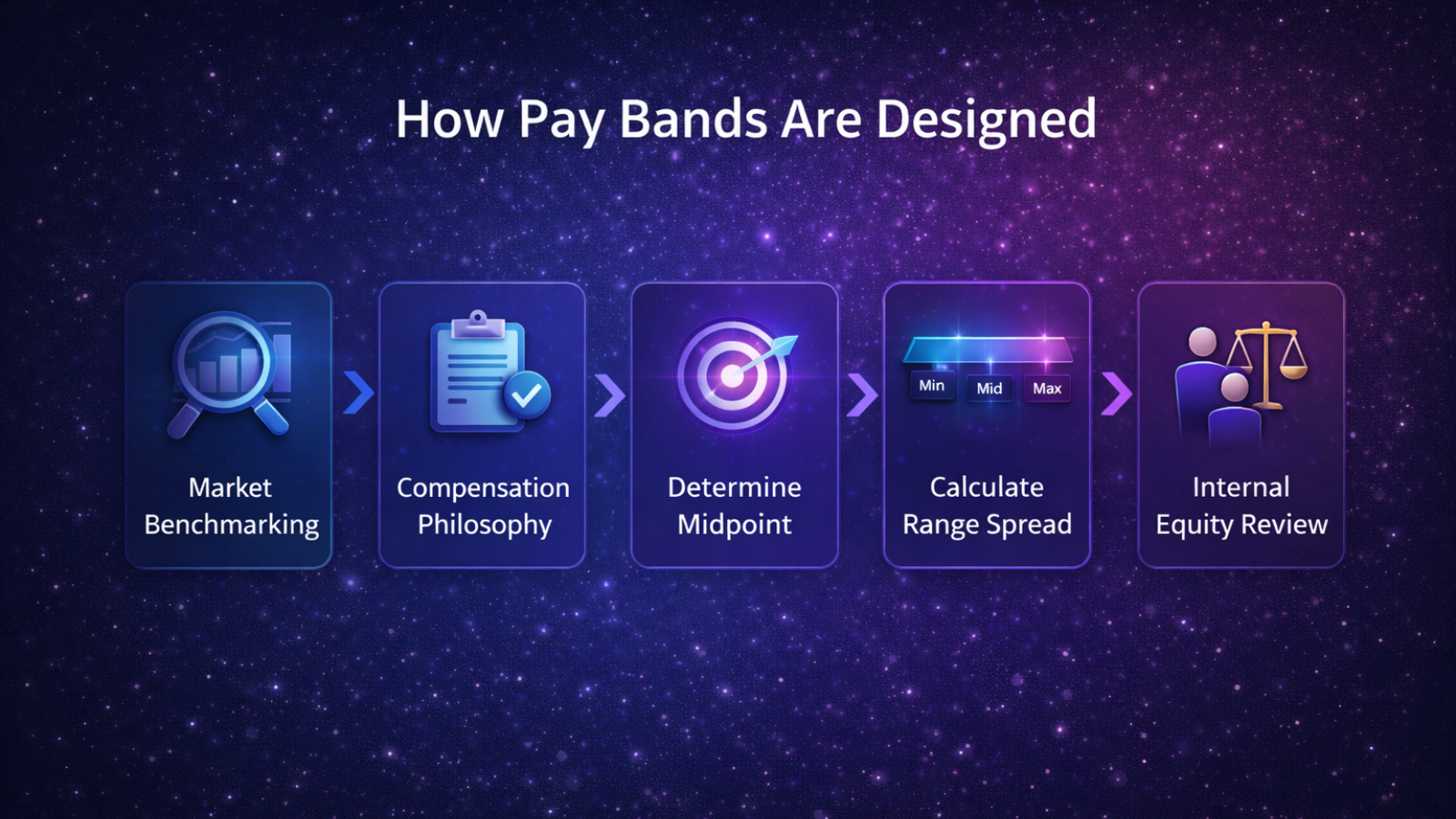
Designing pay bands involves several analytical steps rather than arbitrary range setting.
Organizations begin with market benchmarking. External salary data is gathered from surveys, competitors, and industry platforms. Roles are matched by responsibility rather than job title alone.
Next, compensation philosophy is defined. Some organizations target the 50th percentile of the market, while others position themselves above the market for critical roles.
Range spread is then determined. Entry roles may have a spread of 30 to 40 percent, while senior leadership bands can exceed 100 percent because impact varies significantly.
The midpoint becomes the anchor. Minimum and maximum values are calculated around that anchor using the chosen spread.
Internal equity review follows. Existing employees are mapped into the proposed ranges to identify compression risks or anomalies.
Finally, bands are approved as part of workforce budgeting. They become reference points for hiring and salary review cycles.
Also Read
How to Choose the Right Attendance Tracker for Your Business
How Pay Bands Work in Organisations
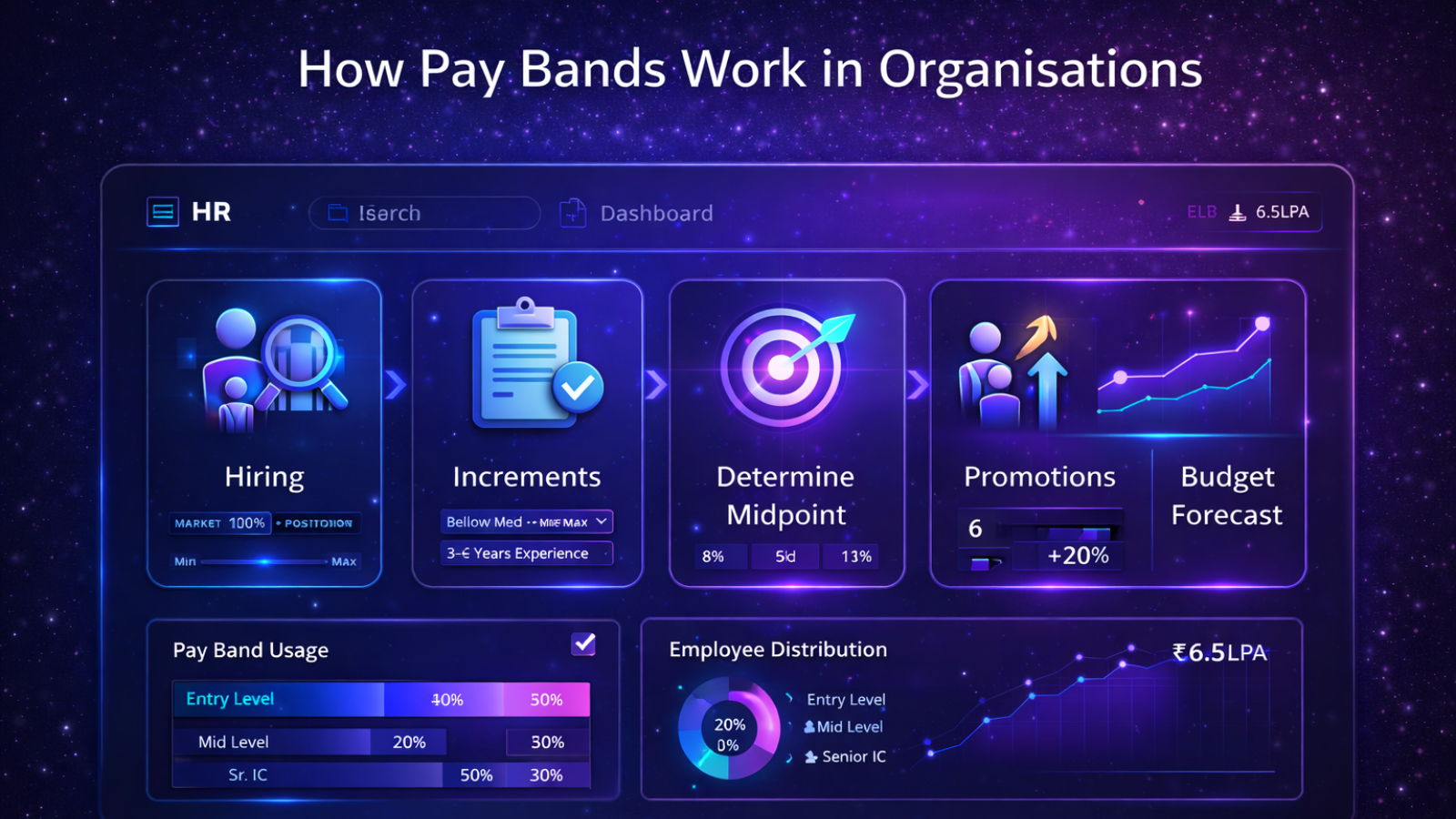
Many organizations combine pay band structures with HR tools such as attendance trackers and payroll software to maintain accurate employee records and support compensation planning.
During hiring, recruiters assess experience, skill depth, and market conditions before positioning candidates within the band. The midpoint often represents a reference for fully proficient hires.
For existing employees, it is a guide increment strategy. Individuals below the midpoint may receive higher percentage increases to move toward market alignment. Employees near the ceiling often require expanded responsibilities to justify significant salary movement.
Promotions typically involve movement into a new band rather than only a salary adjustment. This ensures that title changes reflect real scope changes.
From a financial perspective, it allows organisations to forecast payroll growth by modelling employee distribution across ranges rather than predicting individual salary changes.
Pay transparency initiatives are also influencing how bands are communicated. When ranges are visible, salary conversations shift toward positioning and progression rather than isolated numbers.
Benefits of Pay Bands
It creates structure, but its practical value appears in daily compensation decisions.
- They support fairer salary decisions by reducing extreme variation between employees performing similar work. Differences still exist, but are easier to explain.
- They create consistency across managers. Compensation becomes less dependent on negotiation style or managerial discretion.
- Career progression becomes clearer. Employees understand how movement within a band differs from promotion into a higher band.
- Negotiation remains possible but within realistic limits. Organizations maintain internal equity while offering flexibility to candidates.
- Salary benchmarking becomes more efficient because adjustments can be made at the range level rather than the individual level.
- Budget planning improves. Leadership teams can estimate compensation growth using distribution patterns across bands.
- It also helps reduce bias. While structure does not eliminate bias entirely, it introduces boundaries that encourage objective decision-making.
Retention discussions become more practical because managers can connect skill development and scope expansion to movement within ranges.
Challenges in Managing Pay Bands
It requires ongoing maintenance.
Market movement is the most significant challenge. Salary growth in competitive roles can outpace established ranges, creating retention risk.
Salary compression can occur when experienced employees earn amounts similar to those of new hires due to outdated bands.
Tracking employee positioning within ranges becomes complex after multiple increments and role changes. Organizations often identify employees above range, known as the “red circle,” and those below range, known as the green circle.
Role definition also presents difficulty. Hybrid roles may not align neatly with a single band, requiring judgment and periodic recalibration.
Global organizations face geographic differentials. The same role may require different ranges while maintaining internal fairness.
Perception management matters as well. If pay bands are introduced without explanation, employees may interpret them as limits rather than guidance.
Successful organizations treat pay bands as evolving frameworks informed by market data and business strategy.
Example Pay Band Structure
A practical structure illustrates how bands relate to career growth.
- An entry-level HR band might range from ₹3 to ₹6 LPA with a midpoint around ₹4.5 LPA.
- A mid-level specialist band could range from ₹6 to ₹12 LPA.
- A senior individual contributor band may extend from ₹12 to ₹22 LPA.
Management bands often expand further because responsibility varies widely.
Leadership bands become significantly broader due to impact and accountability differences.
What matters is the relationship between bands rather than exact numbers. Each shift represents increased scope, decision-making authority, and organizational influence.
Salary progression, therefore, reflects role progression rather than tenure alone.
Salary Band vs Pay Range
The terms “salary band” and “pay range” are often used interchangeably, but subtle differences exist.
A pay range may refer to a specific role.
A pay band often groups multiple related roles within a broader level.
Broadbanding is an extension of this idea where several levels are merged into wide ranges to increase flexibility. While this supports agile hiring, it requires strong governance to prevent inequity.
Understanding this distinction helps employees interpret compensation frameworks more accurately.
How Organisations Create Pay Bands
Creating pay bands involves a repeatable process:
- Define job architecture and levels.
- Collect market compensation data.
- Establish compensation philosophy.
- Calculate the midpoint using the target percentile.
- Determine range spread.
- Map existing employees into proposed ranges.
- Identify compression and outliers.
- Approve brands within financial planning cycles.
- Review annually or during major market shifts.
This process ensures pay bands remain grounded in both external competitiveness and internal fairness.
How HR Platforms Support Pay Band Management
Managing compensation through spreadsheets becomes difficult as organizations grow. Many companies now rely on payroll software and HR platforms to centralize salary structures, track pay bands, and manage employee compensation more accurately.
HR platforms such as EmpCloud centralize salary structures and employee positioning within ranges.
Increment cycles can be tracked systematically. Managers propose changes while HR maintains oversight. Budget impact can be analyzed before decisions are finalized.
Integration with payroll ensures approved adjustments flow without duplication. Visibility into compression risk, distribution patterns, and progression timelines improves compensation governance.
Technology does not replace compensation strategy but enables consistent execution at scale.
Conclusion
Pay bands are not merely administrative tools. They shape how organizations hire, reward performance, manage growth, and communicate expectations.
When designed carefully, they balance flexibility with fairness. Employees gain visibility into progression, managers gain guidance for decision making, and leadership gains predictability in workforce costs.
However, pay bands are effective only when treated as living frameworks. Regular market review, transparent communication, and alignment with role architecture determine whether they support trust or create frustration.
Understanding how salary bands are structured allows both employees and organizations to approach compensation discussions with greater clarity, realism, and confidence.
FAQs
1.What is the pay band level?
It indicates where a role sits in the hierarchy and determines the associated salary range.
2.What replaced pay bands?
Some systems adopted pay matrices and levels, although many organizations still rely on bands.
3. Are pay bands used in private companies?
Yes. Most medium and large organizations use them to manage hiring, promotions, and budgeting.
4. Why do companies use pay bands?
Companies use pay bands to maintain fairness, consistency, and budget control in compensation decisions. They help HR teams manage hiring offers, salary increments, promotions, and internal equity across employees performing similar roles.
Quick Search Our Blogs
Type in keywords and get instant access to related blog posts.