
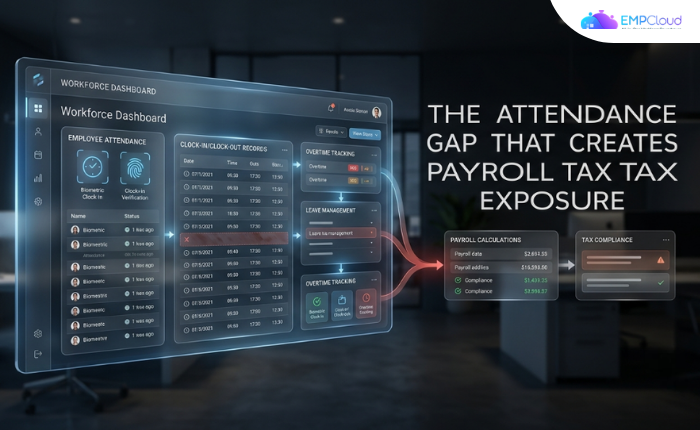
Most payroll audits don’t fail because of a tax calculation mistake. They fail because someone clocked out at 5:47 p.m. and the system recorded a blank.
That blank — one empty field in one row — doesn’t look like a compliance risk. But multiply it across a full payroll run, add a cut-off deadline, and you have the exact conditions the IRS and the Department of Labor are now hunting for. The DOL recovered back wages for nearly 177,000 workers in fiscal year 2025, averaging $1,465 per worker — and a significant share of those cases began with misclassified time, not deliberate fraud.
The uncomfortable truth: your tax software is probably fine. Your attendance data almost certainly isn’t.
In a hurry? Listen to the blog instead!
Where the Real Gap Lives
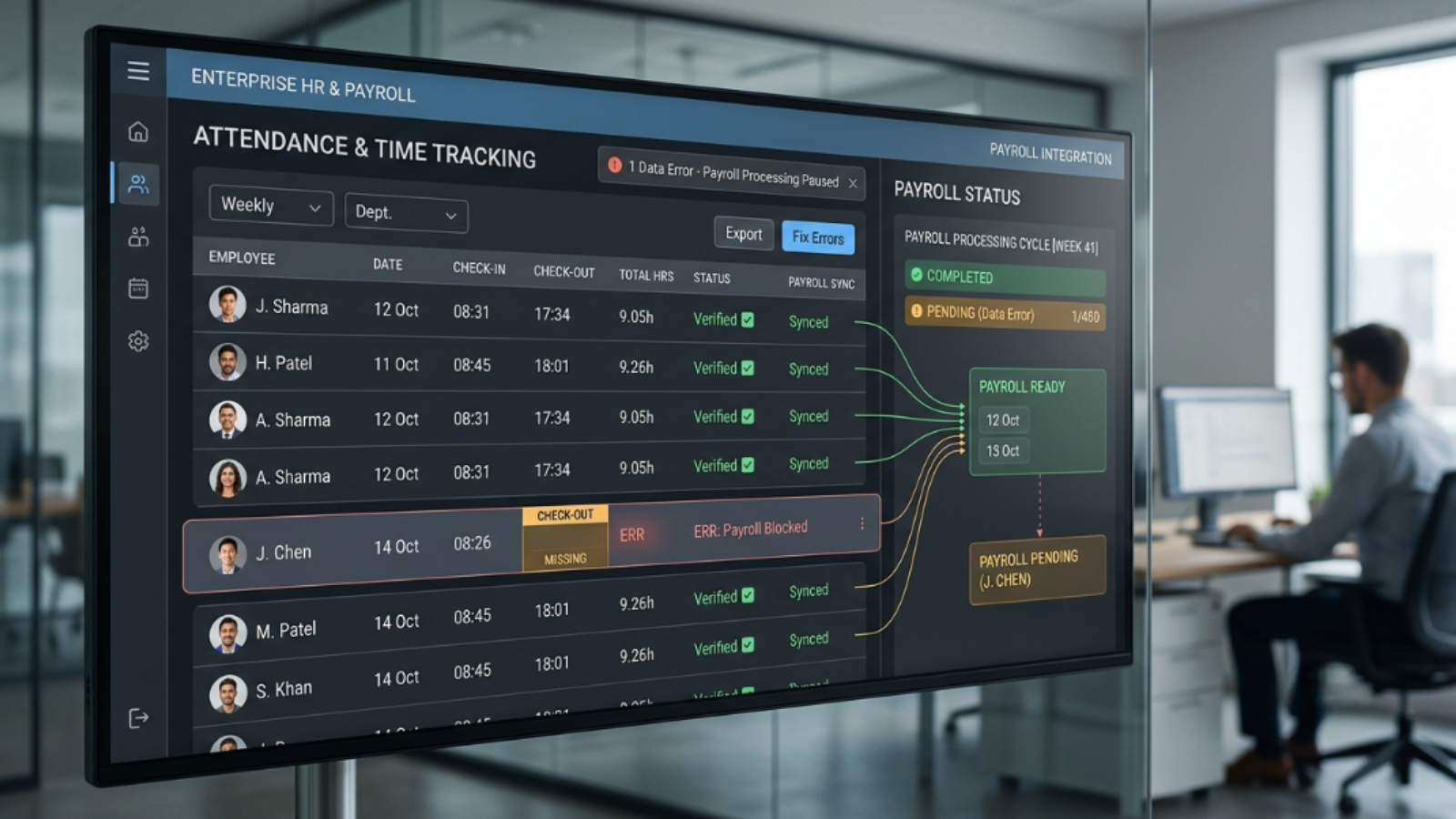
There are five data columns that determine whether a payroll run is clean: employee name, date, check-in time, check-out time, and leave category. A blank or a default value in any one of those five fields is, as our own research describes it, a silent error waiting to become a payroll dispute. Not a risk. A waiting dispute.
The reason these errors survive long enough to cause damage is structural, not human. Attendance capture and payroll calculation sit on two different platforms in most mid-sized companies, connected by a manual export-import handoff that happens under deadline pressure once or twice a month. That reconciliation almost never happens cleanly, and once a team grows beyond five to ten employees, data-sync cracks become permanent features of the process rather than one-off mistakes.
The scale is harder to dismiss than most HR leaders expect: attendance errors occur at a rate of 1,139 incidents per 1,000 employees. The average company has more attendance errors than it has staff. That’s not a rounding problem. That’s a structural misalignment between two systems that need to be the same system.
Why 2025 Raises the Stakes Specifically
Two regulatory changes make this year the worst time to carry attendance-to-payroll data risk.
First, the IRS is tightening payroll tax reporting requirements — employers now face information-return penalties of up to $340 per form for late or incorrect filings, rising to $680 for intentional disregard. At scale, that’s not an administrative inconvenience. It’s a material liability.
Second — and this one is underappreciated — the “no tax on overtime” provision introduced in 2025 requires employers to accurately track and separately report overtime hours on W-2s. Which means if your attendance data has gaps, default values, or buddy-punched records, you are now misreporting a line item the IRS specifically asked you to get right. Manual attendance systems enable exactly this kind of data corruption: buddy punching and time manipulation corrupt the payroll inputs that determine tax withholding calculations.
And then there’s the state-level PTO exposure that compounds everything. California treats accrued vacation as earned compensation that cannot be forfeited. Massachusetts requires payout of unused vacation on termination. Applying a single PTO policy uniformly across states — which most companies do — creates payroll compliance exposure that attendance data errors make nearly impossible to audit after the fact.
Sectors Carrying the Most Structural Risk
Not every company carries equal exposure. Two sectors show up repeatedly in structural payroll error analysis.
Telecom companies managing field engineers across multiple regions face the sharpest version of this problem: engineers capture their own hours in one system while payroll processes those hours in another, with no automated validation between them. When those two systems don’t share a common source of truth, compliance precision becomes genuinely non-negotiable — and self-reported hours create direct legal liability.
NBFC environments face a similar constraint. In a sector where regulatory audits are routine and compensation structures are complex, the margin for attendance data error is effectively zero. A manual handoff between HR and payroll platforms isn’t just inefficient there. It’s a liability the regulator will eventually find.
What Integrated Attendance-to-Payroll Actually Looks Like
EMPCloud keeps attendance capture and payroll calculation inside the same platform — no export file, no manual reconciliation step, no version mismatch between what HR approved and what payroll processed.
For office-based staff, face recognition biometric attendance tracking eliminates buddy punching at the source. The payroll input is a verified clock event, not a self-reported one. For field workforces, geo-location tracking captures where engineers actually were when they checked in — which matters when time records become the subject of a wage dispute or a DOL audit.
The less obvious feature is what happens when you need to audit your own data before the regulator does. EMPCloud’s Smart SQL natural-language analytics tool pulls attendance, leave, and payroll data in a single conversation — plain English, no query language required. That means running a pre-payroll audit against those five critical fields doesn’t require waiting for the payroll team to produce a report. It’s a different operational posture than most companies are in today. Research across enterprises using AI-powered HRMS shows 95% accuracy in statutory compliance versus 75–80% with manual systems, and a 60% reduction in payroll processing time. The accuracy improvement is what matters here — the speed is a byproduct of removing the reconciliation step.
For a deeper look at where biometric data and payroll accuracy intersect, the breakdown of biometric attendance and payroll errors is worth reading before you configure your clock-in policy.

The Three Things to Fix Before Your Next Payroll Run
You don’t need to overhaul your entire stack this week. But there are three changes that meaningfully reduce exposure before the next cut-off.
- Audit the five fields, not the totals. Pull your last payroll cycle’s raw attendance data and count blanks and defaults in check-in time, check-out time, and leave category. The aggregate hours may look correct while individual records are corrupted. Totals mask field-level errors.
- Kill the manual handoff. If attendance and payroll live in separate systems connected by an export file, every payroll run carries the risk that someone opened and edited that file. That’s not a policy problem — it’s an architecture problem. The fix is a platform where both functions share the same data layer.
- Separate overtime from regular hours in your tracking now. With the 2025 overtime reporting requirement in effect, systems that aggregate total hours without flagging overtime separately are already non-compliant at the data level, before a single form is filed.
The Mistake That Keeps Repeating
HR teams invest in payroll compliance at the calculation layer — better tax tables, better withholding logic, more accurate statutory deductions. That’s not wrong. But the errors that produce DOL investigations and IRS penalties mostly don’t originate in the calculation. They originate upstream, in attendance data that entered the payroll system already wrong.
An absent employee whose leave wasn’t formally approved before the payroll cut-off is often coded as unpaid absent by default, requiring a manual adjustment that quietly accumulates correction costs across every pay cycle. Multiply that by a team that’s grown from 20 to 120 people — exactly the growth path that startup and NBFC clients follow — and the error rate compounds faster than the headcount does.
The companies that get payroll compliance right aren’t the ones with the most sophisticated tax software. They’re the ones who stopped treating attendance data as a separate upstream problem and started treating it as the first step of the payroll run itself.
That reframe is worth more than any single feature.
EMPCloud operates across 15+ countries and manages 50,000+ employees for 200+ companies — and the payroll compliance patterns we see are consistent regardless of sector: the gap is almost always in the data, not the calculation. Start your free 15-day EMPCloud trial and run your first integrated attendance-to-payroll audit before your next cut-off.
FAQs: –
1. How can attendance errors create payroll tax exposure?
Attendance errors can affect regular hours, overtime, leave deductions, and taxable wages. When incorrect or incomplete attendance data flows into payroll, it can lead to incorrect tax withholding, reporting errors, and potential penalties. Fixing the issue at the attendance stage reduces payroll tax exposure before the filing stage.
2. Can inaccurate attendance records cause payroll tax penalties?
Yes. Inaccurate attendance records can result in incorrect wage calculations, overtime reporting, and tax withholding. If those errors reach payroll filings or employee tax forms, they can contribute to compliance issues and penalties. That’s why attendance data should be validated before each payroll run.
3. How does overtime tracking affect payroll tax compliance?
Overtime hours can affect employee wages and the information employers must report. If a system combines regular and overtime hours or relies on incomplete attendance records, payroll teams may have difficulty reporting overtime accurately. Separating and validating overtime at the attendance stage helps reduce downstream compliance risk.
4. What attendance data should HR audit before processing payroll?
HR should check at least five critical fields: employee name, work date, check-in time, check-out time, and leave category. Look specifically for blanks, default values, duplicate records, unusual hours, and mismatches between attendance and approved leave. These field-level checks can uncover problems that payroll totals may hide.
5. How can integrated attendance and payroll software reduce compliance risk?
Integrated attendance and payroll software keeps verified attendance data connected directly to payroll calculations, reducing manual exports, spreadsheet edits, and reconciliation errors. With a shared data layer, HR teams can identify missing attendance, overtime, and leave information before it affects payroll and tax reporting.
Quick Search Our Blogs
Type in keywords and get instant access to related blog posts.