
If your team is working hard but results still feel unclear, the problem might not be effort; it could be measurement. KPI examples give businesses a practical way to turn vague goals into trackable numbers. Whether you are leading a startup or managing a large enterprise, understanding the right key performance indicators for each department helps you stay focused, aligned, and growth-ready.
In this guide, we will walk through real-world KPI examples for every major department, from sales and marketing to HR and finance, so you can build a performance culture that actually delivers consistent results for your business.
Listen To The Podcast Now!
What Are KPIs and Why Do They Matter?
Before jumping into some specific KPI examples, it is worth understanding what a KPI actually is and why it holds so much weight in business performance conversations today.
KPI stands for Key Performance Indicator. It is a measurable value that shows how effectively an individual, team, or entire organization is achieving its defined objectives. Without clearly defined KPIs, managers are essentially flying blind, making decisions based on feelings rather than facts. With the right indicators in place, leaders can spot bottlenecks early, celebrate what is actually working, and shift resources toward activities that produce real outcomes.
A strong KPI shares a few common traits. It is specific, meaning it targets one clear area of performance. It is measurable, so progress can be tracked over time. It is time-bound, with a defined review period, weekly, monthly, or quarterly.
And most importantly, it is directly connected to a business goal that actually matters to the organization’s growth. When every department operates with this kind of clarity, alignment improves across the board and performance follows naturally.
KPI for the Sales Department:

1. Monthly Revenue Growth: Measures how much your sales revenue increases month over month, helping you understand whether your strategies are driving consistent business growth.
Example: If revenue increases from $10 lakh in January to $12 lakh in February, that’s a 20% growth.
2. Lead Conversion Rate: Tracks the percentage of leads that turn into paying customers, indicating how effectively your sales team closes deals. For businesses converting audiences into paying members, membership site software can help streamline sign-ups, manage member access, and create a smoother purchasing experience.
Example: If you convert 50 customers out of 500 leads, your conversion rate is 10%.
3. Average Deal Size: Calculates the average value of each closed deal, helping forecast revenue and identify high-value customer segments.
Example: If total revenue is $5 lakh from 25 deals, the average deal size is $20,000.
4. Sales Cycle Length: Measures the time it takes to convert a lead into a customer, reflecting the efficiency of your sales process.
Example: Reducing the sales cycle from 45 days to 30 days indicates improved efficiency.
5. Customer Acquisition Cost (CAC): Determines how much your business spends to acquire a new customer, including marketing and sales expenses.
Example: Spending $1 lakh to acquire 100 customers results in a CAC of $1,000 per customer.
6. Quota Attainment Rate: Shows the percentage of sales representatives who meet or exceed their sales targets within a given period.
Example: If 7 out of 10 sales reps achieve their targets, the quota attainment rate is 70%.
Regularly reviewing these KPIs on a weekly or bi-weekly basis helps maintain a strong sales pipeline, improve performance, and keep targets aligned with business goals.
KPI Examples for the Marketing Department:
1. Website Traffic Growth:
Measures how your website visitors increase over time, indicating the effectiveness of your content strategy, SEO, and digital campaigns.
Example: If your website traffic grows from 20,000 visitors in January to 25,000 in February, that’s a 25% increase.
2. Cost Per Lead (CPL):
Shows how much you are spending to generate each lead, helping evaluate the efficiency of your marketing campaigns.
Example: If you spend $50,000 on a campaign and generate 500 leads, your CPL is $100 per lead.
3. Email Open Rate:
Tracks the percentage of recipients who open your emails, reflecting how effective your subject lines and messaging are.
Example: If 2,000 people receive your email and 400 open it, the open rate is 20%.
4. Return on Ad Spend (ROAS):
Measures how much revenue you generate for every rupee spent on advertising, indicating campaign profitability.
Example: If you spend $10,000 on ads and generate $50,000 in revenue, your ROAS is 5x.
5. Social Media Engagement Rate:
Indicates how actively your audience interacts with your content through likes, comments, shares, and clicks.
Example: If a post receives 1,000 interactions from 10,000 followers, the engagement rate is 10%.
6. Marketing Qualified Lead (MQL) Volume:
Measures the number of leads that meet predefined criteria and are ready to be passed to the sales team.
Example: If you generate 1,000 leads in a month and 300 meet MQL criteria, your MQL volume is 300 leads.
These KPI examples help marketing teams clearly demonstrate their impact, turning marketing from a cost center into a measurable and accountable growth driver for the business.
KPI Examples for the HR Department:
1. Employee Turnover Rate:
Measures the percentage of employees leaving the organization over a specific period, helping identify retention challenges early.
Example: If 20 employees leave out of 200 total employees in a year, the turnover rate is 10%.
2. Time to Hire:
Tracks the total time taken to fill a position, from job posting to candidate acceptance, reflecting recruitment efficiency.
Example: If it takes 30 days on average to hire a candidate after posting a job, your time to hire is 30 days.
3. Absenteeism Rate:
Indicates how often employees are absent from work, helping uncover engagement or workplace issues.
Example: If employees are absent for 200 days collectively out of 5,000 total working days, the absenteeism rate is 4%.
4. Training Completion Rate:
Measures how many employees complete assigned training programs, showing investment in skill development.
Example: If 80 out of 100 employees complete a training program, the completion rate is 80%.
5. Offer Acceptance Rate:
Reflects the percentage of candidates who accept job offers, indicating the strength of your employer brand and compensation.
Example: If 40 offers are made and 30 candidates accept, the acceptance rate is 75%.
6. Cost Per Hire:
Calculates the total cost involved in hiring a new employee, including recruitment, onboarding, and administrative expenses.
Example: If you spend ₹2 lakh to hire 10 employees, the cost per hire is ₹20,000.
These KPI examples help HR teams move beyond administrative functions and become strategic drivers of workforce growth, enabling better hiring decisions and creating a workplace where employees are more likely to stay and succeed.
Employee Engagement KPI Examples You Should Track:
Engaged employees are measurably more productive, loyal, and committed to going beyond their basic job requirements. Monitoring employee engagement kpi examples gives leaders real, actionable visibility into team morale and organizational culture before problems surface. Here are the key ones to watch:
1. Employee Net Promoter Score (eNPS) measures how likely your employees are to recommend your company as a great place to work to others.
2. Survey Participation Rate indicates whether employees genuinely believe their feedback is valued and acted upon by leadership.
3. Recognition Frequency: Tracks how often employees are meaningfully acknowledged for their contributions and achievements at work.
4. Internal Promotion Rate indicates whether real career growth opportunities exist within your organization for high-performing team members.
5. Team Satisfaction Score reveals how employees feel about their immediate managers, team dynamics, and day-to-day working environment.
6. Voluntary Turnover Rate specifically tracks employees who choose to leave, signaling deeper engagement or cultural concerns worth addressing.
Tracking these indicators consistently allows organizations to act before disengagement spreads, building a genuinely motivated and high-performing workforce across departments.
KPI Examples for the Finance Department:
Finance KPIs keep businesses financially stable and give leadership the confidence to make bold, informed decisions every single quarter. These kpi examples are non-negotiable for any finance team serious about sustainable growth:
1. Gross Profit Margin shows how efficiently the company is converting revenue into profit after accounting for the cost of goods sold.
2. Operating Cash Flow indicates whether day-to-day business operations are generating enough cash to sustain and fund growth.
3. Accounts receivable turnover measures how quickly and reliably customers are paying their outstanding invoices to the business.
4. Budget Variance highlights meaningful differences between projected spending plans and actual expenditure across all departments.
5. The Debt-to-Equity Ratio reflects the overall financial leverage, borrowing risk, and long-term stability of the organization’s balance sheet.
6. Net Profit Margin: The ultimate measure of overall business profitability after all operating costs, taxes, and expenses are accounted for.
Finance leaders who monitor these kpi examples consistently are far better positioned to prevent cash flow crises, optimize expenditure, and plan strategically for what lies ahead.
KPI Examples for the Customer Support Department:

Customer support teams sit at the heart of retention and brand reputation. Using strong kpi examples in this department can genuinely transform the quality of experience your customers receive every day:
1. First Response Time Measures how quickly support agents acknowledge and begin responding to incoming customer queries or complaints.
2. Customer Satisfaction Score (CSAT) directly gauges how satisfied customers feel immediately after completing a support interaction with your team.
3. First Contact Resolution Rate: Tracks the percentage of customer issues that are fully resolved within a single interaction, without follow-ups.
4. Average Resolution Time reflects the overall speed and efficiency of your support team when working through customer problems end to end.
5. Ticket Backlog Volume: Monitors the number of unresolved tickets at any given time, indicating whether the team is keeping pace with demand.
6. Customer Effort Score (CES) measures how easy or difficult customers find it to get their issues resolved through your support channels.
Reviewing these kpi examples regularly helps support leaders close training gaps, streamline processes, and build lasting customer loyalty that drives real business retention over time.
KPI Examples for Project Management Teams:
Project teams constantly juggle timelines, budgets, and stakeholder expectations. The right kpi examples bring structure, visibility, and accountability to every stage of the project lifecycle:
1. On-Time Delivery Rate: The clearest indicator of how effectively your team is planning, executing, and managing project timelines end to end.
2. Budget Adherence: whether projects are being consistently delivered within their originally approved and allocated financial limits.
3. Resource Utilization Rate shows how productively each team member’s skills and available time are being assigned across active projects.
4. Scope Creep Frequency: Monitors how often unplanned changes enter projects, quietly inflating costs and pushing deadlines further back.
5. Stakeholder Satisfaction Score ensures that completed deliverables genuinely meet the expectations of clients, sponsors, and key decision-makers.
6. Return on Project Investment Measures whether the business outcomes generated by a completed project justify its total cost and effort.
Project managers who track these kpi examples are significantly more likely to deliver initiatives on time, within budget, and with strong confidence from everyone involved in the process.
Also Read:
10 Must-Track Employee KPI Metrics For Better Performance In 2026
How To Use Employee Engagement Metrics To Boost Performance?
How EmpCloud Helps You Track KPIs Seamlessly:
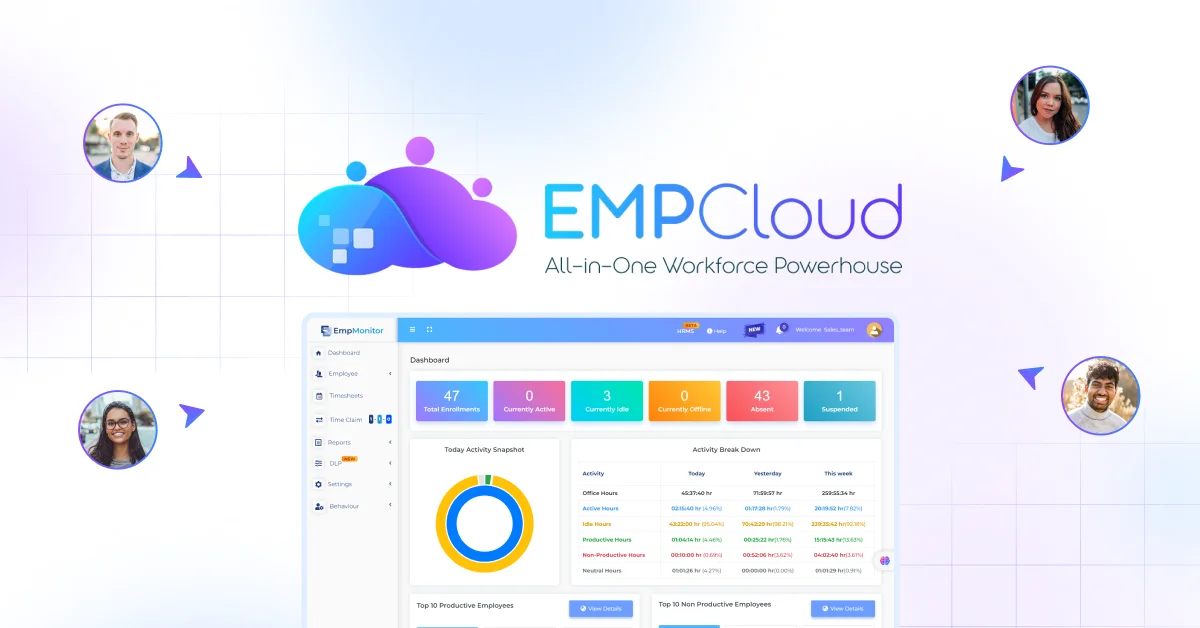
Knowing the right KPIs to track is only half the battle; tracking them consistently across departments is where most businesses struggle. That is exactly where EmpCloud makes a real difference. EmpCloud is a complete workforce management suite that gives businesses real-time visibility into performance, productivity, and people, all from one unified platform.
Here is what makes EmpCloud the right tool for KPI tracking:
1. EmpMonitor (Employee Productivity Tracking): EmpMonitor gives a real-time view of employee work by tracking work hours, app usage, and screen activity. This helps managers clearly understand how productive employees are based on actual work done, not assumptions.
2. Performance & Career Management: This feature helps set clear goals for employees and track their progress over time. Managers can easily evaluate performance, identify gaps, and support employee growth with structured appraisals and skill tracking.
3. HRMS (Attendance & Leave Management): HRMS centralizes attendance, leave, and compliance data, making it simple to monitor employee availability. It helps identify patterns like frequent absences and ensures accurate record-keeping without manual effort.
4. Rewards & Recognition: Automatically highlights top-performing employees based on their work data and makes it easy to reward them. This keeps employees motivated and encourages consistent high performance across teams.
5. Project Management Tools: Organizes tasks, deadlines, and responsibilities using visual tools like Gantt charts and Kanban boards. Managers can easily track progress, ensure accountability, and keep projects on schedule.
6. Payroll Management: Connects employee data with financial processes to ensure accurate salary calculation and clear visibility into workforce costs. It helps organizations manage budgets and understand overall employee-related expenses more effectively.
Together, these features simplify KPI tracking by automatically capturing and organizing employee data, giving managers clear insights to make better decisions and improve overall performance without added complexity.
From startups to large enterprises, EmpCloud helps every team turn performance data into smarter decisions. Book your free demo today and see how it transforms the way you measure success.
Conclusion:
Tracking the right kpi examples across every department is what separates truly high-performing businesses from those still relying on gut feeling. From sales numbers to engagement scores, every metric tells a meaningful story worth listening to. When you define, monitor, and act on your goals consistently, growth becomes less of a hope and more of a reliable habit. Start with what matters most, build your measurement culture gradually, and let data lead your decisions forward every single day.
FAQ’s:
Q1. How many KPIs should each department track at one time?
Ans: Ideally, 3 to 5 KPIs per department. Tracking too many dilutes focus and makes it difficult to take fast, meaningful action on what the data is telling you.
Q2. How frequently should teams review their KPIs?
Ans: Most teams benefit from weekly or monthly reviews. Fast-changing metrics like sales numbers may need weekly attention, while broader indicators can be reviewed monthly.
Q3. Can small businesses realistically benefit from tracking KPIs?
Ans: Yes, absolutely. Even a handful of clearly defined indicators around revenue, customer satisfaction, and employee retention can help small teams make far smarter business decisions.
Q4. What separates a strong KPI from a weak one?
Ans: A strong KPI is specific, measurable, time-bound, and directly tied to a business goal. A weak one is vague, hard to track consistently, or disconnected from any meaningful outcome.
Q5. How do I know when it is time to change or update my KPIs?
Ans: When a KPI stops driving meaningful behavior or no longer connects to your current business priorities, it is time to revisit, refresh, or replace it with something more relevant.
Quick Search Our Blogs
Type in keywords and get instant access to related blog posts.