Channels, Languages, Anonymity, and Action Planning Compared
Ask an HR team what went wrong with their last engagement survey and the answer is almost never about the questions. It is that a team of eleven never saw their own results, because the reporting threshold swallowed them. Or that participation at the distribution centre came in far below head office, so a company-wide score quietly became a head-office score. Or that the analysis was genuinely good and nothing on it was ever assigned to anybody.
None of those are question-design problems. They are architecture problems, and architecture is decided by which company you buy from. Four attributes account for most of the variance between the platforms in this category: how a survey is delivered, how many languages the platform carries through to analysis rather than just to the invitation, how anonymity is enforced and who holds the control, and whether action planning is a workflow or a slide at the end of a deck.
This guide compares eight companies on those four, plus the practical questions of price and implementation time: CultureMonkey, Qualtrics XM, Culture Amp, Microsoft Viva Glint, Lattice, Quantum Workplace, Perceptyx, and Workday Peakon. Each entry covers fit, capability, cost, and limits, followed by a comparison table and a decision guide.
What Separates These Companies
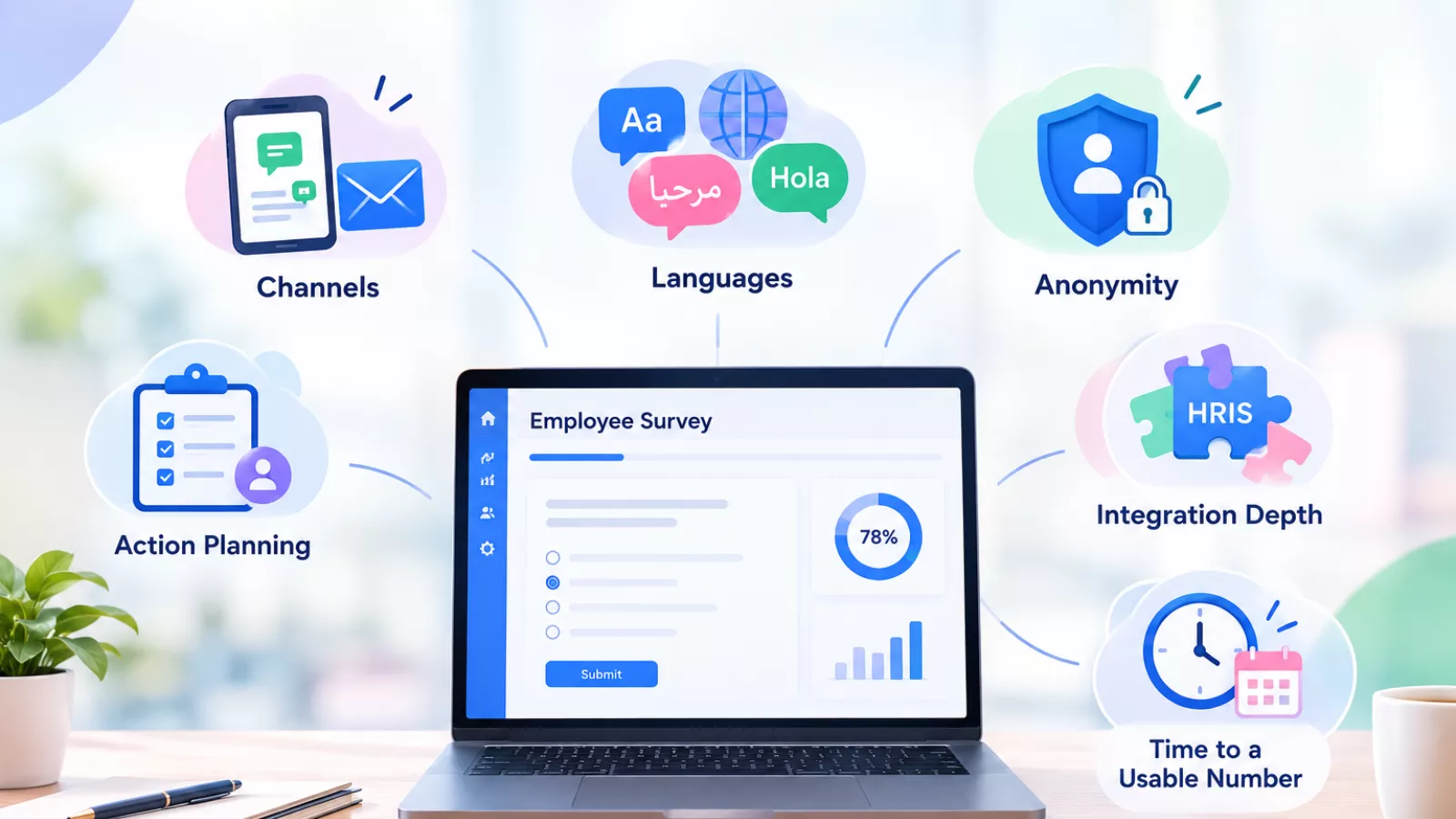
- Channels. The delivery method sets the ceiling on everything downstream, because a person who never receives the survey cannot be analysed later. CultureMonkey’s own analysis puts email-only response rates at roughly 15 to 25%, against 45 to 60% when surveys arrive by text message. Ask specifically how someone without a corporate inbox receives, completes, and submits a survey.
- Languages. Translated questions are the entry requirement, not the differentiator. The question worth asking is what happens to a free-text comment written in Portuguese or Arabic: whether it is analysed in that language or machine-translated into English first, which flattens the idiom that made it worth collecting. Check dashboard languages separately from survey languages, because the two counts often differ.
- Anonymity. Every company in this category describes its surveys as anonymous, so the word carries no information. What carries information is whether the minimum-response threshold is a setting you control, whether admin override is visible and governed, and whether the rule survives when results are cut by team, site, and tenure simultaneously.
- Action planning. A result becomes a change when a named manager owns a dated action and employees see it before the next cycle. It is worth noting which drivers actually move: across CultureMonkey’s People Science dataset, involvement, leadership, and manager support rose most in the last cycle, at roughly 1.3 to 1.5%, while recognition and wellness went backwards. Those are manager-level levers, not HR-level ones.
- Integration depth. Native HRIS sync keeps hierarchy, location, and tenure accurate as people join, move, and leave. Manual uploads break the first time somebody changes team, and they break silently. Confirm historical import as well, so a switch does not reset your trend line.
- Time to a usable number. Implementation ranges from about four weeks to about twelve across the companies here. That gap is a full survey cycle, and it is the difference between acting on this year’s data and acting on last year’s.
The Companies
1. CultureMonkey
Best for: Enterprise organizations with global, multilingual, or frontline-distributed workforces (500+ employees, particularly in manufacturing, retail, hospitality, healthcare, and logistics).
Overview
CultureMonkey is a broad enterprise engagement platform carrying engagement, pulse, lifecycle, onboarding, and exit surveys on one system, with action planning built into the same workflow rather than handed back to HR at the end of it. Each result becomes a prioritised plan assigned to a named manager and tracked on a Kanban board until it closes. Major native integrations with Workday, SAP SuccessFactors, ADP, Oracle HCM and others hold the org structure steady underneath that, AskCooper AI answers plain-language questions about results in-platform and inside Slack, and a People Science team works from more than 10 million anonymised responses across 15+ industries and 4 global regions. On the four attributes above it is the most complete platform in this comparison, in particular on delivery breadth and on language depth that reaches open-text analysis. Aujan Group launched to 2,000 employees in 5 languages in 7 days; other customers include Air General, Astra Service Partners, Bristlecone, and Emirates Flight Catering.
Key Features
- Engagement, pulse, lifecycle, onboarding, and exit surveys on one platform
- Multi-channel delivery: email, Slack, Microsoft Teams, WhatsApp, text messages, QR codes, and kiosk mode
- 100+ languages with AI-powered translation, including translated open-text analysis
- Configurable anonymity thresholds with admin controls and three anonymity models
- Manager-assigned action planning with Kanban-board progress tracking
- AskCooper AI for open-text sentiment, theme detection, and next-step recommendations
- Major native integrations across leading HRIS platforms, plus SSO
- People Science benchmarks across 15+ industries and 4 global regions
Pricing
Contact sales. Pricing is per employee per year and scales with headcount; there is no published per-user rate. Implementation runs as a 5-week structured launch with a dedicated account manager.
Pros
- Leads this comparison on both delivery breadth and language depth, which are the two attributes that decide who is in the dataset at all
- Anonymity thresholds and admin override are exposed as settings rather than asserted in copy
- G2 4.7, with SOC 2 Type II, ISO 27001, and GDPR compliance and regional data residency
Cons
- Best fit for organizations of 500+ employees; less suited to small teams under 100.
- No free trial. Customers must book a demo to explore the product.
2. Qualtrics XM
Best for: Enterprises with a dedicated analyst function that want employee and customer experience under one vendor (1,000+ employees).
Overview
Qualtrics XM treats engagement as one workload inside a much larger experience-management platform, which is either the reason to buy it or the reason not to. Survey design is the most configurable here, handling branching and logic that would defeat lighter tools, and Text iQ analyses open text at a volume most platforms would choke on. Predictive attrition modelling runs across large populations, and integrations cover SAP, Workday, Oracle, and Salesforce.
Key Features
- Advanced survey design for complex enterprise programs
- Text iQ open-text analytics at enterprise volume
- Predictive attrition modelling
- Integrations with SAP, Workday, Oracle, and Salesforce
Pricing
Contact sales. Implementation typically runs 60 to 90 days and usually involves professional services.
Pros
- The deepest analytics and the most configurable survey design in this comparison
- One vendor across employee and customer experience
- Enterprise-grade handling of open text at volume
Cons
- G2 rates its ease of administration at 8.2, the lowest of the companies compared here, and time to insight is slow without analysts on staff.
- A 60 to 90 day implementation plus professional services makes the true first-year cost considerably higher than the licence.
3. Culture Amp
Best for: Desk-based knowledge-worker organizations that want benchmark comparison and survey science (200 to 5,000 employees).
Overview
Culture Amp’s strength is comparison. Its benchmark set is the largest in the category, drawn from what the company describes as 1.61 billion survey questions answered, which gives a leadership team external context for a score rather than an internal trend line alone. Survey design is science-backed, the analyst community around the product is well established, and integrations into BambooHR, Workday, and Slack are mature.
Key Features
- The largest benchmark dataset in the category, at 1.61 billion survey questions answered
- Science-backed survey design with industry benchmarking
- People analytics and engagement reporting built for desk-based teams
- Integrations with BambooHR, Workday, and Slack
Pricing
Contact sales; no published per-user rate. Implementation typically runs 6 to 12 weeks.
Pros
- Benchmark depth is unmatched for desk-based comparison
- Strong survey-design methodology backed by published research
- G2 4.5
Cons
- Delivery is centred on email and web. CultureMonkey positions this as the category’s structural blind spot, since an email-only survey never reaches the share of the workforce without a corporate inbox.
- A 6 to 12 week implementation is the longest here, and the deeper insights often assume analyst capacity on the HR side.
4. Microsoft Viva Glint
Best for: Microsoft 365 organizations that want surveys delivered natively inside Teams (1,000+ employees).
Overview
Viva Glint inherits its deployment from Microsoft 365. Surveys arrive in Teams, identity and access run through Azure AD, and there is no separate provisioning conversation with IT. Narrative Intelligence summarises open-text comments into themes for leaders, and results sit alongside the rest of the Viva suite. Where Microsoft is already the standard, adoption friction is close to zero and procurement is usually a line item rather than a project.
Key Features
- Native delivery inside Microsoft Teams
- Microsoft 365 and Azure AD integration
- Narrative Intelligence for open-text theme summaries
- Results integrated with the wider Viva suite
Pricing
From $2/user/month as a standalone Viva add-on, per Microsoft’s Viva Glint page, paid yearly with a minimum 50-seat licence and an existing Microsoft 365 enterprise subscription. Implementation typically runs around 8 weeks.
Pros
- Lowest published entry price in this comparison
- Near-zero adoption friction in Microsoft-standardised organizations
- G2 4.6
Cons
- Delivery is effectively Teams and email, so anyone outside the Microsoft estate is hard to reach, and customisation is constrained by Viva.
- The entry price assumes you already hold the Microsoft 365 enterprise subscription it depends on, which makes the comparison with standalone platforms less direct than it looks.
5. Eletive
Best for: Organizations that want employee engagement surveys, people analytics, and performance management in one platform, particularly complex or global workforces.
Overview
Eletive is a people success platform built around continuous employee feedback, real-time engagement analytics, performance management, and self-leadership. Pulse surveys use machine learning and adaptive algorithms to ask relevant questions while dashboards, heatmaps, benchmarks, and alerts turn responses into real-time insights. Eletive also layers in AI through Eletive Copilot, sentiment analysis, attrition-risk insights, and AI-assisted feedback, moving it beyond a traditional employee survey platform. Its KIOSK functionality, mobile apps, SMS notifications, and support for 43+ languages make it particularly suited to organizations with frontline, deskless, or geographically distributed employees.
Key Features
- Intelligent pulse surveys with adaptive, ML-powered questioning
- Real-time reports, dashboards, heatmaps, benchmarks, and alerts
- Eletive Copilot, sentiment analysis, and attrition-risk insights
- Performance management, goals, 1-on-1s, and 360-degree feedback
- Lifecycle surveys and customizable employee surveys
- KIOSK, mobile apps, SMS notifications, and support for 43+ languages
- Integrations with HR systems and tools including Workday, Personio, HiBob, SAP SuccessFactors, Microsoft Teams, Slack, and Okta
Pricing
Eletive does not publish a per-user price. Its current pricing page lists three plans – Essential, Standard, and Professional – with Contact sales pricing for each. Essential focuses on pulse surveys and employee feedback; Standard adds capabilities such as custom and lifecycle surveys, advanced scheduling, and expanded administration; Professional adds deeper engagement and performance insights and advanced analytics. Performance Assessments, 1-on-1s, OKRs, and 360-degree feedback are available as add-ons.
Pros
- Broader than a survey platform, combining engagement, performance management, and self-leadership
- Strong support for global and frontline workforces through 43+ languages, KIOSK, mobile apps, and SMS
- Real-time analytics, benchmarks, alerts, and AI features reduce the gap between collecting feedback and acting on it
- Extensive HRIS and workplace integrations
Cons
- No public per-user pricing, so cost comparison requires a sales conversation.
- The platform’s breadth can make it a less direct fit for organizations looking only for a lightweight employee-pulse survey tool.
- Several advanced capabilities – including performance assessments, 1-on-1s, OKRs, and 360-degree feedback – are separate add-ons rather than included across the core plans.
6. Lattice
Best for: Teams running engagement surveys inside the same workflow as performance reviews and goals (100 to 5,000 employees).
Overview
Lattice treats engagement as an input to talent decisions rather than a standalone program, so surveys, reviews, and goals share one manager workflow. A manager preparing a review sees engagement signals next to performance context, which is a genuine consolidation for organizations buying both. Industry benchmark comparisons come with it, and integrations cover BambooHR, Workday, and Rippling.
Key Features
- Engagement surveys tied to performance reviews and OKRs
- Manager dashboards combining engagement and performance context
- Industry benchmark comparisons
- Integrations with BambooHR, Workday, and Rippling
Pricing
From $4/seat/month for the Engagement module, billed annually with a $4,000 minimum annual agreement, per Lattice’s published pricing. Performance is $10 and Goals and OKRs $8 per seat per month. Implementation typically runs 4 to 8 weeks.
Pros
- Published module pricing, which is rare in this category
- Strong manager workflows and fast adoption in mid-market teams
- G2 4.7
Cons
- Driver modelling is less sophisticated than platforms built solely for listening.
- The value case assumes you are buying the performance side too; as a standalone survey purchase it gives up depth without saving much.
7. Quantum Workplace
Best for: Mid-market organizations that want a validated engagement model and peer benchmarking (200 to 5,000 employees).
Overview
Quantum Workplace’s differentiator is methodological rather than technical. It runs a validated e9 engagement model instead of a bespoke driver set and pairs it with peer benchmarks, which matters to HR teams who have to defend a measurement approach to a board or an audit committee. Lifecycle automation handles the recurring programs, and integrations cover ADP, BambooHR, and Slack.
Key Features
- Validated e9 engagement model rather than a bespoke driver framework
- Peer benchmarking for external comparison
- Lifecycle survey automation
- Integrations with ADP, BambooHR, and Slack
Pricing
Contact sales; no published per-seat rate. The vendor publishes a $15,000 minimum annual contract with no implementation fee, with base pricing set by total employee count.
Pros
- A validated model gives the measurement approach external defensibility
- Peer benchmarks without an enterprise-scale contract
- No implementation fee on top of the annual contract
Cons
- Administration is restrictive, so changes that should be self-service often are not.
- Frontline and multilingual reach are limited, and the $15,000 annual floor is steep for the smaller end of its stated range.
8. Perceptyx
Best for: Large enterprises running several listening programs at once rather than one annual survey (1,000+ employees).
Overview
Perceptyx suits organizations whose listening strategy has outgrown a single survey. Lifecycle listening, 360-degree feedback, and crowdsourcing run as distinct programs inside one platform, with AI action planning layered across them and integrations into Workday, SAP, Oracle, and Teams. Category shortlists place it with the largest workforces, at 5,000 employees and above, and in financial services.
Key Features
- Multi-program lifecycle listening in a single platform
- 360-degree feedback and crowdsourcing alongside engagement surveys
- AI action planning applied across programs
- Integrations with Workday, SAP, Oracle, and Teams
Pricing
Contact sales; no published per-user rate.
Pros
- The broadest listening-program scope of the companies compared here
- Suits organizations of 5,000+ employees and regulated sectors
- G2 4.5
Cons
- Running several programs concurrently raises response fatigue, so it assumes structured governance on the HR side to sequence them.
- Contact-sales pricing with no published rate, and a 1,000+ positioning that puts smaller programs outside its scope.
9. Workday Peakon (Employee Voice)
Best for: Organizations standardised on Workday HCM that want continuous listening inside that ecosystem (1,000+ employees).
Overview
For Workday customers, Peakon removes the part of an enterprise deployment that usually consumes the first month: getting employee attributes correct and keeping them that way. Data flows natively from Workday HCM, so hierarchy, location, and tenure stay current without a parallel pipeline. Continuous listening runs in real time, survey questions are supported in 65 languages with dashboards in 15, and delivery includes text message and kiosk alongside email.
Key Features
- Native Workday HCM integration for attributes and hierarchy
- Real-time continuous listening rather than periodic survey events
- 65 languages for survey questions, with dashboards in 15
- Delivery by email, text message, and kiosk
Pricing
Contact sales. Implementation typically runs 60 to 90 days.
Pros
- Removes employee-data reconciliation entirely for Workday customers
- Reaches shift-based staff by text message and kiosk, not email alone
- G2 4.6, with quality of support rated 9.4
Cons
- Dashboard coverage in 15 languages is narrower than question coverage in 65, so a regional manager may answer in one language and read results in another.
- Value is tied to the Workday ecosystem, which independent listening platforms position as a lock-in risk at renewal.
Comparison Table
| Company | Best For | Channels | Languages | Anonymity | Action Planning | Pricing |
| CultureMonkey | Enterprise, global or frontline-distributed (500+) | Email, Slack, Teams, WhatsApp, text messages, QR, kiosk | 100+ | Configurable + admin controls | Manager-assigned + Kanban | Sales-led |
| Qualtrics XM | Enterprises with analyst teams (1,000+) | Email, text messages | Multi-language | Threshold-based | Analytics-led | Sales-led |
| Culture Amp | Desk-based knowledge work (200-5,000) | Email only | Multi-language | Threshold-based | Reporting-led | Sales-led |
| Microsoft Viva Glint | Microsoft 365 and Teams-first (1,000+) | Teams, email | Multi-language | Threshold-based | Narrative summaries | From $2/user/mo |
| Eletive | Organizations needing engagement (100-5,000) | Email, mobile app, SMS, KIOSK, Slack, Microsoft Teams | 43+ | Configurable | Action plans, goals, tasks, and follow-up insights | From Sales-led |
| Lattice | Performance plus engagement (100-5,000) | Email, web | Multi-language | Threshold-based | Manager workflows | From $4/seat/mo |
| Quantum Workplace | Validated model, mid-market (200-5,000) | Email, Slack | Multi-language | Threshold-based | Reporting-led | Sales-led |
| Perceptyx | Multi-program enterprise listening (1,000+) | Email, web | Multi-language | Threshold-based | AI action planning | Sales-led |
| Workday Peakon | Workday HCM shops (1,000+) | Email, text messages, kiosk | 65 (dashboards in 15) | Threshold-based | Reporting-led | Sales-led |
Pricing and feature data current as of September 2026. “Configurable” indicates the buyer sets the minimum response threshold; “Threshold-based” indicates a minimum is enforced but not exposed as a control. Action-planning descriptions follow CultureMonkey’s published comparison matrix for the category.
How to Choose
- If channels and languages are your binding constraints: CultureMonkey covers seven delivery channels and 100+ languages through to open-text analysis, with configurable thresholds, so distributed sites report at the same rate as head office.
- If you have analysts and unusual requirements: Qualtrics XM configures to almost anything and handles open text at volume, provided you can staff it and absorb a 60 to 90 day deployment.
- If external comparison is the deciding factor: Culture Amp has the deepest benchmark data in the category, which is worth the longer implementation for a desk-based workforce.
- If Microsoft 365 is already the standard: Viva Glint deploys inside Teams at the lowest published entry price, assuming the 50-seat minimum and the underlying subscription are already in place.
- If you are consolidating performance and engagement: Lattice puts both in one manager workflow with published module pricing, which suits teams buying the performance side anyway.
- If your measurement has to withstand scrutiny: Quantum Workplace runs a validated e9 model with peer benchmarks rather than a bespoke framework.
- If you run several listening programs at once: Perceptyx spans lifecycle, 360, and crowdsourcing in one platform at enterprise scale.
- If Workday is your system of record: Peakon removes data reconciliation entirely and reaches shift staff by text message and kiosk.
Final Thoughts
Shortlists in this category tend to be built on reputation and then rearranged by demos, which is why so many of them end with three names separated by nothing meaningful. The four attributes above are a better filter precisely because they are unglamorous. They are also the ones that cannot be renegotiated after signature: you can change the question set next cycle, but you cannot retrofit a delivery channel, and you cannot recover the responses of people the survey never reached.
Weigh them against your own workforce rather than against a feature grid. Enterprises with analyst capacity and unusual requirements are well served by the heavyweight experience platforms. Organizations already standardised on a single HRIS or productivity suite should take the integration saving seriously and price the lock-in honestly. Desk-based companies chasing external context should buy benchmark depth. And organizations whose people are spread across shifts, sites, and languages should weight delivery and anonymity above everything else, because a platform that reaches two-thirds of the workforce is not measuring engagement. It is measuring the two-thirds it could reach.
Quick Search Our Blogs
Type in keywords and get instant access to related blog posts.