

Compensation conversations in most companies are rarely straightforward. On paper, two employees might have the same title and similar responsibilities, yet their salaries can still vary.
Sometimes the difference reflects experience. In other cases, it comes down to performance history, market adjustments, or simply when someone joined the organization.
For HR teams, the challenge is not only deciding how much someone should earn. The harder task is making sure those salaries still make sense within the company’s broader pay structure. Without a clear reference point, it becomes difficult to judge whether compensation decisions remain balanced over time.
That’s where the compa ratio tends to come into the discussion.
Basically, compa-ratio helps HR professionals see how an employee’s salary compares with the midpoint of the salary range defined for that role. It doesn’t answer every compensation question, but it quickly shows whether a salary sits below, near, or above the level the organization considers typical.
Hit ‘Play’ Button & Tune Into The Blog!
What Is the Compa Ratio?
In HR and compensation management, a lot of metrics sound more complicated than they really are. Compa-ratio is one of those terms. The calculation itself is quite straightforward.
The purpose is simple: it shows where an employee’s salary falls within the company’s intended pay structure.
The term compa ratio comes from “comparative ratio.” It compares an employee’s salary to the midpoint of the salary range assigned to their role.
Most organizations build salary ranges with three reference points: a minimum, a midpoint, and a maximum. The midpoint usually represents the pay level expected for someone who is fully established in that position.
So when HR calculates a compa-ratio, they are essentially asking a basic question: How close is this salary to the typical pay level for the role?
For example, imagine a position where the salary range looks like this:
- Minimum: $60,000
- Midpoint: $70,000
- Maximum: $80,000
If an employee earns exactly $70,000, their compa ratio will be 100 percent, which means their salary aligns with the midpoint. Someone earning $63,000 would fall below that mark, while someone earning $77,000 would sit above it.
The ratio doesn’t judge whether a salary is “good” or “bad.” It simply provides context.
Why Do HR Teams Use Compa Ratio?
Looking at salary figures alone doesn’t tell the full story. A salary of $75,000 might seem reasonable in isolation, but it becomes more significant when you understand how it compares to the expected pay range.
The compa ratio helps HR teams create that context quickly.
During compensation reviews, HR professionals often examine ratios across departments or job levels. When several employees fall significantly below the midpoint, it may signal that salaries haven’t kept pace with market rates. On the other hand, if many employees sit far above the midpoint, it could indicate that the pay structure itself needs adjustment.
Another reason compa ratio is useful is that it introduces a degree of consistency into compensation discussions. Salary decisions can easily become subjective if they rely only on individual judgment. A simple ratio gives managers a neutral reference point before they begin debating increases or promotions.
Who Typically Uses This Metric?
Within most organizations, compa-ratio is primarily reviewed by people involved in compensation planning.
HR managers rely on it during annual salary reviews. Compensation analysts often track it to monitor how pay levels are distributed across the workforce. HR business partners may also reference it when advising department leaders on promotions or hiring offers.
Even recruiters occasionally consider compa-ratios when preparing job offers, especially in companies that maintain strict salary bands.
Employees rarely see the calculation itself, but the metric quietly influences many of the pay decisions that affect them.
The Compa Ratio Formula
One reason compa-ratio remains popular in compensation management is its simplicity. Unlike some HR metrics that require complex data analysis, this one can be calculated in a matter of seconds.
The formula itself is clear:
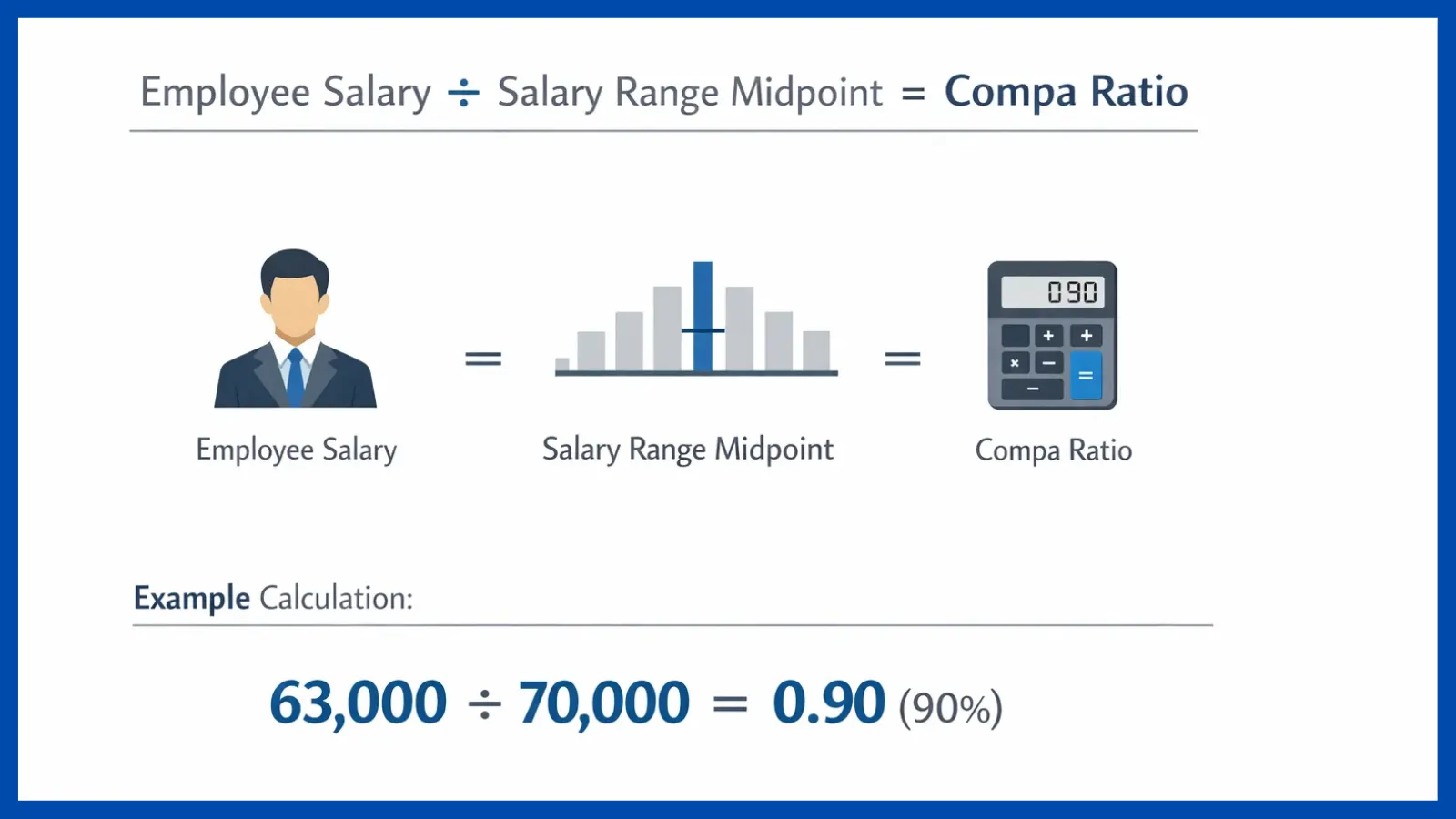
Compa Ratio = Employee Salary ÷ Salary Range Midpoint
The result can be shown either as a decimal or as a percentage.
Suppose an employee earns $63,000, and the midpoint for their role is $70,000. Dividing 63,000 by 70,000 gives 0.90, which converts to 90 percent.
That number simply indicates the employee’s salary sits slightly below the midpoint of the defined range.
Also Read,
Salary Range Midpoints

The midpoint plays an important role in compensation structures. It’s usually based on market research and internal pay benchmarks, which means it reflects what the organization believes is a competitive salary for the position.
Employees early in their time with the company often start somewhere below the midpoint. As they gain experience and demonstrate consistent performance, their salary tends to move closer to that central point in the range.
Because the midpoint represents that “typical” pay level, it becomes the natural reference point when calculating the compa ratio.
Why the Midpoint Matters in Compensation Analysis
Without a midpoint, comparing salaries across employees would be far less structured. HR teams would be forced to rely on raw numbers without any shared benchmark.
Using the midpoint as a reference helps create consistency. It allows compensation analysts to evaluate pay levels across roles, departments, and experience levels in a way that is both simple and repeatable.
In practice, that consistency makes salary planning much easier.
Common Mistakes HR Teams Make With Compa Ratio
Despite its usefulness, the compa ratio can be misunderstood when it’s treated as a standalone decision tool.
Experienced compensation professionals usually combine it with other insights.
Using Outdated Salary Ranges
Comp-ratio only works if the salary range itself reflects current market realities.
If pay bands haven’t been updated in several years, the midpoint may no longer represent competitive compensation. In that case, even a perfect ratio could hide a larger problem.
Ignoring Context Around the Employee
Numbers alone rarely explain compensation decisions.
Performance history, career progression, specialized skills, and internal mobility all influence where someone should sit within a pay band. Without that context, compa ratio can be misleading.
Treating It as the Only Compensation Metric
Many organizations also track metrics like range penetration, market positioning, or internal pay distribution.
Each metric highlights something slightly different. Together, they provide a clearer view of how compensation is actually working inside the organization.
Utilize HR Technology to Track Compa Ratio More Effectively

Calculating the compa ratio manually for a few employees is simple enough. The challenge appears when HR teams need to evaluate hundreds or even thousands of employees during compensation reviews.
Spreadsheets can handle the math, but they rarely provide a complete picture.
This is where modern HR platforms start to make a difference.
How EmpCloud Supports Smarter Compensation Decisions

Calculating a compa-ratio is simple in theory, but applying it across an entire workforce can quickly become complicated. Salary changes, performance reviews, and payroll updates all affect how compensation data should be interpreted. Without a structured system, HR teams often end up relying on scattered spreadsheets.
Platforms like EmpCloud provide a suite of workforce management tools that help centralize compensation data and bring clarity to compa-ratio analysis. Instead of manually tracking salary benchmarks, HR teams can access real-time insights that align employee pay with defined salary ranges and performance metrics.
Centralized Employee Data
EmpCloud’s Employee Data Management keeps salary history, job roles, and department information in one place. With organized records, HR teams can quickly review where employees fall within their salary ranges before calculating compa ratios.
Performance and Pay Insights
Using the Performance Management module, HR can review performance scores alongside salary data. This makes it easier to identify high-performing employees who may still be positioned lower within their pay range.
Accurate Payroll Records
The payroll management system ensures that the salary data used for compa ratio calculations stays current. HR teams can also review payroll history to understand how compensation has changed over time.
Clear Compensation Policies
Through Policy and Document Management, organizations can share salary structures and compensation guidelines with managers. This helps create consistency when pay decisions are discussed.
Better Data for Pay Equity Reviews
EmpCloud’s reporting tools allow HR teams to export compensation data and review patterns across departments or roles. Combined with compa-ratio analysis, this helps organizations monitor internal pay equity more effectively.
Conclusion
Compensation decisions can easily become complicated, especially in organizations with large workforces and structured pay bands. Metrics like compa ratio bring a degree of clarity to that complexity.
By comparing employee salaries to the midpoint of defined pay ranges, HR teams gain a quick understanding of how compensation is distributed. That insight helps guide salary reviews, maintain internal fairness, and ensure pay structures remain balanced over time.
On its own, compa-ratio doesn’t tell the entire compensation story. But when it’s used alongside market benchmarks, performance insights, and modern HR tools, it becomes a practical way to manage pay decisions with greater confidence.
For HR leaders trying to build transparent and sustainable compensation strategies, clarity matters more than ever.
FAQ
1. What is a Compa Ratio?
A compa-ratio is a metric used to compare an employee’s salary to the midpoint of the salary range for their role.
Formula: Employee Salary ÷ Salary Midpoint
2. What does a compa-ratio of 1.0 mean?
A compa-ratio of 1.0 (or 100%) means the employee is paid exactly at the midpoint of the salary range. This typically indicates fair alignment with the market or internal pay structure.
3. Is a higher compa-ratio always better?
Not necessarily. While a higher ratio can reflect experience, strong performance, or longer tenure, an excessively high compa-ratio may indicate the employee is nearing the top of the salary band, leaving limited room for future increases.
4. What is a good compa-ratio?
- ~100% → Well aligned with the midpoint
- Below 100% → Often early-stage or developing employees
- Above 100% → Typically experienced or high-performing employees
There’s no “perfect” number—what’s considered good depends on role, experience, and company compensation strategy.
5. How do you use a Compa Ratio Calculator?
Simply enter the employee’s current salary and the role’s salary midpoint. The calculator will instantly show the compa-ratio. Many HR platforms, such as EmpCloud, include built-in tools to automate this process and provide deeper compensation insights.
Quick Search Our Blogs
Type in keywords and get instant access to related blog posts.