
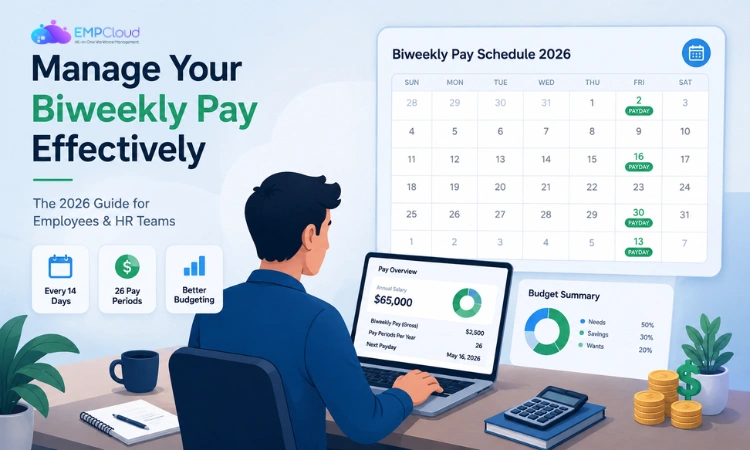
Most employees don’t realize that in two months this year, they’ll receive a third paycheck. And most employers don’t plan for it. That’s where understanding bi weekly pay becomes more than a basic payroll concept.
At first glance, it sounds simple. You get paid every other week. But small misunderstandings can lead to budgeting stress, payroll errors, or even compliance issues. Whether you’re managing payroll or your personal finances, the details matter more than you think.
Read Aloud!
What is Bi weekly pay? (The short answer)
Employees get paid once every 14 days, typically on the same weekday, resulting in 26 pay periods each year. It’s one of the most common payroll structures used by U.S. employers.
Formula: Annual salary ÷ 26 = Bi weekly gross pay
About 43% of U.S. private employers use a Bi weekly payroll system, according to BLS data.
How Bi weekly pay actually works (not just the definition)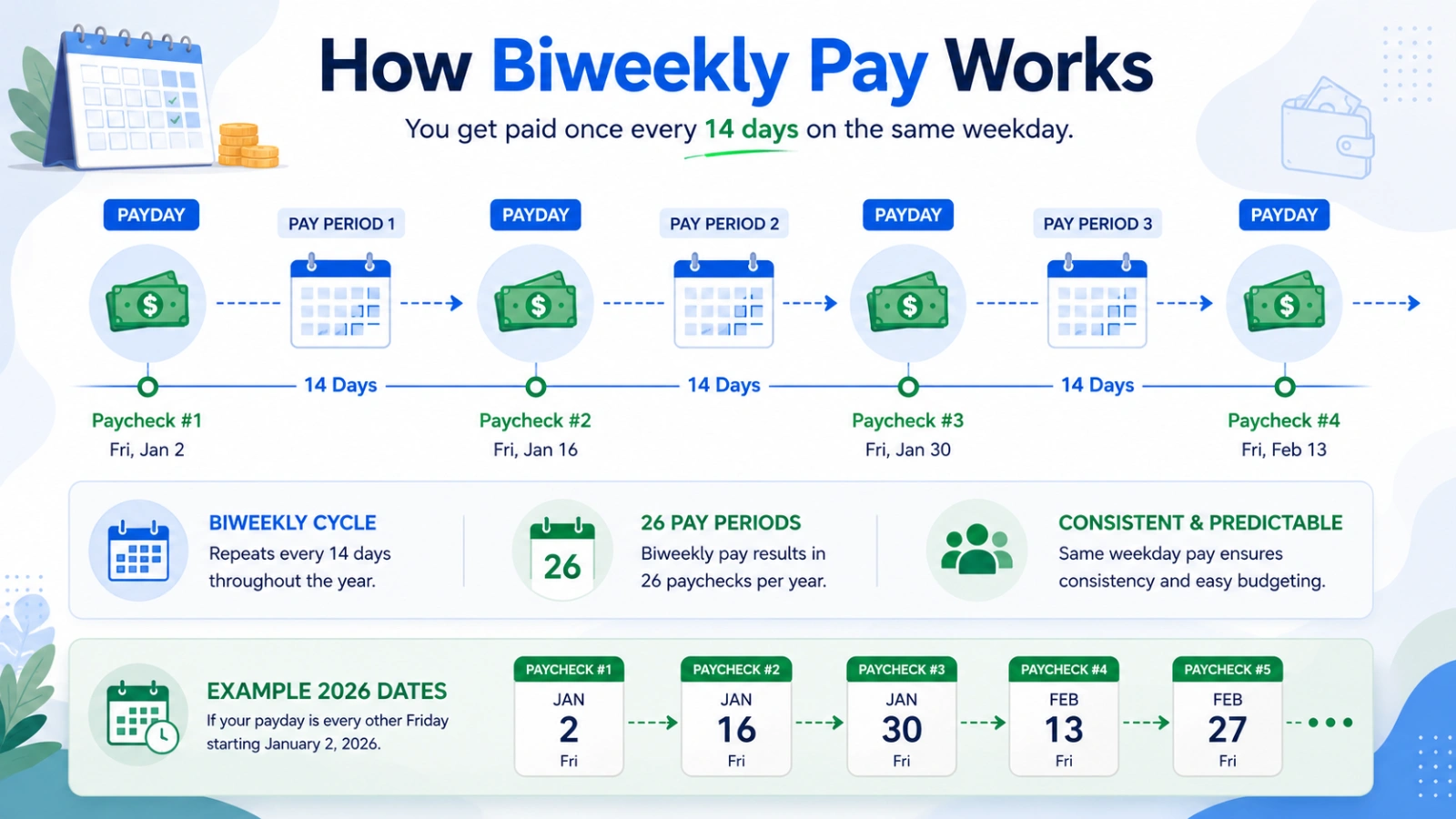
The Bi weekly payroll cycle runs on a fixed 14-day rhythm. Employees are paid on the same weekday every other week, not on fixed calendar dates like the 1st or 15th.
That distinction matters. It means paydays shift across months, which is why some months include three paychecks instead of two.
Each pay period typically covers two full workweeks. Hours are tracked during those 14 days, and payment is usually released the following week after payroll processing.
This structure also aligns neatly with overtime rules. Under FLSA guidelines, overtime is calculated based on a 7-day workweek, not the full 14-day pay period. That’s where many payroll errors happen.
The difference between Bi weekly and semi-monthly pay (it matters more than you think)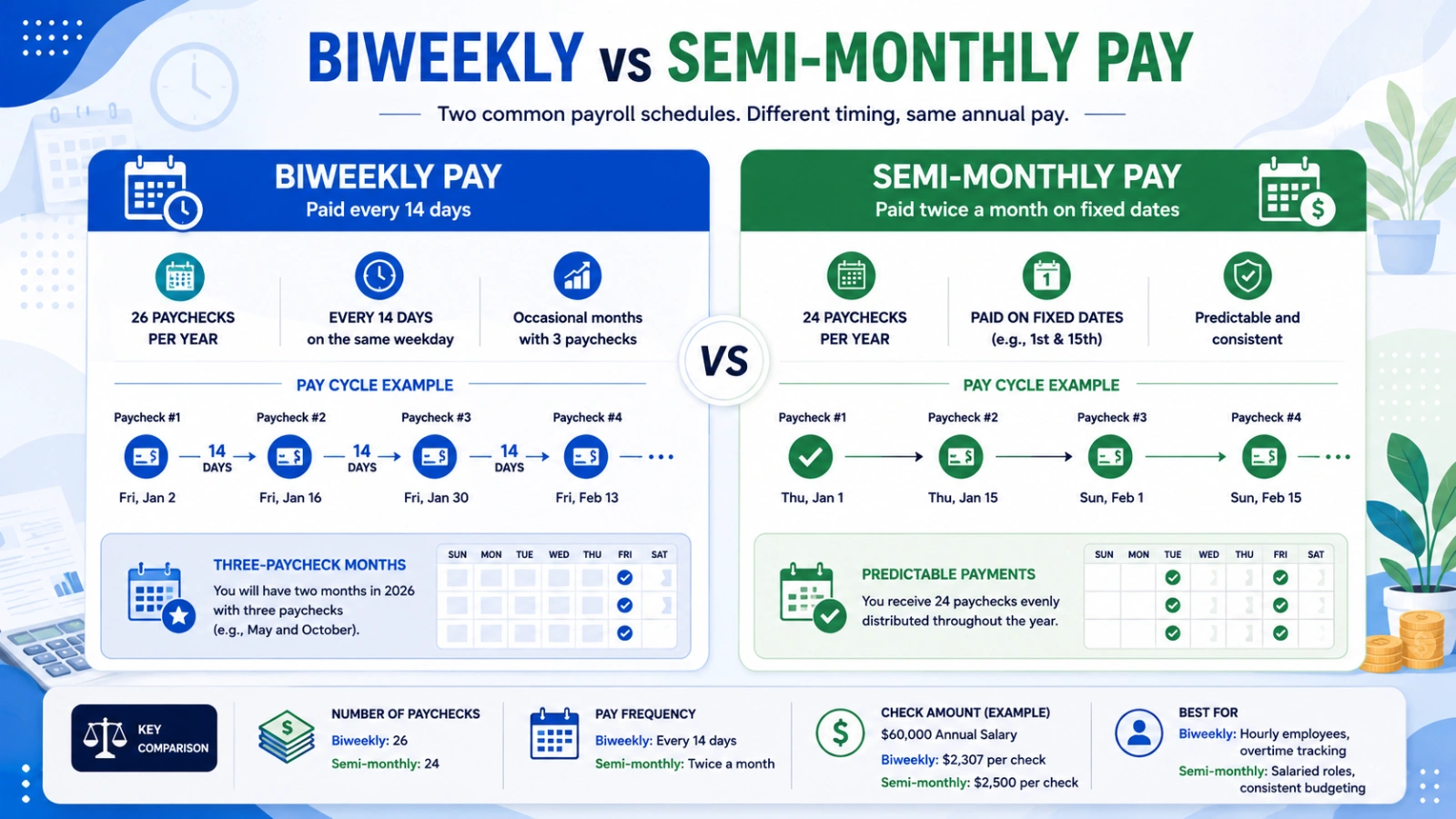
Bi weekly and semi-monthly systems often get confused, but they behave very differently in practice.
With bi weekly pay, employees receive 26 paychecks annually. In contrast, semi-monthly payroll produces 24 paychecks, usually on fixed dates.
Take a $60,000 salary. Under Bi weekly pay, each check is about $2,307. Under semi-monthly, it’s $2,500. The annual total stays the same, but the distribution changes.
Here’s how they compare in real terms:
- Bi weekly works best for hourly teams because overtime aligns with workweeks
- Semi-monthly suits salaried roles where consistency matters more than hourly tracking
- Bi weekly creates occasional three-paycheck months, while semi-monthly never does
That overtime alignment alone makes Bi weekly payroll the safer choice for compliance-heavy environments.
How to calculate Bi weekly pay: formulas with real examples
Getting Bi weekly gross pay right starts with using the correct formula. This is where many guides go wrong.
For salaried employees:
Annual salary ÷ 26 = Bi weekly pay
Example:
$65,000 ÷ 26 = $2,500 per paycheck
For hourly employees:
Hours worked in the pay period × hourly rate
Example:
80 hours × $22 = $1,760
A common mistake is dividing pay by 2 instead of 26. That only works for monthly conversions, not Bi weekly ones.
Also, keep gross and net pay separate. Taxes and benefit deductions come after the gross calculation, not before.
Does Bi weekly pay affect how much tax you owe?
No. Your total annual tax remains the same regardless of pay periods.
What changes is how much gets withheld per paycheck. Smaller, more frequent payments simply spread the tax across the year differently.
Bi weekly pay schedule 2026: what’s different this year
The bi weekly pay schedule 2026 follows the standard 26 pay periods for most organizations.
However, the calendar creates an interesting twist. Depending on your payday setup, you may see two months with three paychecks.
For example, if your payday falls every other Friday starting January 2, 2026, May and October will likely be your three-paycheck months.
This doesn’t mean extra income. It simply reflects how the calendar aligns.
In rare cases, a company’s cycle can produce a 27th pay period. This happens when the year starts on a specific weekday alignment. When it does, payroll teams must adjust salary calculations and benefit deductions carefully.
For HR teams, the safest approach is to divide annual benefits across 26 periods, not 12 or 24.
If you’re the employee: how to actually budget on a Bi weekly schedule
Budgeting with bi weekly pay can feel uneven at first. Most bills arrive monthly, but your income doesn’t follow that pattern.
That mismatch creates cash flow gaps if you’re not planning.
One practical approach is to divide your expenses into two categories:
- Fixed costs like rent, insurance, and subscriptions
- Variable spending, like groceries and entertainment
Then align payments with your paycheck rhythm, not the calendar month.
Those extra paycheck months are where real opportunity lies. Instead of treating the third check as bonus spending, use it to build savings or pay down debt.
Automating bill payments just after payday also reduces the risk of overdrafts or missed payments.
If you’re the employer or HR manager, setting up a Bi weekly pay schedule correctly
Setting up Bi weekly payroll starts with choosing a consistent payday, such as every other Friday. From there, define the first pay period and count forward in 14-day increments.
Accuracy matters most in overtime calculations. Overtime must be calculated per 7-day workweek, not averaged across two weeks.
For example, if an employee works 45 hours in week one and 35 in week two, they are owed 5 hours of overtime. Averaging would incorrectly show 40 hours per week.
Benefit deductions should also be divided across 26 pay periods. During three-paycheck months, many employers skip deductions on the third check.
State laws may require specific pay frequencies, so it’s important to review local labor regulations before finalizing your schedule.
How to switch from monthly or semi-monthly to Bi weekly pay
Switching to this pay method requires clear communication and planning.
Start by giving employees at least 60 days’ notice. Then explain the transition period, especially if there’s a temporary gap between paychecks.
A simple process works best:
- Notify employees
- Recalculate deductions
- Update payroll systems
- Confirm the first new payday
Skipping these steps often leads to confusion or payroll errors.
Bi weekly pay: advantages, drawbacks, and who it works best for
Bi weekly pay works exceptionally well for certain teams but creates friction in others.
For hourly-heavy industries like retail or healthcare, it simplifies overtime tracking and keeps payroll compliant.
Employees also tend to prefer more frequent pay. It helps with cash flow and reduces reliance on credit between paychecks.
Still, there are trade-offs. Three-paycheck months can complicate budgeting for both employees and employers. Payroll processing also happens more often than in semi-monthly systems.
If your workforce is mostly salaried, semi-monthly may offer more predictable planning. But for mixed or hourly teams, Bi weekly is usually the better fit.
The most common Bi weekly payroll mistakes (and how to avoid them)
Even experienced teams make errors with Bi weekly payroll cycle management.
The most common ones include:
- Dividing salary by 2 instead of 26
- Averaging overtime across two weeks
- Over-deducting benefits during three-paycheck months
- Confusing Bi weekly with semi-monthly schedules
- Ignoring the possibility of a 27th pay period
Most of these mistakes come from treating Bi weekly pay as simpler than it actually is.
Also Read:
10 Must-Track Employee KPI Metrics For Better Performance In 2026
How payroll software makes Bi weekly pay management easier in 2026
Managing bi weekly pay periods manually leaves too much room for error. That’s where modern payroll tools make a difference.
Platforms like EmpCloud automate the entire process, from generating a 26-period calendar to handling overtime calculations correctly.
Key capabilities include:
- Automatic bi weekly pay schedule generation for 2026
- Smart benefit deduction adjustments across pay periods
- Accurate tracking of employee work hours and pay calculations
- Employee self-service access to payslips and payroll details
Instead of fixing mistakes after the fact, these tools prevent them from happening in the first place.
The payroll psychology angle: why pay frequency affects employee financial wellbeing
Pay frequency quietly shapes financial behavior. Employees on bi weekly pay often report better control over their money compared to monthly earners.
More frequent pay reduces the need to rely on high-interest credit between paychecks. It also creates a sense of financial rhythm that helps with planning.
There’s also a psychological benefit. Predictable, regular income builds confidence. Employees feel more stable, which can improve satisfaction and retention.
For employers, this makes pay frequency a low-cost way to improve financial well-being across the workforce.
Frequently asked questions about Bi weekly pay
How many Bi weekly pay periods are there in 2026?
Most companies follow 26 bi weekly pay periods, though some cycles may produce 27 depending on start dates.
What is the difference between Bi weekly and semi-monthly pay?
Bi weekly has 26 paychecks on fixed weekdays, while semi-monthly has 24 on fixed dates.
Which months in 2026 have three paychecks?
It depends on your payday schedule, but Friday cycles often create triple-paycheck months like May and October.
How do I calculate my Bi weekly pay from my annual salary?
Divide your salary by 26. For example, $55,000 equals $2,115.38 per paycheck.
What are the legal requirements for switching pay schedules?
Federal law allows flexibility, but most states require advance notice and compliance with pay frequency rules.
How should benefit deductions be handled in a three-paycheck month?
Employers typically skip deductions on the third check or spread costs evenly across 26 pay periods.
Quick Search Our Blogs
Type in keywords and get instant access to related blog posts.