Employee training is no longer limited to occasional workshops or onboarding sessions. As businesses grow, employees need continuous access to learning resources that help them understand new tools, processes, products, and workplace practices.
For many companies, the challenge is not knowing what employees need to learn. The challenge is creating enough high-quality training content and keeping it updated as the organization changes.
Traditional training methods often require significant time from HR teams, managers, and subject matter experts. Creating presentations, recording sessions, editing videos, and updating materials for every change can become difficult to manage at scale.
AI is changing how companies approach training content creation. By helping teams transform existing knowledge into structured learning resources, AI tools make it easier to create, update, and distribute training materials across the organization.
Why Scalable Training Content Matters
As companies expand, training requirements grow more complex. A small organization may rely on direct communication and informal knowledge sharing, but larger teams need structured learning systems.
Companies need training content for different areas, including:
- Employee onboarding
- Software and tool training
- Compliance education
- Leadership development
- Product knowledge
- Role-specific learning
The challenge is ensuring every employee receives accurate and consistent information.
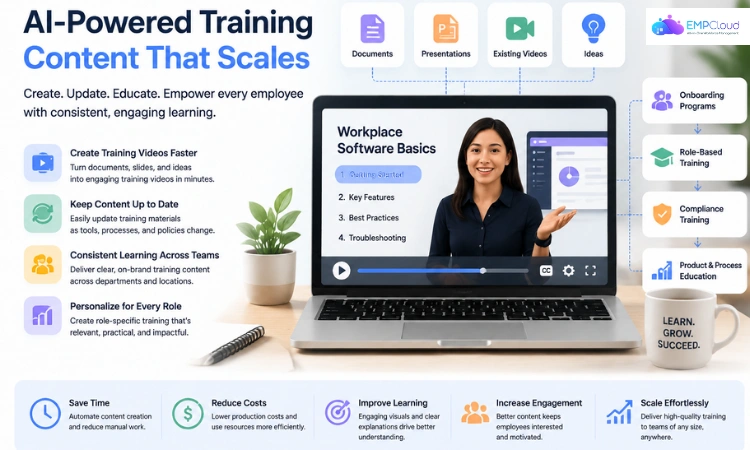
Scalable training content allows companies to create resources once and make them available to employees whenever needed. This reduces repetitive work while improving access to important knowledge.
The Challenge of Traditional Training Methods
Creating traditional training materials often involves several steps. Teams need to collect information, organize it, create presentations, record sessions, and distribute the final content.
This process can become slow when information changes frequently.
For example, a company introducing a new internal software system may need to update training materials every time a feature changes. A manually created training video may quickly become outdated, requiring additional time and resources to replace.
AI tools help companies make this process more flexible by reducing the effort required to create and update learning resources.
Turning Existing Knowledge Into Training Content
Most organizations already have valuable training information stored across documents, presentations, guides, and internal resources.
The challenge is making this information easier for employees to consume.
AI tools can help transform existing company knowledge into different formats, such as:
- Training videos
- Learning summaries
- Visual explanations
- Step-by-step guides
For example, a company handbook can become an employee introduction video, or a technical document can become a visual training resource.
This helps organizations make better use of existing knowledge while creating more engaging learning experiences.
How AI Helps Create Training Videos at Scale
Video has become one of the most effective formats for employee learning because it combines visuals, explanations, and demonstrations.
However, producing training videos traditionally requires scripting, recording, editing, and production support.
AI video workflows are making this process easier by helping companies create professional learning content without requiring a full production team.
Organizations can create videos for:
- New employee onboarding
- Software tutorials
- Workplace policies
- Product education
- Internal processes
This allows companies to build larger training libraries while reducing the time required for production.
Read More!
Building Consistent Learning Experiences Across Teams
Large companies often face the challenge of maintaining consistency across departments and locations.
Different teams may create their own training materials, which can lead to differences in messaging, quality, and information accuracy.
AI-assisted workflows can help companies create more consistent learning resources by maintaining a common structure and communication style.
For example, a global organization training employees across different regions can create localized resources while keeping the core information and brand voice consistent.
Using AI Workflows to Create Training Content Faster
Creating scalable training content requires more than generating individual videos. Companies need a workflow that connects research, planning, content creation, and updates.
Invideo Agent can support companies in creating training content by helping transform ideas, scripts, and references into complete video projects. It allows teams to move through planning, visual development, generation, and editing within a connected workflow.
For HR and learning teams, this can be useful when creating multiple training resources that need to follow the same structure and maintain consistency across different topics.
For example, a company creating onboarding videos for different departments can use an AI-assisted workflow to organize content while keeping the overall training experience aligned.
With invideo Agent Two, organizations managing larger training libraries can coordinate more complex workflows involving content planning, visual development, and production processes across multiple learning resources.
Improving Employee Learning With Visual Content
Different employees learn in different ways. Some prefer reading documents, while others understand information better through demonstrations and examples.
AI helps companies create learning materials in formats that match different learning preferences.
A process that may be difficult to explain through text can become easier to understand through a visual walkthrough or video demonstration.
For example, an HR team explaining workplace software can create a step-by-step video showing employees how to complete tasks instead of relying only on written instructions.
Keeping Training Materials Updated Over Time
One of the biggest challenges with company training is keeping information current.
Business processes change, tools are updated, and policies evolve. Outdated training materials can create confusion and reduce employee productivity.
AI tools help companies update content more efficiently by making it easier to revise scripts, modify learning resources, and create updated versions.
This is especially valuable for fast-growing companies where information changes frequently.
Personalizing Training for Different Roles
Not every employee requires the same training.
A new sales employee may need product education, while an engineering team may need technical training. Managers may require leadership resources that are different from individual contributors.
AI tools can help companies create more personalized learning experiences by adapting content for specific roles.
Instead of creating one generic training resource, organizations can develop targeted materials that are more relevant for each employee group.
AI Models and Their Role in Training Content Creation
Different AI models are improving different parts of content creation, including writing, visuals, video generation, and editing.
For training teams, video generation models are making it easier to create engaging educational resources without traditional production requirements.
For example, AI models help creators generate cinematic video sequences with improved motion and scene understanding. This can support companies creating visual training content, demonstrations, and internal learning materials where clear storytelling is important.
By combining different AI capabilities, organizations can create more effective learning experiences.
Choosing the Right AI Tools for Training Content
The right AI tool depends on the company’s learning goals and the type of content being created.
Organizations should consider:
- The type of training materials required
- How frequently content needs updates
- Number of employees using the resources
- Level of customization needed
- Existing learning systems
Some companies may need AI tools focused on video creation, while others may benefit more from writing, presentation, or knowledge management solutions.
A combination of tools can help create a complete training ecosystem.
The Future of AI-Powered Employee Training
AI is changing employee training from a resource-heavy process into a more flexible and scalable system.
Companies will increasingly use AI to create personalized learning experiences, update training materials faster, and provide employees with easier access to knowledge.
As workplaces continue to evolve, scalable training content will become essential for helping employees adapt and grow.
AI will not replace the role of trainers or HR professionals. Instead, it will help them create better resources and spend more time improving the overall learning experience.
Final Thoughts
Creating training content at scale has always been a challenge for growing companies. AI tools are helping solve this by making it easier to transform knowledge into engaging learning resources.
From onboarding videos and process guides to role-specific training materials, AI-powered workflows allow organizations to create consistent and accessible learning experiences.
As companies continue to invest in employee development, AI will play an important role in building training systems that are faster, smarter, and easier to maintain.
Quick Search Our Blogs
Type in keywords and get instant access to related blog posts.