Managing time well is one of the most valuable skills you can build, yet most people never learn it systematically. Between constant notifications, overloaded task lists, and the pressure to always be “on,” staying productive feels harder than ever.
The good news? There are proven time management methods that actually work. This guide covers 12 of the best, explains who each one suits, and helps you pick the right approach for your lifestyle.
What Are Time Management Methods?
Time management methods are structured frameworks that help you plan, prioritize, and execute tasks more efficiently. Rather than reacting to whatever demands your attention, these systems give you a proactive way to decide where your time goes.
Used consistently, the right method can help you:
- Get more done in fewer hours
- Reduce decision fatigue and mental clutter
- Stop procrastinating on important work
- Feel calmer and less overwhelmed at the end of each day
Why Most People Struggle With Time Management
Before diving into specific techniques, it helps to understand why time management is so difficult in the first place.
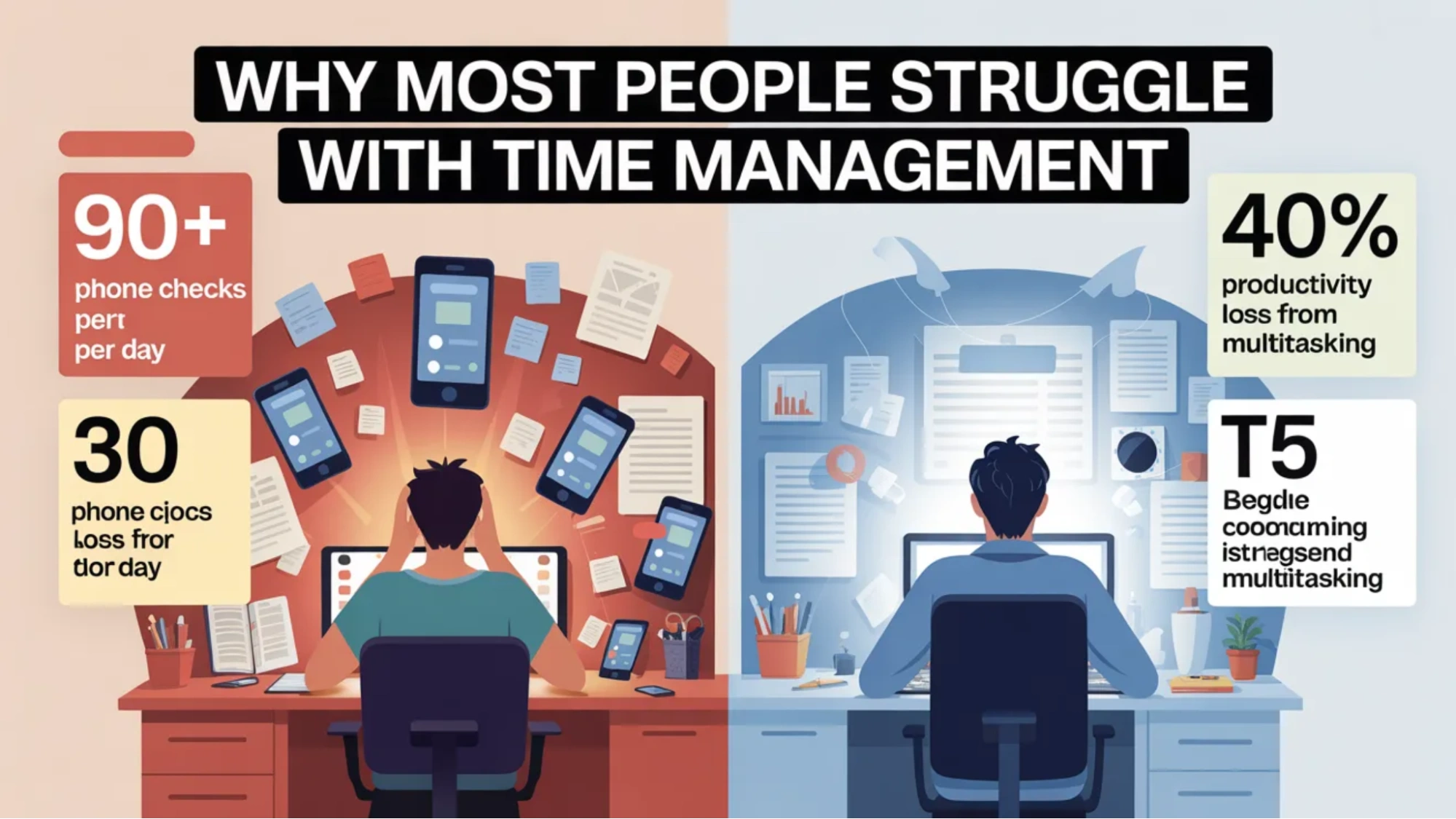
Digital distractions are the biggest culprit. The average person checks their phone over 90 times per day. Each interruption breaks your focus and costs 15-20 minutes to fully recover.
Multitasking makes things worse, not better. Studies consistently show that switching between tasks reduces overall output by up to 40%.
Poor prioritization means urgent-but-unimportant tasks crowd out the work that actually matters. Many people end the day feeling busy but unproductive.
Traditional productivity advice, like “just wake up earlier”, ignores the deeper issue: it’s not about having more time, it’s about using the time you have more intentionally.
Quick Comparison: The 12 Best Time Management Methods
1. Pomodoro Technique, Best for Sustained Focus
Developed by Francesco Cirillo in the late 1980s, the Pomodoro Technique is one of the simplest and most effective time management methods available.
How it works:
- Choose a task to work on
- Set a timer for 25 minutes and work with full focus
- Take a 5-minute break
- After 4 rounds, take a longer 15-30 minute break
The method works because it makes large tasks feel manageable, builds in regular recovery time, and trains your brain to associate focus with a defined time window.
Best for: Students studying for exams, remote workers prone to distraction, and anyone who struggles to start tasks.
Pro tip: Use apps like Forest, Focus Keeper, or a simple kitchen timer rather than your phone, which invites distraction.
Also Read!
Productivity Software: The Complete Guide to Working Smarter in 2026
Work Tracking Software: The Complete Guide to Boosting Productivity in 2026
2. Time Blocking, Best for a Structured Schedule
Time blocking means dividing your day into dedicated chunks for specific types of work, and protecting those blocks from interruption. Instead of a vague to-do list, your calendar becomes your daily plan. For example:
- 8:00-10:00 AM, Deep work (writing, coding, strategy)
- 10:00-10:30 AM, Email and messages
- 10:30 AM-12:00 PM, Meetings
- 1:00-3:00 PM, Project work
Why it works: When every hour has a purpose, you spend less time deciding what to do next. It also makes it easier to say no to requests that don’t fit your schedule.
Common mistake to avoid: Leaving no buffer time between blocks. Always schedule 10-15 minutes of transition time so overruns don’t derail your entire day.
Best for: Professionals managing multiple projects, entrepreneurs, and anyone with a varied daily workload.
3. Eisenhower Matrix, Best for Prioritization
The Eisenhower Matrix (also called the Urgent-Important Matrix) divides tasks into four quadrants:
Most people spend too much time in the “urgent but not important” zone, responding to emails, attending unnecessary meetings, and handling other people’s priorities. The matrix forces you to identify what actually deserves your attention.
How to use it: Each morning, list your tasks and assign each one to a quadrant. Focus the bulk of your day on Quadrant 2 (important, not urgent), this is where strategic, high-value work lives.
Best for: Managers, team leaders, anyone who feels constantly reactive rather than proactive.
4. Getting Things Done (GTD), Best for Mental Clarity
Created by productivity consultant David Allen, Getting Things Done is a comprehensive system for capturing and organizing every task, idea, and commitment so nothing slips through the cracks.
The five core steps:
- Capture, write down everything that has your attention
- Clarify, decide what each item means, and what action it requires
- Organize, Sort items into lists (projects, next actions, someday/maybe)
- Reflect, review your lists regularly
- Engage, do the work
GTD works because it clears mental RAM. When you stop trying to remember everything, you can focus entirely on what you’re doing right now.
Best for: High-volume knowledge workers, anyone who feels overwhelmed by too many open loops.
5. Eat That Frog, Best for Beating Procrastination
Based on a concept popularized by author Brian Tracy, Eat That Frog is simple: identify the most important, most dreaded task on your list, your “frog”, and do it first thing in the morning.
Why it works: Willpower and cognitive energy are highest early in the day. Tackling your hardest task before distractions accumulate means it gets done with your best effort. It also creates a powerful sense of momentum that carries through the rest of the day.
Best for: Chronic procrastinators, anyone who spends mornings on low-value tasks to avoid a difficult one.
6. Task Batching, Best for Reducing Context Switching
Task batching means grouping similar activities together and doing them in one dedicated block rather than spreading them throughout the day. For example:
- All email responses: 9:00-9:30 AM and 4:00-4:30 PM
- All phone calls: 11:00-11:30 AM
- All creative writing: 8:00-10:00 AM
Every time you switch between unrelated tasks, your brain needs time to reorient. Batching eliminates that switching cost. Studies suggest it can improve output quality and reduce errors, particularly in creative and analytical work.
Best for: Creatives, writers, customer-facing roles, and anyone managing several different types of tasks daily.
7. Pareto Principle (80/20 Rule), Best for High-Impact Work
The Pareto Principle states that roughly 80% of your results come from 20% of your efforts. Applied to productivity, this means identifying the small number of tasks that generate the most value, and spending more time on those.
How to apply it:
- List your current tasks and projects
- Ask: “Which 20% of these produces 80% of my results?”
- Protect time for those high-value tasks
- Delegate, delay, or drop the rest
Best for: Entrepreneurs, freelancers, anyone looking to work smarter rather than harder.
8. SMART Goals, Best for Goal-Driven Planning
SMART is a framework for setting goals that are actually achievable:
- Specific , clear, and well-defined
- Measurable , Trackable with concrete criteria
- Achievable , Realistic given your resources
- Relevant , Aligned with your broader objectives
- Time-bound , has a deadline
Vague goals like “be more productive” lead nowhere. A SMART version might be: “Complete the first draft of my project report by Friday at 5 PM.”
Best for: Anyone who sets intentions but struggles to follow through, project managers, and students.
9. Deep Work, Best for Complex, Creative Tasks
Coined by author Cal Newport, Deep Work refers to focused, distraction-free work on cognitively demanding tasks. It’s the opposite of the shallow multitasking most knowledge workers default to.
How to practice it:
- Schedule dedicated deep work blocks (2-4 hours minimum)
- Turn off all notifications and close unnecessary tabs
- Work in a consistent, distraction-free environment
- Gradually increase your capacity over time
Deep work produces your highest-quality output. It’s where real creative and analytical breakthroughs happen. Most professionals can only sustain 3-4 hours of genuine deep work per day, which makes protecting those hours critically important.
Best for: Writers, developers, researchers, designers, and anyone whose best work requires sustained concentration.
10. ABCDE Method, Best for Systematic Task Prioritization
The ABCDE Method, popularized by Brian Tracy, assigns a priority letter to every task:
- A , Must do. Serious consequences if skipped.
- B , Should do. Mild consequences if skipped.
- C , Nice to do. No real consequences if skipped.
- D, Delegate. Someone else can handle this.
- E, Eliminate. Remove it entirely.
Before starting your day, go through your task list and assign a letter to each item. Never work on a B task while an A task remains undone.
Best for: Busy professionals with long, mixed-priority task lists.
11. Parkinson’s Law, Best for Faster Completion
Parkinson’s Law states: “Work expands to fill the time available for its completion.” If you give yourself a week to finish a task that could be done in two hours, it will somehow take the full week.
How to use it: Deliberately set shorter deadlines than you think you need. Instead of “finish the report this week,” commit to finishing it by noon tomorrow. The artificial constraint forces focus and eliminates perfectionism-driven delay.
Best for: Perfectionists, anyone prone to over-thinking or over-engineering tasks, remote workers without natural deadline pressure.
12. Attention Management, The Modern Alternative to Time Management
While traditional time management focuses on scheduling, Attention Management recognizes that your attention, not your time, is your scarcest resource.
You can have 8 hours free, but accomplish nothing if your attention is fragmented. The goal is to protect your ability to focus deeply.
Key practices:
- Turn off all non-essential notifications
- Use website blockers during focus sessions (Cold Turkey, Freedom)
- Design your environment to minimize visual and auditory distractions
- Practice single-tasking deliberately
- Built-in recovery time, sustained attention requires rest
Best for: Anyone working in a digitally saturated environment, people with ADHD, and remote workers.
Improve Time Management With Smart Workforce Productivity Tools
Managing your time effectively becomes much easier when you have the right productivity tools to organize tasks, track productivity, and streamline daily operations. Platforms like EMP Monitor Cloud help businesses and teams improve efficiency with real-time productivity tracking, task management, and intelligent workforce monitoring.
Whether you manage remote teams, field employees, or office staff, using a centralized productivity platform can reduce manual work, improve accountability, and help teams stay focused on high-priority tasks.
Which Time Management Method Is Right for You?
There’s no single best method; the right one depends on your work style and challenges:
If you struggle to focus, start with the Pomodoro Technique or Deep Work.
If you feel disorganized: Try Time Blocking or GTD.
If you procrastinate, Eat That Frog or Parkinson’s Law will help most.
If you’re overwhelmed, the Eisenhower Matrix or ABCDE Method helps you prioritize quickly.
If you’re distracted by technology: Start with Attention Management.
A practical approach: Pick one method and commit to it for two weeks before layering in another. Most high performers eventually combine two or three, for example, Time Blocking to structure the day, Deep Work to protect focus sessions, and the Eisenhower Matrix to prioritize the task list.
Common Time Management Mistakes to Avoid
Even with good systems, these habits will undermine your productivity:
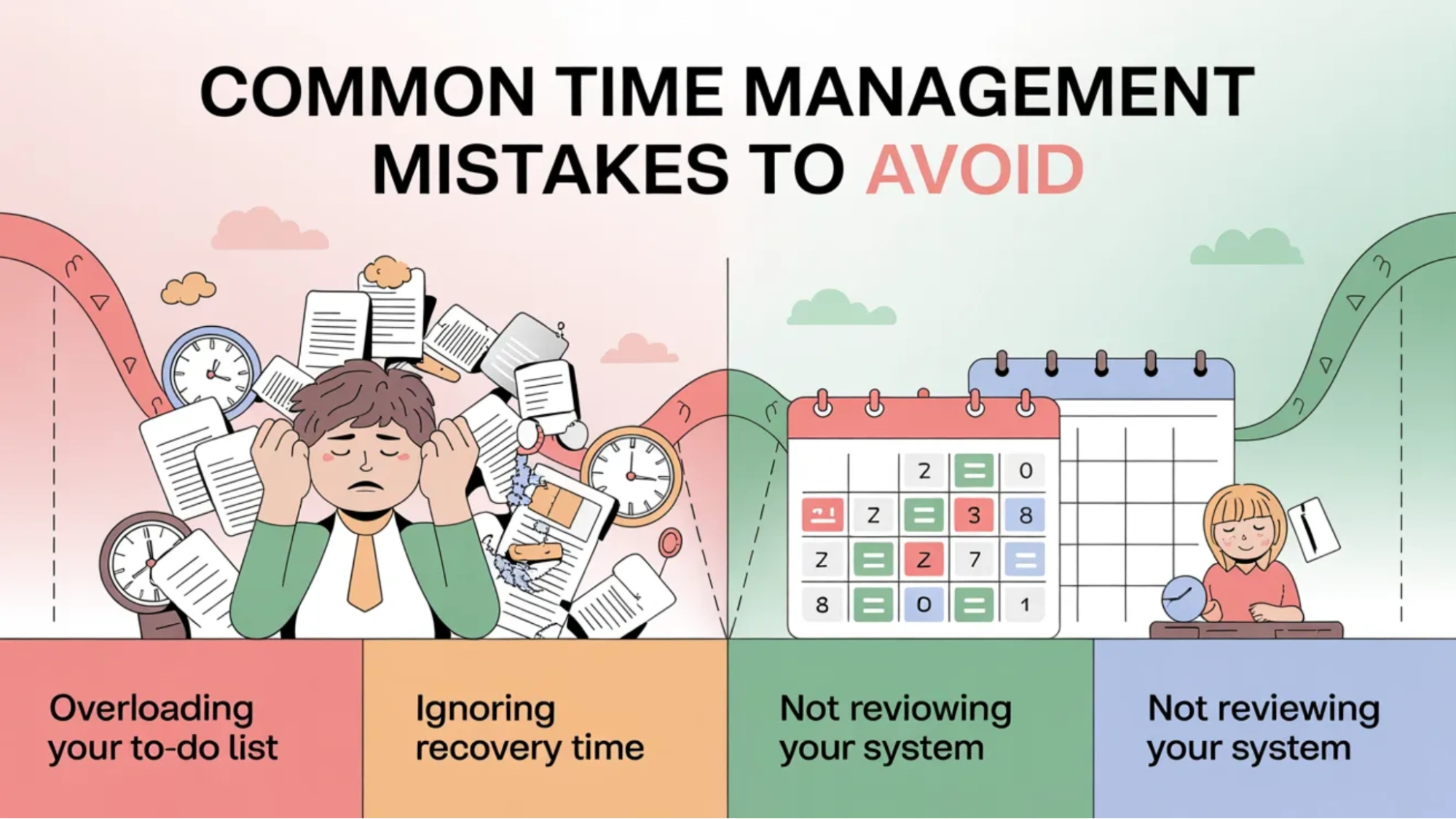
Overloading your to-do list. A list of 30 items creates anxiety, not clarity. Limit yourself to 3-5 priority tasks per day.
Ignoring recovery time. Rest is not a reward for finishing work; it’s a prerequisite for high performance. Schedule breaks deliberately.
Treating all tasks equally. Not everything deserves the same energy. Use the Eisenhower Matrix or ABCDE method to separate high-value work from noise.
Not reviewing your system. Spend 10 minutes at the end of each day reviewing what you completed and planning tomorrow. This daily review is one of the highest-ROI habits you can build.
Conclusion
Better time management doesn’t require more discipline or longer hours. It requires a system, a clear framework that tells you what to work on, when, and for how long.
Start small: choose one method from this list, apply it consistently for 7 days, and observe what changes. Once it becomes natural, build on it.
Over time, the right combination of these time management methods won’t just make you more productive; it will reduce stress, improve the quality of your work, and give you back the mental space to focus on what actually matters.
Frequently Asked Questions About Time Management Methods
What is the most effective time management method for busy professionals?
The most effective time management method for busy professionals is usually Time Blocking combined with task prioritization systems like the Eisenhower Matrix. These methods help organize schedules, reduce distractions, and ensure high-priority tasks receive focused attention.
How can time management methods improve work-life balance?
Good time management methods reduce unnecessary stress, prevent last-minute work pressure, and help people complete tasks more efficiently. This creates more personal time, improves mental well-being, and supports a healthier work-life balance.
Which time management method works best for remote teams?
Remote teams often benefit from Time Blocking, Task Batching, and productivity tracking tools because these methods improve accountability, scheduling, communication, and focus in distributed work environments.
Can time management methods reduce workplace stress?
Yes. Structured productivity systems reduce mental overload by helping people prioritize tasks, manage deadlines, and avoid multitasking. Clear schedules and organized workflows often lead to lower stress levels and better focus.
Quick Search Our Blogs
Type in keywords and get instant access to related blog posts.