

You’ve probably heard the term productivity vs efficiency tossed around, but most people misunderstand what it really means, and it’s costing them results. You finish the day ticking off tasks, attending meetings, and answering emails, yet somehow the things that truly move the needle haven’t moved at all.
Here’s the truth: productivity alone can make you busy, and efficiency alone can make you clever, but neither guarantees meaningful progress. The professionals who succeed know exactly when to push for output and when to streamline processes, and they do it without burning out.
In this guide, you’ll learn to spot the difference, apply each strategically, and combine both for maximum results so every action you take counts and your effort translates into real achievement.
In a hurry? Listen to the blog instead!
Productivity vs Efficiency: The Quickest Guide You’ll Ever Read

Productivity measures how much you output: tasks completed, goals reached, results delivered. Efficiency measures how well you use your resources to get there, time, energy, money, and attention. You can be productive without being efficient (doing a lot, badly), and efficient without being productive (doing a small thing perfectly that didn’t need doing). The goal is to be both: generating meaningful output through smart, optimized effort.
Productivity vs Efficiency: The Simple Truth You’re Missing

Most professionals mix up output with process, and it quietly costs them results. This section uncovers the real distinction between productivity vs efficiency and why it matters for every task you tackle.
What Productivity Really Means (And Why It’s More Than Busywork)
Productivity is about output. Plain and simple. How much did you produce in a given timeframe? How many goals did you reach, deliverables did you finish, and milestones did you hit?
What productivity doesn’t care about is how you got there. It doesn’t ask whether your process was elegant or messy, cheap or expensive. It only looks at the result end of the equation. This makes it incredibly useful for measuring whether work is actually happening, but dangerous when treated as the only metric worth chasing.
A highly productive day can still be a wasteful one. Writing ten blog posts when you only needed two is productive. Closing fifteen sales calls when three well-prepared ones would have closed the same number is productive. The volume is real. The value is debatable.
Productivity becomes genuinely powerful when it’s goal-aligned, when the output you’re measuring is the output that actually matters. That’s when chasing more of it makes sense.
What Efficiency Actually Means (Stop Wasting Time, Start Winning)
Efficiency is about the ratio between what you put in and what you get out. It’s the science of not wasting resources time, money, attention, energy — to achieve a desired result.
An efficient process produces the same (or better) output with fewer inputs. Think of it as eliminating the gap between effort and outcome. Where productivity asks “how much did we do?”, efficiency asks “how well did we do it, and at what cost?”
This is where the concept of efficiency vs effectiveness sometimes gets tangled in people’s thinking. Effectiveness is doing the right things. Efficiency is doing things right. Productivity is how much of those things you do. All three matter — but they’re not the same thing, and conflating them leads to wasted effort in all directions.
The limitation of pure efficiency thinking is that you can optimize a broken process beautifully. A perfectly efficient system that produces the wrong output is still a failure.
Productivity vs Efficiency: How to Tell the Difference Instantly
Stop guessing which approach to take. This section gives you clear markers and examples so you can instantly know when to prioritize productivity vs efficiency.
| Factor | Productivity | Efficiency |
| Core Question | How much did we produce? | How well did we use our resources? |
| Measured By | Output volume, tasks completed, results | Input-to-output ratio, time saved, waste reduced |
| Focus | Quantity and results | Process and resource use |
| Risk When Overused | Burnout, low-quality output | Over-optimization, missing the big picture |
| Best Metric Example | Reports completed per week | Time per report, cost per deliverable |
| When to Prioritize | Deadline sprints, scaling output | Repetitive systems, cost reduction |
When to Prioritize Productivity Over Efficiency (And Vice Versa)
Some situations demand speed; others demand precision. Here’s how to make confident decisions about productivity vs efficiency for maximum impact.
High-Speed Mode: When Productivity Should Lead
Some situations call for volume over perfection. A product launch with a hard deadline. A sales quarter where pipeline generation matters more than anything else. A creative brainstorming phase where producing lots of ideas quickly is the whole point.
In output-driven moments, obsessing over efficiency can actually slow you down. Good enough and done beats perfect and pending. When speed to result matters most, productivity metrics — tasks completed, goals hit, output delivered — should guide your decisions.
Teams in early-stage startups often live in this mode by necessity. Getting product to market fast is more valuable than having a perfectly streamlined process to build it.
Streamline Mode: When Efficiency Comes First
When you’re running a repeatable process customer support workflows, weekly reporting, recurring content production, onboarding sequences efficiency is everything. You’ve already proven the process works. The only question is whether you can do it with less drag.
Repetitive tasks are where efficiency gains compound over time. Cutting ten minutes from a daily process saves nearly an hour per week. Across a team of ten people, that’s a significant return over a year.
The efficiency vs productivity tension is most visible here. If you push for volume in a well-established process without optimizing it, you’re just scaling your inefficiencies.
The Sweet Spot: How to Balance Both Without Overthinking
The honest answer is that you need a simple decision rule, not a philosophy degree.
Ask two questions. First: is this a new or one-time task? If yes, lead with productivity, get it done, learn, iterate. Second, is this a recurring or scalable process? If yes, lead with efficiency optimization before you scale.
Then layer the other on top. Once a process is efficient, push productivity. Once you’re hitting strong output numbers, look for efficiency gains to protect your team’s energy. The two aren’t opponents. They’re stages in the same cycle.
Everyday Wins: Productivity and Efficiency in Real Life
See how these concepts play out in emails, meetings, and daily routines. Small adjustments here can lead to big improvements in results.
Email: Checking email 20 times a day is neither productive nor efficient. Batch your inbox into two or three daily windows. You’ll produce the same responses with a fraction of the context-switching cost. That’s an efficiency gain that also protects your productive hours.
Meetings: A two-hour meeting with six people and no agenda is a productivity black hole. Before scheduling, ask: Does this need to be synchronous? Could a shared doc replace it? Trimming unnecessary meetings is a pure efficiency win that gives back hours for actual output.
Deep work blocks: Scheduling focused work time for two to three uninterrupted hours is one of the highest-leverage productivity moves you can make. Not because it feels good, but because focused effort produces exponentially more output than the same time split across interruptions.
Project work: At the start of any project, identify the two or three decisions or tasks that will unblock everything else. Get those done first. That’s efficiency thinking applied to a productivity goal.
5 Proven Frameworks to Skyrocket Productivity AND Efficiency
These frameworks are practical, actionable, and tested. Apply them today to improve productivity vs efficiency and get more done with less wasted effort.
- Outcome-Process Framework
Before starting any task, define the desired outcome clearly. Then design or evaluate your process against that outcome. If the process doesn’t lead there efficiently, redesign it before you begin. This stops you from efficiently doing the wrong thing.
- Weekly Output Review
Every Friday, spend fifteen minutes reviewing what you actually produced versus what you intended to produce. Not activity — output. This surfaces patterns quickly: where did time go that didn’t produce results? That’s your efficiency gap. Where did output stall despite effort? That’s your productivity blocker.
- Input-Cost Analysis
For any recurring task, calculate the full input cost: time, money, attention, tools. Then ask whether the output justifies it. If a weekly report takes three hours but no one reads it, the efficiency ratio is terrible regardless of how well you do it.
- 80/20 Prioritization + Buffer Time
The 80/20 rule (Pareto Principle) holds up well in most knowledge work: roughly 20% of tasks drive 80% of meaningful results. Identify those tasks, protect time for them, and build a buffer around them. Buffer isn’t slack — it’s the space that makes deep work possible without constant spillover.
- Auto + Delegate + Eliminate Method
Before adding any task to your system, run it through three filters. Can it be automated? Can it be delegated to someone better suited for it? Can it be eliminated without real consequence? Only what survives all three filters deserves your direct attention. This is efficiency thinking at its most practical.
Stop Sabotaging Yourself: Common Productivity vs Efficiency Mistakes
Avoid the pitfalls that make busywork feel like progress. Recognize and fix the habits that hurt productivity vs efficiency.
Busy doesn’t equal productive. An activity that doesn’t generate meaningful output is noise. Sending emails, attending optional meetings, and reorganizing your task list can all feel like work without advancing a single important goal. If you can’t connect a task to a measurable result, question it.
A perfect process isn’t automatically efficient. Over-engineering a workflow by adding approval steps, documentation requirements, or review stages that don’t add value is a common trap. Smooth doesn’t always mean fast or lean.
Measuring the wrong metrics. Hours worked, emails sent, and tasks completed measure activity, not impact. The right metrics depend on your goals. For a sales team, it might be revenue per rep. For a content team, it might be engagement per piece. Match the metric to the outcome, not the effort.
Tools aren’t a silver bullet. A new project management app won’t fix a broken prioritization habit. Software amplifies your system for better or worse. Before investing in a new tool, be honest about whether the problem is the tool or the behavior behind it.
Read More!
How To Calculate Payroll Accurately: Step-by-Step Guide
What’s an Overtime Calculator & How To Use It Right?
EmpCloud: The Secret Weapon to Balance Productivity and Efficiency
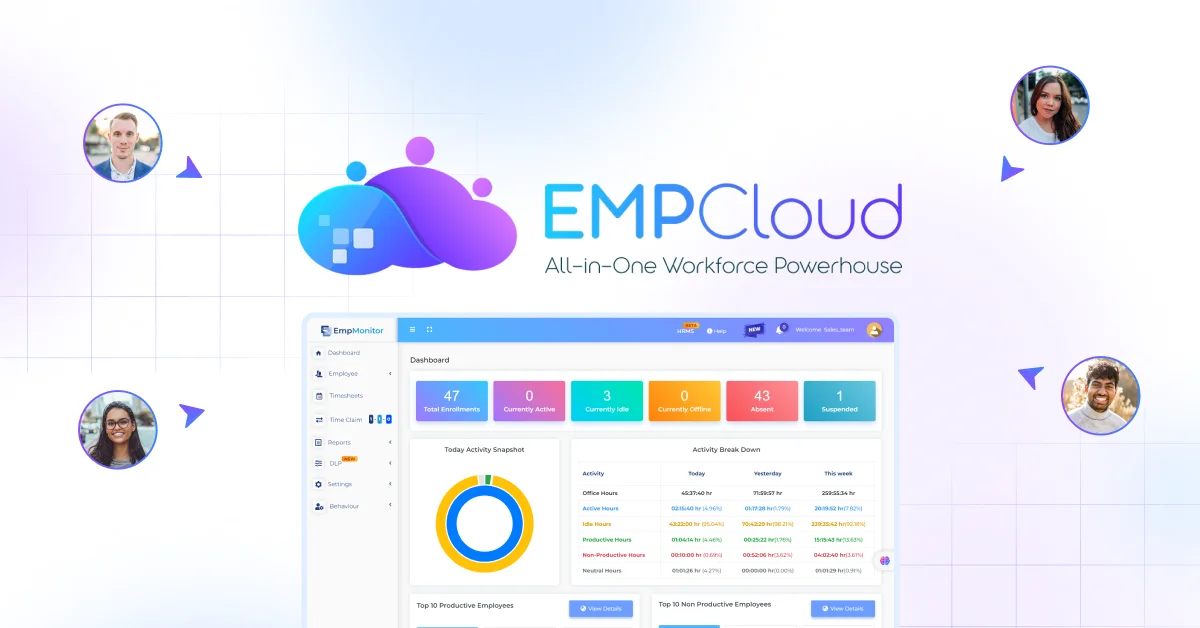
For teams managing multiple projects and people, the biggest challenge isn’t knowing what to do; it’s having visibility into what’s actually happening. That’s where EmpCloud becomes genuinely useful.
EmpCloud gives managers and teams the data layer they need to act on both productivity and efficiency without guesswork:
- Real-time dashboards — See what’s happening across teams and projects right now, not in next week’s report.
- Productivity insights — Track output trends over time so you can see whether effort is translating into results, and where it isn’t.
- Efficiency monitoring — Identify where time is being spent versus where it’s producing value. Spot bottlenecks before they become crises.
- Collaborative workflows — Reduce coordination friction so team energy goes into work, not work about work.
- Goal vs actual analytics — Shift the focus from activity tracking to outcome comparison. The question isn’t “how busy was everyone?” It’s “Did we hit the goal?”
The practical result is a clearer picture of where a team is being productive, where it’s being efficient, and where both are breaking down. That clarity changes how decisions get made.
Conclusion: Stop Chasing Busy, Start Chasing Results
Most people spend their careers optimizing one without understanding the other, working harder in the wrong direction, or streamlining processes that shouldn’t exist. The distinction between productivity vs efficiency isn’t academic. It’s the difference between a team that’s always busy and a team that consistently wins.
The frameworks, examples, and mental models in this piece aren’t meant to be applied all at once. Pick one. The Weekly Output Review is an easy starting point. It takes fifteen minutes on Friday and will show you more about your real priorities than a month of to-do lists. Or run your task list through the Auto + Delegate + Eliminate filter before next Monday.
Small adjustments compound. That’s true of efficiency, and it’s true of productivity vs efficiency.
So here’s the question worth sitting with: which one are you actually getting wrong right now doing too little of the right things, or doing too much of the wrong things? Your answer tells you exactly where to start.
FAQ
Can you be efficient but unproductive?
Yes, and it’s more common than people expect. If you’re executing a process flawlessly but the process produces outputs that don’t matter to your goals, you’re efficient but unproductive. A perfectly optimized workflow for generating reports nobody reads is a textbook example.
Which matters more for managers?
Managers need both, but at different levels. At the individual and team level, efficiency questions dominate: are our processes clear, lean, and effective? At the goal and strategy level, productivity questions take over: are we generating the outcomes the organization needs? The best managers toggle between both and know when each lens applies.
How do you measure productivity and efficiency in a team?
Productivity metrics should tie to outputs: deliverables completed, goals achieved, revenue generated per period. Efficiency metrics should tie to ratios: output per hour, cost per unit of output, cycle time for recurring tasks. Avoid using activity proxies (hours logged, emails sent) as stand-ins for either. They measure effort, not impact.
Are productivity tools really worth it?
It depends entirely on the underlying system. A tool layered on top of clear priorities and good habits will amplify both. The same tool dropped into a chaotic environment will add noise and a new interface to manage. Before adopting a tool, define the problem precisely. If the issue is visibility of who’s doing what and where things stand, tools help. If the issue is prioritization or culture, a tool won’t fix it.
Quick Search Our Blogs
Type in keywords and get instant access to related blog posts.