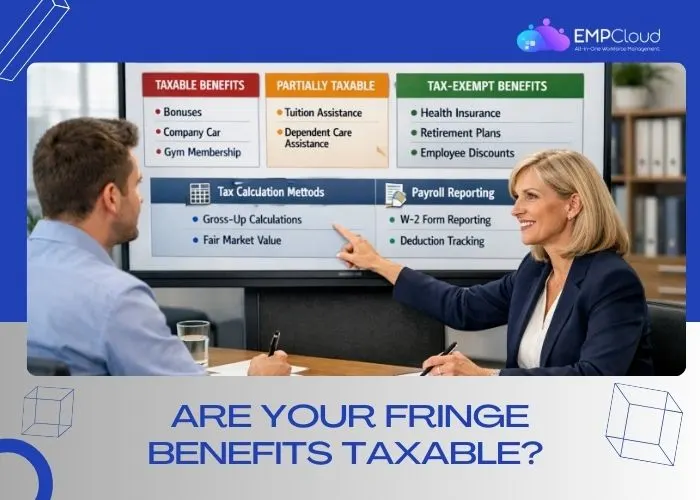
When it comes to total employee compensation, fringe benefits play a far bigger role than most people realise. Whether you are an employer designing a competitive package or an employee trying to understand what you earn beyond your paycheck, fringe benefits are central to that conversation.
But here is the question that often creates confusion: are they actually taxable? The answer is not always straightforward. Some benefits are fully taxable, some are partially taxable, and others qualify for complete tax exemption.
Understanding which category applies helps employers stay compliant and enables employees to avoid unexpected tax liabilities. In this guide, we break down everything you need to know about their tax treatment, calculation methods, payroll reporting, and more. While the rules discussed here are largely based on widely followed tax principles, specific regulations may vary across countries.
Listen To The Podcast Now!
Understanding Fringe Benefits:
Understanding what fringe benefits are is the essential first step before addressing their tax implications. In plain terms, they refer to any form of compensation provided to employees beyond their regular wages or salary. Think of them as workplace extras, perks that add measurable, real-world value to an employee’s overall package.
Common examples include employer-sponsored health insurance, company vehicles, meal allowances, gym memberships, tuition reimbursement, group life insurance, retirement contributions, and childcare support. Employers typically offer these to attract top talent, improve satisfaction at work, and build a stronger organisational culture that goes beyond basic pay. This approach can also be an effective measure to Prevent Intellectual Property Theft by enhancing employee loyalty and satisfaction.
From the IRS perspective, any such benefit is generally treated as part of an employee’s gross income unless federal law specifically excludes it. This is where confusion most often arises for both organisations and their teams.
It is also worth noting that these benefits are not exclusive to full-time workers. Part-time employees, independent contractors, and even business owners may receive them and be subject to the applicable tax rules. Building this foundational understanding is critical before exploring what is and is not taxable.
Common Types of Fringe Benefits for Employees:

A fringe benefits employee package can look very different depending on the company, industry, and seniority level of the role. That said, certain types consistently appear across most workplaces and are worth understanding in depth.
- Health and Medical Coverage: Employer-sponsored health, dental, and vision insurance are among the most highly valued perks available in today’s job market.
- Retirement Plan Contributions Employer matching into 401(k) or pension plans is a widely offered benefit that carries distinct tax implications for both parties.
- Transportation Allowance: This covers company vehicles, subsidised transit passes, and employer-provided parking for commuters.
- Education Assistance: Employers may pay for tuition, professional certifications, or skills development programs for eligible employees.
- Meals on Business Premises S: Subsidised employer-provided meals at the workplace can qualify under this umbrella.
- Group life insurance is a standard feature in many corporate compensation packages.
- Wellness and mental health programs, Gym memberships, mental health support, and employee assistance programs are growing in prevalence across industries.
Each of these categories carries its own specific tax treatment. Knowing what your employer provides and how each benefit is classified is the foundation for managing your taxable income accurately.
Are Fringe Benefits Taxable?
The general rule is simple: most fringe benefits are taxable unless a specific exclusion applies. This means their fair market value (FMV) is typically included in an employee’s gross income and may be subject to income tax and other statutory deductions.
However, the actual tax treatment depends on several factors, including the type of benefit, its value, and how it is used.
For example, a company car used strictly for business purposes is generally not taxable. But if the same vehicle is used for personal trips, the personal-use portion becomes taxable income.
Because taxable benefits are treated similarly to wages, employers are required to include their value in payroll calculations and report them appropriately in year-end tax documents. Misclassifying a taxable benefit as exempt, or applying exclusions incorrectly can lead to compliance issues, penalties, or additional tax liabilities.
Which Fringe Benefits Are Tax-Exempt?

Not all workplace perks are taxable. Several benefits may be excluded from taxable income, provided certain conditions and limits are met:
- Health Insurance Premiums: Employer-paid medical coverage is generally tax-exempt.
- Dependent Care Assistance: Employer-provided childcare support may be exempt up to specified annual limits.
- Education Assistance: Tax-free education benefits may apply within defined thresholds.
- Commuter Benefits: Transit passes and parking allowances may qualify for tax exemption within monthly limits.
- Meals for Employer Convenience: Meals provided primarily for business or operational reasons may not be taxable.
- De Minimis Benefits: Small, infrequent perks such as snacks or occasional gifts are typically exempt.
- Achievement Awards: Non-cash awards for service or performance may qualify for tax benefits within limits.
Understanding these exemptions allows employers to design more tax-efficient compensation structures while maximising employee value.
Fringe Benefit Calculation Methods:
Accurately calculating fringe benefits is essential for proper payroll reporting and compliance. Employers must determine the fair market value (FMV) of each taxable benefit—essentially, what the employee would pay for the same benefit in the open market.
The standard formula is:
Taxable Value = Fair Market Value − Amount Paid by the Employee
For example, if an employer provides a company vehicle valued at 5,000 per year and the employee contributes 1,000 toward personal use, the taxable value becomes 4,000.
Different valuation methods may apply depending on the benefit type. For vehicle-related benefits, commonly used approaches include:
- Cents-per-mile method
- Annual lease value method
- Commuting valuation method
Once calculated, the taxable value is added to the employee’s wages, and applicable taxes are applied. Accuracy is critical, as errors can lead to compliance risks and administrative challenges.
Managing Benefits Through Your Payroll Cycle:
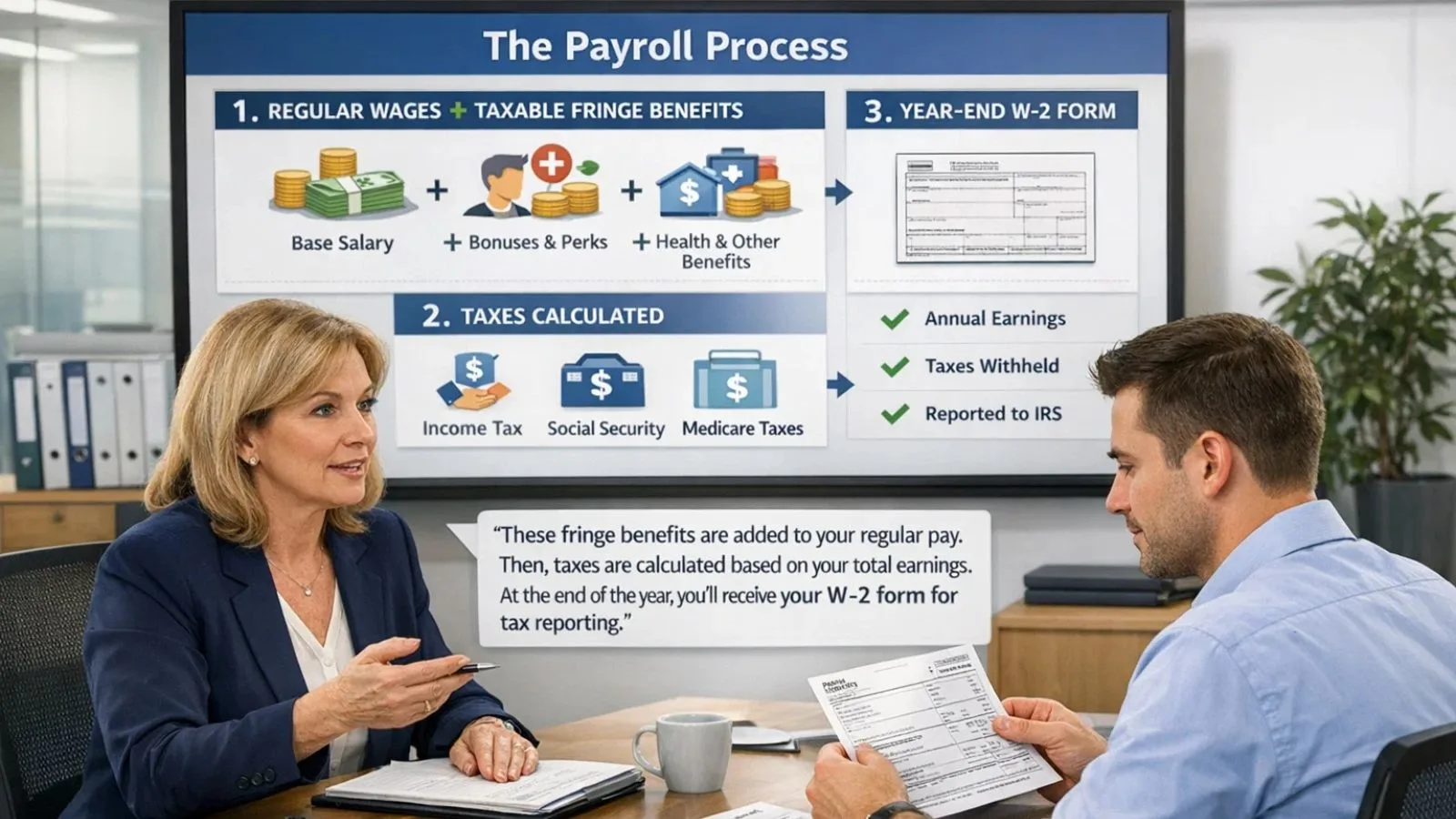
Handling fringe benefits within payroll requires careful coordination. Since taxable benefits form part of total compensation, they directly impact payroll processing, tax calculations, and reporting.
In most cases, the taxable value of benefits is added to the employee’s wages in the payroll period when the benefit is provided. Employers then calculate applicable taxes on the combined amount.
One common challenge is timing. Benefits do not always align neatly with payroll cycles. Some organisations distribute the value across pay periods, while others account for certain benefits as a year-end adjustment.
Regardless of the method used, consistency and proper documentation are essential. Inaccurate reporting can lead to discrepancies in employee tax records and potential compliance issues.
Tax Reporting Responsibilities for Employers:
Employers carry significant responsibility when it comes to benefit taxation and reporting.
First, each benefit must be evaluated to determine whether it is taxable or qualifies for an exclusion. This requires staying updated with current tax regulations.
Second, taxable benefits must be accurately reflected in employee compensation records and included in year-end reporting documents.
Third, failure to report or withhold correctly can result in penalties, back taxes, and interest charges—even if the error was unintentional.
The most effective way to stay compliant is to adopt a proactive approach: regularly review benefit policies, stay informed about regulatory changes, and use reliable payroll systems to manage calculations and reporting.
Common Mistakes Employers Make With Benefits:
Even well-managed organisations can make mistakes when handling fringe benefits. Some of the most common issues include:
Assuming non-cash benefits are not taxable: Many employers believe that if a benefit is not paid in cash, it does not need to be taxed. This is a common misconception. Non-cash perks such as company cars, free meals, gift vouchers, or gym memberships can still be taxable unless they meet specific exemption conditions. Failing to recognise this can lead to underreporting of employee income and potential compliance issues.
Using incorrect valuation methods: Accurately determining the value of a fringe benefit is essential. Employers are required to use appropriate valuation methods to calculate the fair market value. Applying the wrong method, especially for benefits like vehicles or housing, can result in incorrect taxable amounts. Overvaluation can burden employees with higher taxes, while undervaluation can expose the organisation to penalties.
Ignoring exemption limits: Certain benefits come with defined tax-free limits. For example, education assistance or dependent care benefits may only be exempt up to a specific annual threshold. If these limits are exceeded and the excess amount is not treated as taxable income, it creates a compliance gap. Employers must track these limits carefully throughout the year.
Not updating policies: Tax laws and regulations change over time. A benefit that was previously exempt may later become taxable or may come with new conditions. Organisations that fail to review and update their policies regularly risk applying outdated rules, which can lead to incorrect reporting and legal complications.
Poor recordkeeping: Maintaining accurate and detailed records is critical, especially for benefits that involve mixed personal and business use. Without proper documentation, such as usage logs, receipts, or valuation records, it becomes difficult to justify tax treatment during audits. Poor recordkeeping increases the likelihood of disputes, penalties, and time-consuming corrections.
Avoiding these mistakes can significantly reduce compliance risks, improve payroll accuracy, and minimise unnecessary administrative burden for the organisation.
Also Read:
Simplify Benefits and Payroll Management With EmpCloud:
Managing benefit tax obligations alongside regular payroll can feel overwhelming, but it does not have to be. EmpCloud is a complete workforce management suite trusted by businesses worldwide, built to streamline HR, payroll, and employee compensation management from one centralised platform.
Here is how EmpCloud can directly support your benefits and payroll operations:
- Automated Salary and Wage Calculations: Accurately compute compensation, including taxable benefit values, without manual errors
- Salary and Tax Policy Management: Keeps payroll aligned with current tax rules and applicable benefit regulations
- Employee Benefits Administration centralises and tracks all employee benefit data in one place for easy management
- Payroll Reporting and Analytics generates comprehensive reports for compliance, audits, and smarter financial decisions.
- Employee Self-Service Portal lets employees access payslips, tax documents, and benefit details independently.
- Seamless System Integration: Connects with your existing HR and accounting platforms for smooth data flow.
- Year-End Processing Simplifies annual payroll closing and ensures accurate W-2 and tax form generation.
Visit EmpCloud to discover how EmpCloud helps businesses manage complex payroll needs with clarity and confidence.
Conclusion:
Fringe benefits are a valuable component of employee compensation, but their tax treatment requires careful attention. Whether a benefit is fully taxable, partially exempt, or entirely excluded depends on its type, value, and how it is provided.
Employers must ensure accurate reporting, proper tax handling, and ongoing compliance with applicable regulations. Employees, on the other hand, should understand how these benefits impact their overall income.
While the rules can be complex, the right knowledge and systems make it entirely manageable. With a structured approach, businesses can offer competitive benefits while staying fully compliant, and employees can make informed financial decisions without surprises.
FAQ’s:
Q1: Are all workplace benefits subject to income tax?
Ans: No, not all workplace benefits are taxable. Some benefits are fully exempt, while others are only tax-free up to certain limits. For example, employer-paid health insurance, education assistance, and commuter benefits may not be taxed if they meet specific conditions and stay within prescribed thresholds. However, any amount exceeding those limits or failing to meet the criteria may become taxable.
Q2: Who is responsible for withholding taxes on benefits?
Ans: The employer is responsible for handling the tax side of fringe benefits. This includes determining whether a benefit is taxable, calculating its value, applying the correct tax treatment, and withholding the necessary taxes. Employers must also report these amounts accurately in employee tax documents at the end of the financial year.
Q3: Can small businesses offer tax-advantaged benefits?
Ans: Yes, small businesses can absolutely offer tax-advantaged benefits. Many benefit options are designed to be accessible to organisations of all sizes. By structuring benefits properly, small businesses can provide meaningful perks to employees while also managing costs efficiently and taking advantage of available tax benefits.
Q4: What happens if an employer incorrectly classifies a taxable benefit as exempt?
Ans: Incorrect classification can lead to serious compliance issues. If a taxable benefit is treated as exempt, it may result in underreported income and insufficient tax withholding. This can trigger penalties, additional tax liabilities, and interest charges during audits. In some cases, it may also create complications for employees when filing their taxes.
Q5: How often do benefit tax rules change?
Ans: Benefit-related tax rules are reviewed regularly and may change from year to year. Updates can include adjustments to exemption limits, eligibility conditions, or reporting requirements. Because of this, employers should review their benefit policies annually and stay informed about any regulatory changes to ensure ongoing compliance.
Quick Search Our Blogs
Type in keywords and get instant access to related blog posts.