

You must have heard the term business days if you have ever placed an online order, taken a loan, or waited for a refund. Yet many people still ask: what are business days? Understanding this concept is essential for managing expectations in a professional environment, planning project timelines, and keeping business operations running smoothly.
As an entrepreneur, employee, or consumer, knowing how business days work helps you manage deadlines, delivery schedules, and transaction timelines more effectively. This becomes especially important when coordinating internal processes, client commitments, or tools like Pick The Best Onboarding Software For Small Business, where setup timelines and implementation schedules are often defined in business days.
Time is money. If you don’t understand what business days mean, you risk missing deadlines, paying late fees, and frustrating clients. This guide breaks down everything you need to know about business days, from their basic definition to how they vary across industries and countries, so you can plan better and avoid
Listen To The Podcast Now!
Understanding the Basics: What Are Business Days?

Business days are those days on which usual trading and administrative operations are conducted. These are typically on working days Monday through Friday without weekends or any formally recognized holidays. It is usually applied to calculate times in which transactions, responses, deliveries, and contractual obligations should take place, and the actual working hours vary depending on the location and the nature of the business.
The concept is present as not every organization is on 24/7. Banks work with transactions within a certain set of hours, the government departments have a schedule, and the majority of the corporate setting has a standard of working week. When a company mentions that something should be ready in 3-5 business days it means only these working days.
It should be mentioned that business days may differ, depending on the place and business sector. Although the Monday-Friday concept is the norm, the concept of other sectors varies depending on their requirements. Knowing what are the business days in your particular situation guarantees- you can plan and communicate more effectively regarding business in professional situations.
Business Days vs. Calendar Days: Key Differences:

The other source of confusion is usually the distinction between business and calendar days. The calendar days have all the days of the year, weekends, days off and normal working days. When a person says: 7 calendar days, he/she actually implies a week, not counting the days between.
Business days in turn are counted only along working days. Therefore, when they tell you that something will be coming within 5 business days and you place an order on a Friday, then you will not get it the next Wednesday. Rather, it would come on the next Friday at the latest possible, omitting the weekend altogether.
This difference is very important in the law, freight schedule, and bank operations. Lacking this difference might imply missing critical deadlines, and making unrealistic promises with clients. The knowledge of business days versus calendar days is the basic skill of professional communication and allows avoiding some misunderstandings with high costs.
What Days Are Considered Business Days?
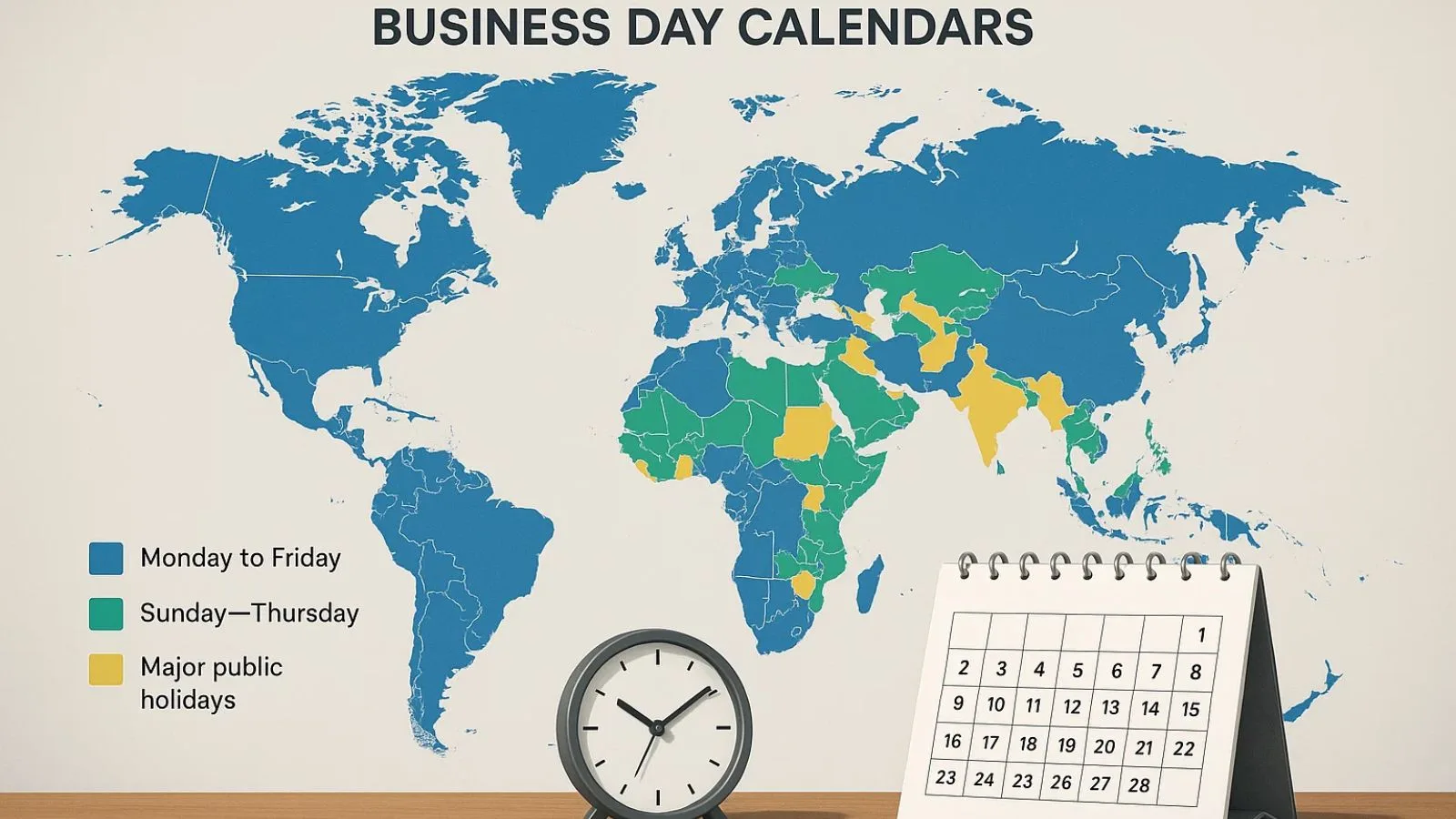
So, what days are business days in a typical week? As mentioned, the standard business week runs Monday through Friday. However, there are important exceptions to this rule.
- Weekends: Saturday and Sunday are generally not considered business days in most countries, though some businesses do operate on these days. Banks and government offices are typically closed.
- Public Holidays: National holidays like Christmas, New Year’s Day, Independence Day, and Thanksgiving (in the US) are not business days. These vary by country and sometimes by state or region.
- Industry Variations: Some industries operate on different schedules. Healthcare facilities, restaurants, and retail stores often operate seven days a week, though they may still use the traditional business day framework for administrative purposes.
- Regional Differences: In some Middle Eastern countries, the business week runs Sunday through Thursday, with Friday and Saturday as the weekend. Understanding these regional variations is crucial for international business and helps clarify what are considered business days in different parts of the world.
How Long Is a Business Day?
When they specify the duration of a business day, they are normally referring to hours in a normal working day. In the olden days, a business day was 8 hours that are typically 9.00 am to 5.00 pm but this may vary.
There are also long working time organizations whereby the business days start at 8:00 AM up to 6:00 PM or even later. The banks are less likely to offer customer service hours, say 9:00 AM to 4:00 PM but may offer more internal servicing beyond these hours.
Insofar as processing is involved, it is not the length that counts but time of transactions. A bank would get to do transactions that had been placed prior to 2:00 PM of the same business day and all that was after this cutoff would be placed on the next business day. That is why one should learn about what are business days and what are the working hours of business days- are so that he/she can engage in time sensitive transactions.
Calculating Business Days: Practical Examples:
Understanding what are business days becomes much clearer with real-world examples. Let’s look at how long is 3 business days in different scenarios.
Scenario 1:
You order a product on Monday that ships in 3 business days. Counting forward,Tuesday (1), Wednesday (2), Thursday (3), you’d expect delivery by Thursday.
Scenario 2:
You place the same order on Friday. Now, counting business days, Monday (1), Tuesday (2), Wednesday (3), you’d expect delivery by Wednesday of the following week.
Scenario 3:
You ordered on Wednesday, but there’s a public holiday on Friday. The count becomes Thursday (1), Monday (2), Tuesday (3), and delivery by Tuesday of the following week.
These examples show why it’s essential to factor in weekends and holidays when calculating business days.
Many online calculators can help you determine exact business days between dates, accounting for regional holidays automatically. Properly understanding what are business days eliminates guesswork and helps you set accurate expectations.
Business Days in Different Industries:
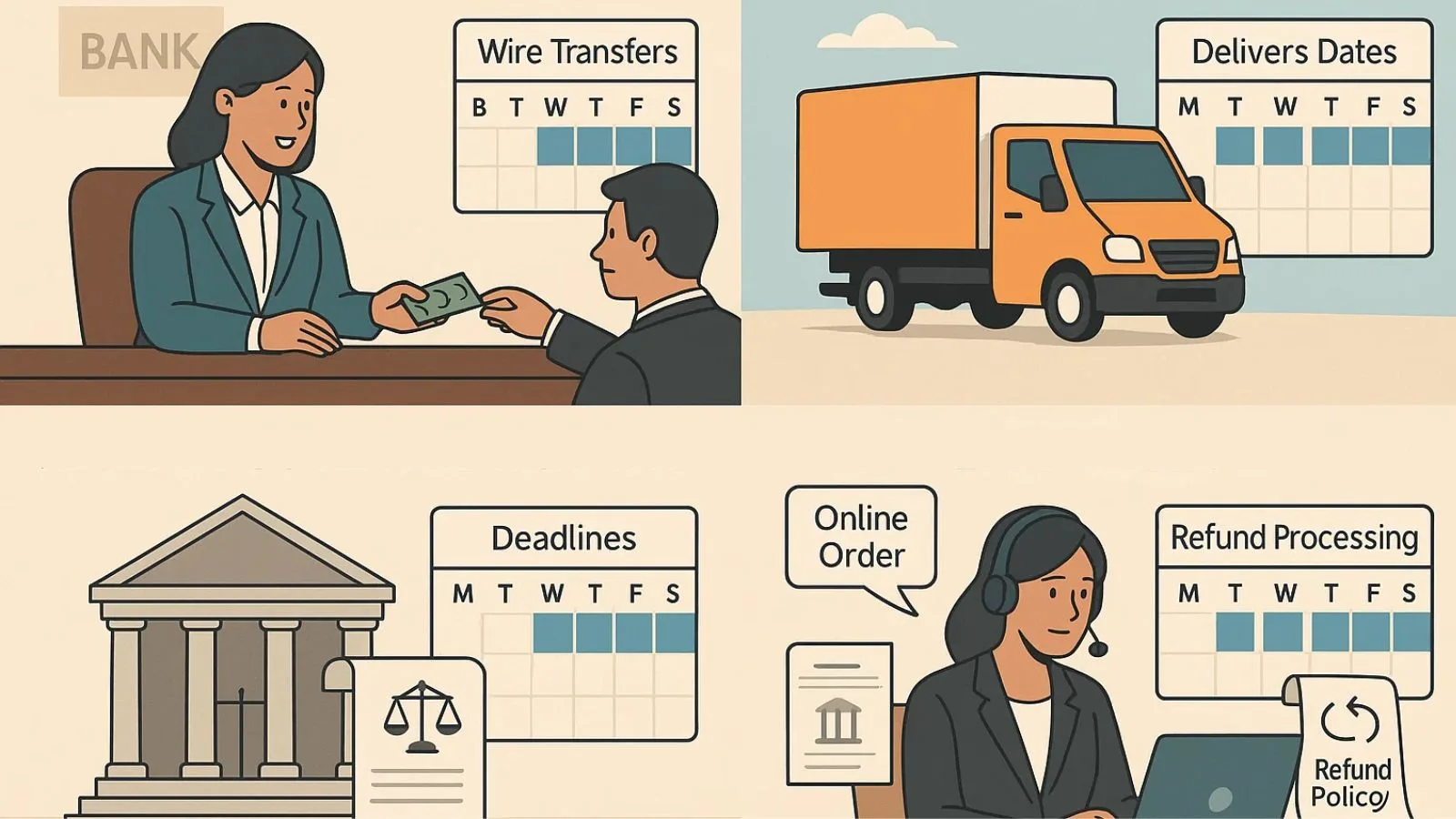
Different sectors interpret and apply business days in various ways, reflecting their unique operational requirements. Knowing what are business days in your particular industry helps ensure compliance and proper planning.
1. Banking and Finance:
Banks strictly adhere to business day schedules for processing transactions, clearing checks, and handling wire transfers. When you deposit a check, it might take 1-2 business days to clear.
International wire transfers can take 3-5 business days depending on the countries involved. Financial institutions are particularly strict about what are business days because regulatory requirements and settlement systems operate on these schedules.
2. Shipping and Logistics:
Shipping companies use business days to set delivery expectations. Standard ground shipping might promise 5-7 business days, while express options reduce this to 1-3 business days.
Understanding what are business days helps customers track packages accurately and logistics companies manage their operations efficiently.
3. Legal and Government Services:
Court deadlines, permit applications, and government requests often operate on business day timelines. Missing a deadline because you counted calendar days instead of business days could have serious legal consequences. Legal professionals must have a precise understanding of what are business days to protect their clients’ interests.
4. E-commerce:
Online retailers typically use business days for processing orders, issuing refunds, and handling customer service requests. A “30-day return policy” usually means 30 calendar days, but processing the actual refund might take 5-7 business days.
E-commerce businesses benefit from clearly communicating what are business days to manage customer expectations effectively.
International Business Days: A Global Perspective:
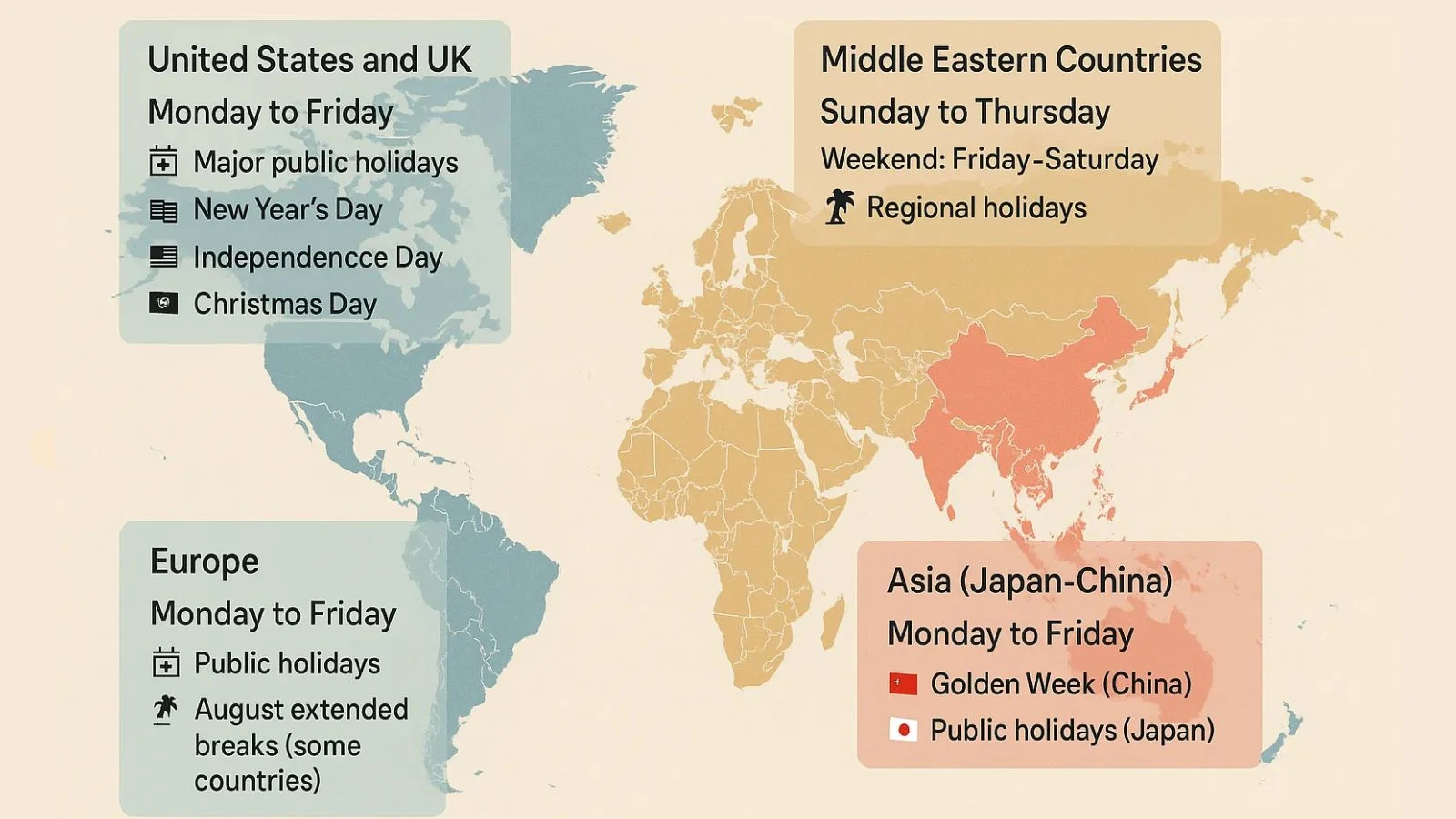
As businesses continue to become international, international diversities will be required as a business day.
In the United States, the business days are Monday up to Friday, however, the federal holidays e.g., Memorial Day and Labor Day are not counted. The same trend can be traced in UK except that the pub holidays there are different such as Boxing Day.
The Middle East countries are likely to use Friday and Saturday weekends and leave Sunday to Thursday as working days. It can lead to lack organization of international teams because they have to find overlapping working days.
The Asian nations (Japan and China) are applying the concept of Monday-Friday but have their own public holidays. One such case might be the Golden Week in China which has the prospects of shutting down business operations weekly.
Nevertheless, the systems used in the European countries incline to Monday Friday system but there are some abnormal holidays in both countries. In addition, a number of European companies crashed during high periods in August. When dealing with global companies, it is important to establish a clear understanding of what is considered business days in all the areas that are operated by a company so that there is a smooth operation of the company.
Also Read:
How To Pick The Best Onboarding Software For Small Business?
Why Is Time Attendance Software Crucial For Efficient Business?
How EmpCloud Streamlines Business Day Management?

In a complex business environment, tracking deadlines, managing workflows, and ensuring timely project completion across different time zones can be challenging. This is where EmpCloud makes a significant difference.
EmpCloud is a comprehensive workforce management solution that helps businesses navigate the complexities of business days with ease. The platform automatically accounts for business days when setting deadlines, scheduling tasks, and managing project timelines.
Instead of manually calculating when something is due or worrying about whether you’ve factored in holidays correctly, EmpCloud does it for you. The system recognizes regional holidays, accommodates different business week structures for international teams, and adjusts timelines automatically.
The platform also provides clear visibility into how many business days remain for any project or task, eliminating confusion and helping teams prioritize effectively. With automated reminders that account for business days, you’ll never miss a critical deadline again.
By integrating business day logic into everyday operations, EmpCloud removes the guesswork from planning and helps organizations maintain consistent, professional standards across all their workflows.
Common Misconceptions About Business Days:
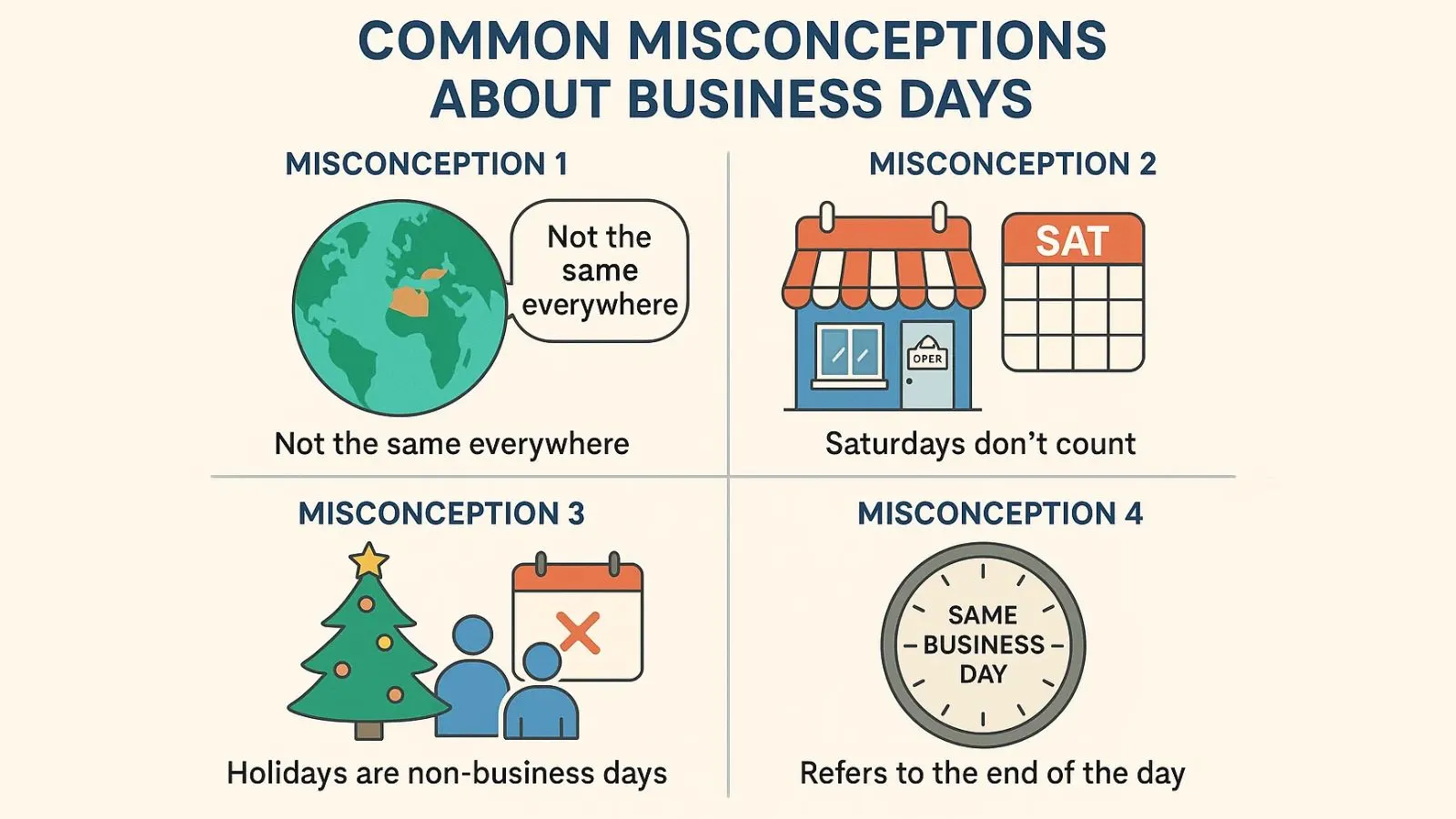
Several myths and misunderstandings surround the concept of business days, and clarifying what are business days can help dispel these misconceptions:
Misconception 1: “Business days are the same everywhere.”
Reality: Business days vary significantly by country and region. What works in the US doesn’t apply in the Middle East or Asia.
Misconception 2: “If a business is open on Saturday, it counts as a business day.”
Reality: Even if some departments operate on weekends, many administrative and financial processes still follow the Monday-Friday business day schedule.
Misconception 3: “Business days include holidays if the company remains open.”
Reality: Public holidays typically don’t count as business days for official processes, even if some employees are working.
Misconception 4: “Same-day means within 24 hours.”
Reality: “Same business day” usually means before the end of that specific business day, not 24 hours later.
Understanding these distinctions helps set realistic expectations in professional contexts. When people truly grasp what are business days, they can avoid these common pitfalls.
Tips for Managing Business Day Expectations:
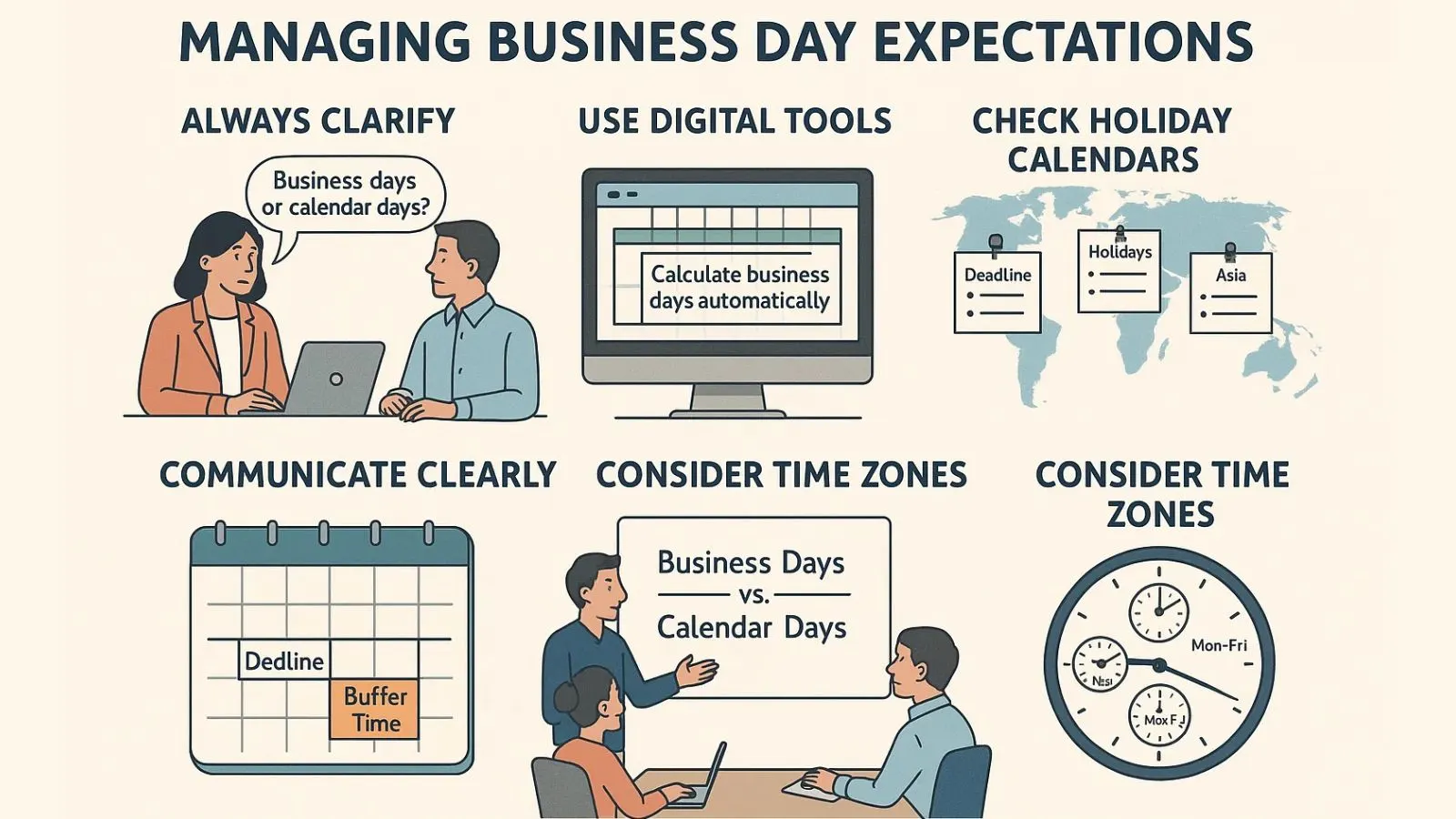
Whether you’re running a business or simply trying to track an order, here are practical strategies for working with business days. Mastering what are business days requires both knowledge and practical application:
1. Always Clarify:
When someone mentions a timeline, confirm whether they mean business days or calendar days. This simple question can prevent significant confusion.
2. Use Digital Tools:
Many project management platforms and calendar applications can automatically calculate business days for you, factoring in holidays and weekends.
3. Build in Buffer Time:
When planning important deadlines, add extra business days to account for unexpected delays or overlooked holidays.
4. Check Holiday Calendars:
Keep regional holiday calendars handy, especially if you work internationally. Many websites provide comprehensive holiday lists by country.
5. Communicate Clearly:
When setting expectations with customers or colleagues, be explicit about whether you’re using business days or calendar days. Don’t assume everyone shares the same understanding of what are business days.
6. Consider Time Zones:
For international work, remember that business days may not align between locations due to time zone differences.
Conclusion:
Knowledge of what are business days is crucial to the business life, whether handling projects, following shipments or handling money. Business days are usually Monday to Friday without including weekends and national holidays but some differences are also found in some industries and between different countries.
The trick here is to realize that the business days are not the same as calendar days and this fact affects deadlines, expectations, and planning. Navigating through business day requirements can be achieved by considering regional differences, proper tool use as well as effective communication, hence, ensuring that your professional functions remain unhindered.
FAQ’s:
Q1: Can business days include Saturdays?
Ans: In general, the answer is no, though some businesses operate on Saturdays. For most official processes, Saturdays aren’t counted as business days.
Q2: How do holidays affect business day counting?
Ans: Public holidays are excluded from business day calculations. If a deadline falls on a holiday, it typically extends to the next business day.
Q3: Are business days the same worldwide?
Ans: No, business days vary by country. Middle Eastern countries often use Sunday-Thursday, while Western countries typically use Monday-Friday.
Q4: What if I need something processed immediately?
Ans: Look for expedited services that guarantee same-business-day processing, though these often come with additional fees.
Quick Search Our Blogs
Type in keywords and get instant access to related blog posts.